
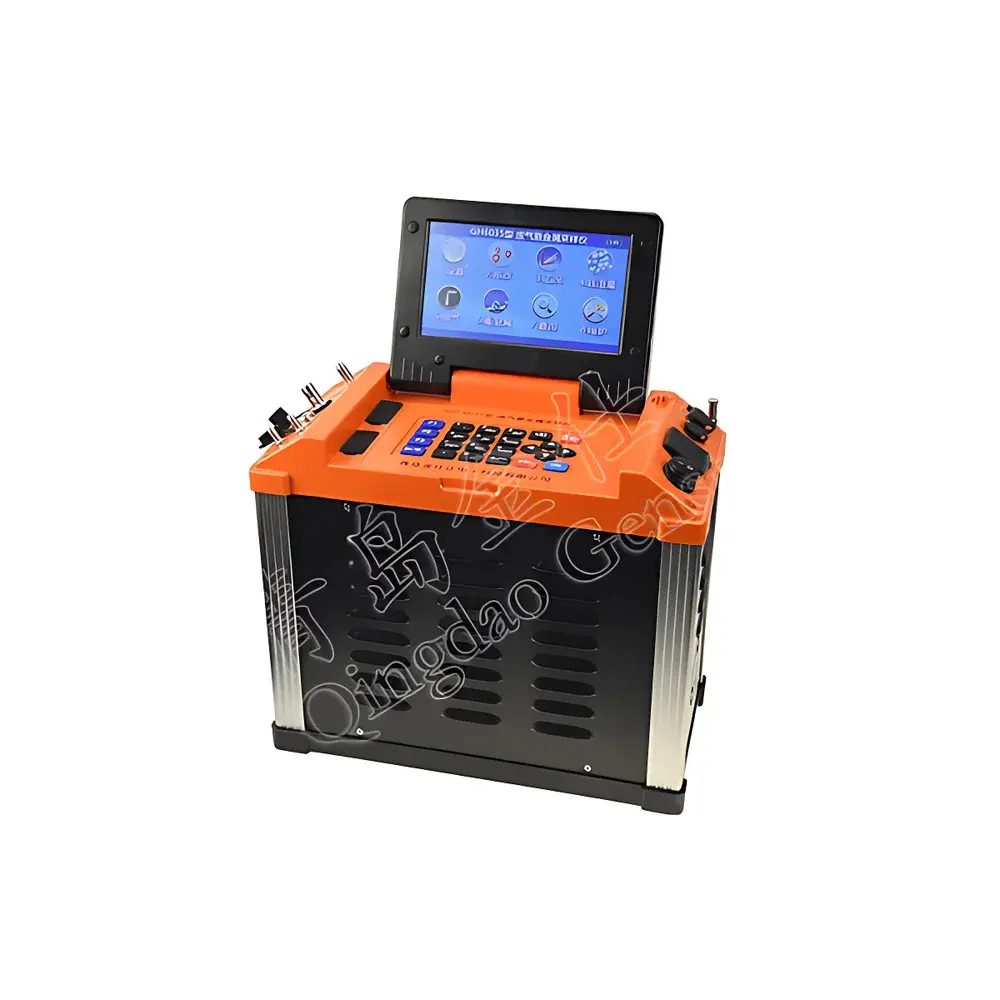
Genetec GH-6035 Stack Emission Heavy Metal Sampling System
| Brand | Genetec |
|---|---|
| Origin | Shandong, China |
| Manufacturer Type | OEM/ODM Producer |
| Country of Origin | China |
| Model | GH-6035 |
| Pricing | Upon Request |
Overview
The Genetec GH-6035 Stack Emission Heavy Metal Sampling System is a field-deployable, dual-mode sampling platform engineered for regulatory-compliant monitoring of metallic pollutants in flue gas streams from stationary emission sources. It operates on two parallel principles: isokinetic sampling via Pitot tube–controlled particulate capture (for elemental metals bound to aerosols and fly ash), and impinger-based solution absorption (for volatile or semi-volatile metal species such as Hg⁰, methylmercury, AsH₃, and SeO₂). Designed specifically for stack testing under dynamic flow conditions, the system maintains strict adherence to U.S. EPA Method 29 and Chinese national standards including GB/T 16157–1996, HJ/T 47–1999, HJ/T 48–1999, and HJ 973–2018. Its architecture integrates real-time flue gas parameter acquisition—temperature, velocity, static/dynamic pressure, O₂, CO, SO₂, and NOₓ—with synchronized heavy metal collection, enabling mass balance calculations and speciation-ready sample preparation for subsequent ICP-MS, AAS, or HG-AFS analysis.
Key Features
- Isokinetic sampling control with integrated Pitot tube and differential pressure transducers, ensuring representative particulate capture across variable duct velocities (1–30 m/s).
- Dual-path sampling manifold: independent, chemically inert PTFE-lined gas train for vapor-phase metal absorption (e.g., KI/HNO₃ for Hg, NaOH/H₂O₂ for As/Se) and high-efficiency quartz fiber filter + backup sorbent cartridge for particulate-bound metals (Sb, Pb, Cd, Cr, Ni, Zn, etc.).
- 7-inch wide-temperature TFT-LCD touchscreen with multi-angle flip mount and tactile keypad overlay—designed for gloved operation in industrial environments; backlighting ensures legibility under low-light stack access conditions.
- Brushless DC dual-chamber sampling pump delivering stable flow rates up to 100 L/min (particulate path) and 1 L/min (gas absorption path), paired with high-accuracy electronic mass flow meters (<±1% FS repeatability).
- Integrated moisture management: stainless-steel multi-stage condenser with 100 mL desiccant chamber and 320 cm³ particulate pre-filter; bottom-mounted drainage port prevents water accumulation during extended sampling campaigns.
- Onboard flue gas analyzer module with electrochemical sensors for O₂, CO, SO₂, and NOₓ—featuring cross-interference compensation algorithms (e.g., CO-induced SO₂ signal drift correction, NO₂–SO₂ spectral overlap mitigation).
- Automatic stack condition logging: stores temperature, pressure, velocity, and dilution ratio per sampling event; supports recall and auto-load for repeat site visits.
- Robust electromagnetic compatibility: multi-stage optical isolation, redundant CPU architecture, and conformal-coated PCBs ensure operational integrity in high-noise industrial settings.
Sample Compatibility & Compliance
The GH-6035 accommodates standard EPA and Chinese regulatory sampling protocols for 17 priority metals: antimony (Sb), arsenic (As), barium (Ba), beryllium (Be), cadmium (Cd), chromium (Cr), cobalt (Co), copper (Cu), lead (Pb), manganese (Mn), mercury (Hg), nickel (Ni), phosphorus (P), selenium (Se), silver (Ag), thallium (Tl), and zinc (Zn). Filter media include quartz fiber (QMA/QMB), Teflon-coated glass fiber, and custom sorbents (e.g., gold-coated sand for Hg⁰). All wet chemistry components comply with ASTM D6784–22 (Method 29) material compatibility requirements. The system meets GLP data integrity expectations through audit-trail-enabled firmware (timestamped event logs, operator ID tagging, parameter change history) and supports 21 CFR Part 11–compliant data export when used with validated software workflows.
Software & Data Management
Embedded firmware supports Unicode input (Chinese/English), context-sensitive on-screen guidance, and guided workflow navigation. Internal storage retains ≥1,000,000 sampling records with full metadata (date/time, GPS-assisted location stamp, stack ID, operator code, calibration status). Data export is performed via USB 2.0 interface using FAT32-formatted drives; CSV-formatted output includes raw sensor values, calculated isokinetic ratios, volumetric flow corrections (dry/wet basis), and QC flags. Optional PC-based desktop software provides automated report generation aligned with HJ 693–2014 and EPA 29 QA/QC templates—including spike recovery tracking, blank subtraction, and method detection limit (MDL) calculation support.
Applications
The GH-6035 is deployed across regulated industrial sectors requiring Tier 1 compliance reporting: non-ferrous smelting (copper, lead, zinc roasting and sintering), lead-acid battery manufacturing, tannery effluent incineration, chemical synthesis plants (e.g., catalyst production, pigment manufacturing), municipal waste-to-energy facilities, and coal-fired power stations equipped with SCR/SNCR systems. It is routinely specified in environmental impact assessments (EIAs), permit renewal audits, and third-party verification of Best Available Techniques (BAT) conformance under EU IED Directive Annex VII monitoring frameworks.
FAQ
Does the GH-6035 meet U.S. EPA Method 29 requirements for certified stack testing?
Yes—the system satisfies all hardware, procedural, and QA/QC criteria outlined in Method 29, including isokinetic sampling control accuracy (±5%), impinger train configuration, and post-sampling preservation protocols.
Can the instrument perform simultaneous particulate and gaseous metal sampling without cross-contamination?
Yes—dual independent flow paths with PTFE-lined tubing, physical separation of filter and absorption modules, and timed sequential valve actuation prevent carryover between phases.
What maintenance intervals are recommended for field deployment?
Filter cartridges require replacement after each sampling run; desiccant and pump inlet filters every 40 hours of cumulative operation; full calibration verification every 100 hours or per project QA plan.
Is remote firmware update supported?
No—updates are performed locally via USB drive using signed firmware packages; no network connectivity is implemented to maintain air-gapped data security.
How is traceability ensured for calibration gases and reference standards?
The system logs calibration gas lot numbers, expiration dates, and certified concentrations; these entries are embedded in exported datasets and retained in internal audit trails for regulatory inspection.
Related Products







