Pharmsteri™ II PES 0.22 µm Sterile Buffer Cartridge Filter
| Brand | Pharmsteri (Entegris) |
|---|---|
| Origin | USA |
| Model | Pharmsteri™ II PES 0.22 |
| Sterilization | Gamma-stable up to 45 kGy or autoclavable (2 cycles, 127°C/30 min) |
| Filtration Rating | 0.22 µm |
| Membrane Material | Polyethersulfone (PES) |
| Support Material | Polyester fiber |
| Housing & Endcaps | Polypropylene |
| O-Rings | Silicone |
| Validated Bacterial Retention | ASTM F838 |
| Max Forward Pressure | 4.0 bar @ 25°C |
| Max Reverse Pressure | 1.7 bar @ 25°C |
| Filter Area | ≥0.72 m² per 10-inch cartridge |
| Endotoxin Release | <0.25 EU/mL (LAL test) |
| TOC Leachables | <0.5 mg/L after 10 L water rinse |
| Conductivity | ≤1.3 µS/cm after 10 L water rinse |
| Chemical Compatibility | pH 1–14 |
| Quality System | ISO 9001 & ISO 13485 certified |
Overview
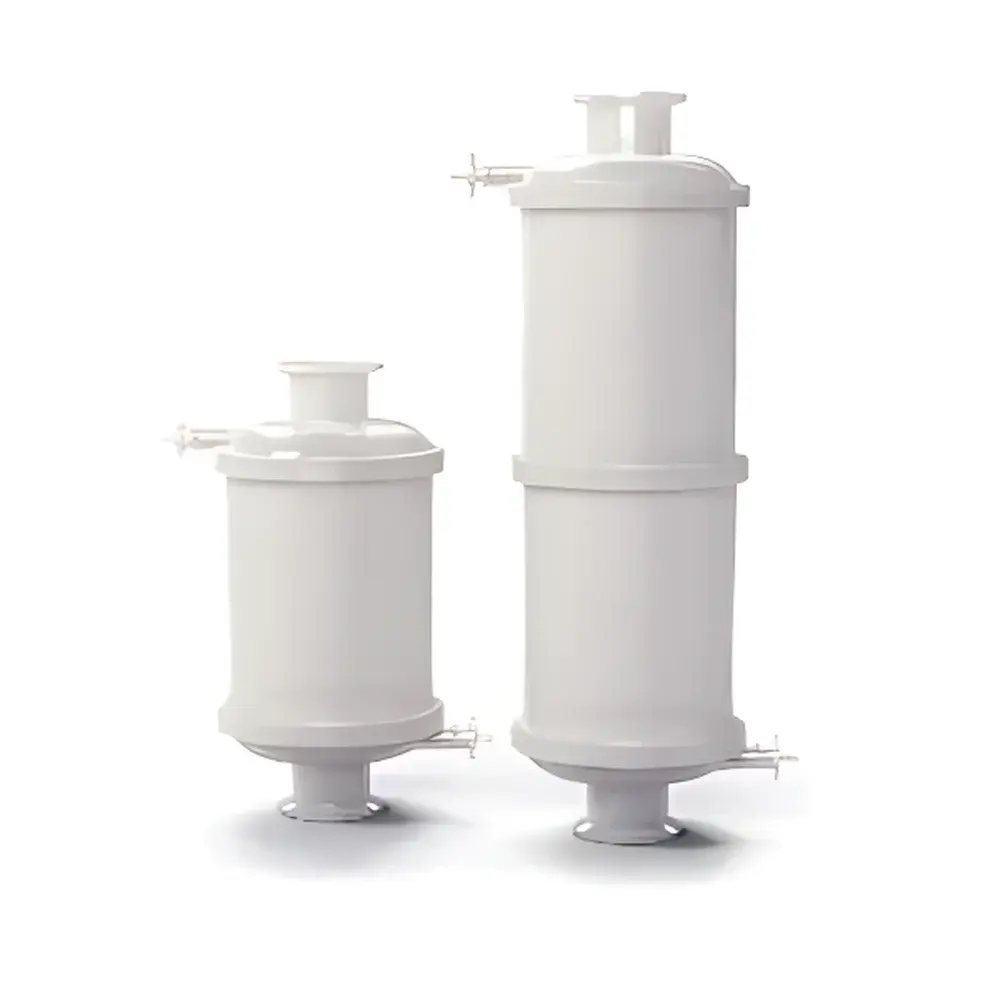
The Pharmsteri™ II PES 0.22 µm Sterile Buffer Cartridge Filter is an engineered single-use filtration solution designed for high-integrity, low-leachable sterile filtration of biopharmaceutical buffers and process liquids. Built upon Entegris’ legacy in ultra-high-purity materials science—originally developed for semiconductor wet processing—the filter leverages polyethersulfone (PES) membrane technology with validated 0.22 µm bacterial retention per ASTM F838. Its design addresses critical needs in modern biomanufacturing: minimizing bioburden in formulation buffers, enabling rapid scale-up of modular single-use systems, and supporting regulatory-compliant operations under cGMP conditions. Unlike stainless-steel housings, the compact, pre-sterilized cartridge eliminates cleaning validation, reduces footprint, and mitigates cross-contamination risk across campaigns involving monoclonal antibodies (mAbs), antibody-drug conjugates (ADCs), viral vectors, and plasmid DNA.
Key Features
- Validated 0.22 µm sterilizing-grade filtration with full ASTM F838 bacterial challenge data (Brevundimonas diminuta)
- Gamma-stable construction rated for up to 45 kGy—enabling seamless integration into gamma-irradiated single-use assemblies
- Autoclavable for two cycles at 127°C for 30 minutes—supports steam-in-place (SIP) compatibility in hybrid or retrofit facilities
- Polyethersulfone (PES) membrane with hydrophilic surface and broad chemical resistance (pH 1–14), compatible with acids, bases, alcohols, and common buffer excipients
- Zero adhesive assembly: thermal bonding eliminates solvent-based adhesives, reducing extractables and enhancing biocompatibility
- Low endotoxin release (<0.25 EU/mL) and minimal leachables—TOC <0.5 mg/L and conductivity ≤1.3 µS/cm post 10 L water rinse (per 10-inch unit)
- USP Class VI cytotoxicity compliant; all wetted components meet ISO 10993-5 requirements for biological evaluation
- Robust mechanical design: max forward differential pressure of 4.0 bar at 25°C; 2.5 bar at 60°C; reverse pressure limit 1.7 bar at 25°C
Sample Compatibility & Compliance
The Pharmsteri II PES 0.22 filter demonstrates consistent performance across diverse bioprocess streams—including phosphate-buffered saline (PBS), Tris-HCl, histidine, acetate, and citrate formulations—without compromising flow rate or integrity. Its polypropylene housing, silicone O-rings, and polyester support structure ensure dimensional stability during repeated thermal cycling and gamma exposure. The device is manufactured under a dual-certified quality management system (ISO 9001 and ISO 13485), with full traceability from raw material sourcing through final release testing. Batch-specific certificates of conformance include retention validation, endotoxin, extractables, and particulate data—supporting FDA 21 CFR Part 11-compliant electronic records and audit readiness for GLP/GMP environments.
Software & Data Management
As a passive filtration component, the Pharmsteri II cartridge does not incorporate embedded electronics or firmware. However, its design supports digital integration within broader process control ecosystems: lot-level documentation is provided in structured PDF and CSV formats compatible with MES (Manufacturing Execution Systems) and QMS (Quality Management Systems). Each filter carries a unique serialized barcode linked to full manufacturing history, sterilization records, and analytical test reports—enabling automated data ingestion via LIMS or SAP QM modules. For users implementing electronic batch records (EBR), the device’s documented compliance with ASTM F838, USP , and ISO 13408-1 facilitates straightforward justification of filter selection in validation protocols.
Applications
- Sterile filtration of formulation and dilution buffers prior to final drug product filling
- Bioburden reduction in intermediate purification steps (e.g., post-protein A eluate, pre-ultrafiltration/diafiltration)
- Final sterile filtration of cell culture media, supplements, and process reagents
- Integration into closed, single-use buffer storage and delivery systems (e.g., Flexsafe® or Sartorius BPS platforms)
- Supporting platform processes for viral vector manufacturing where low DNAse/RNase activity and minimal protein binding are critical
- Use in continuous manufacturing workflows requiring rapid changeover and campaign flexibility
FAQ
Is the Pharmsteri II PES 0.22 filter suitable for use with organic solvents such as ethanol or isopropanol?
Yes—its PES membrane and polypropylene housing exhibit broad compatibility with polar organic solvents at concentrations commonly used in buffer preparation and cleaning-in-place (CIP) solutions. Refer to the chemical compatibility guide for specific concentration and temperature limits.
Can this filter be validated for use in aseptic processing under FDA 21 CFR Part 11?
Yes—the filter itself is a static component, but its lot-specific documentation (including ASTM F838 reports, endotoxin data, and sterilization records) is provided in electronically signed, audit-trail-enabled formats compatible with Part 11-compliant QMS platforms.
What is the recommended maximum flow rate for a 10-inch Pharmsteri II cartridge?
Maximum sustainable flux depends on fluid viscosity, particle load, and operating pressure. Under standard buffer conditions (e.g., PBS, 25°C), typical linear velocities range from 15–30 cm/min at ≤2.5 bar; consult application engineering for process-specific scalability modeling.
Does the filter require pre-wetting or conditioning before use?
No—pre-wetted and gamma-sterilized units are supplied ready-to-use. However, a low-pressure water rinse (≤0.5 bar) is recommended to remove residual storage medium and verify integrity prior to buffer introduction.
How is integrity testing performed post-use?
Forward-flow (FF) or bubble point (BP) testing may be conducted per ASTM F838 Annex A, using manufacturer-recommended test parameters. Post-use testing requires careful handling to avoid membrane damage; many users perform pre-use integrity testing only, supported by full validation of the filter’s retention capability.