
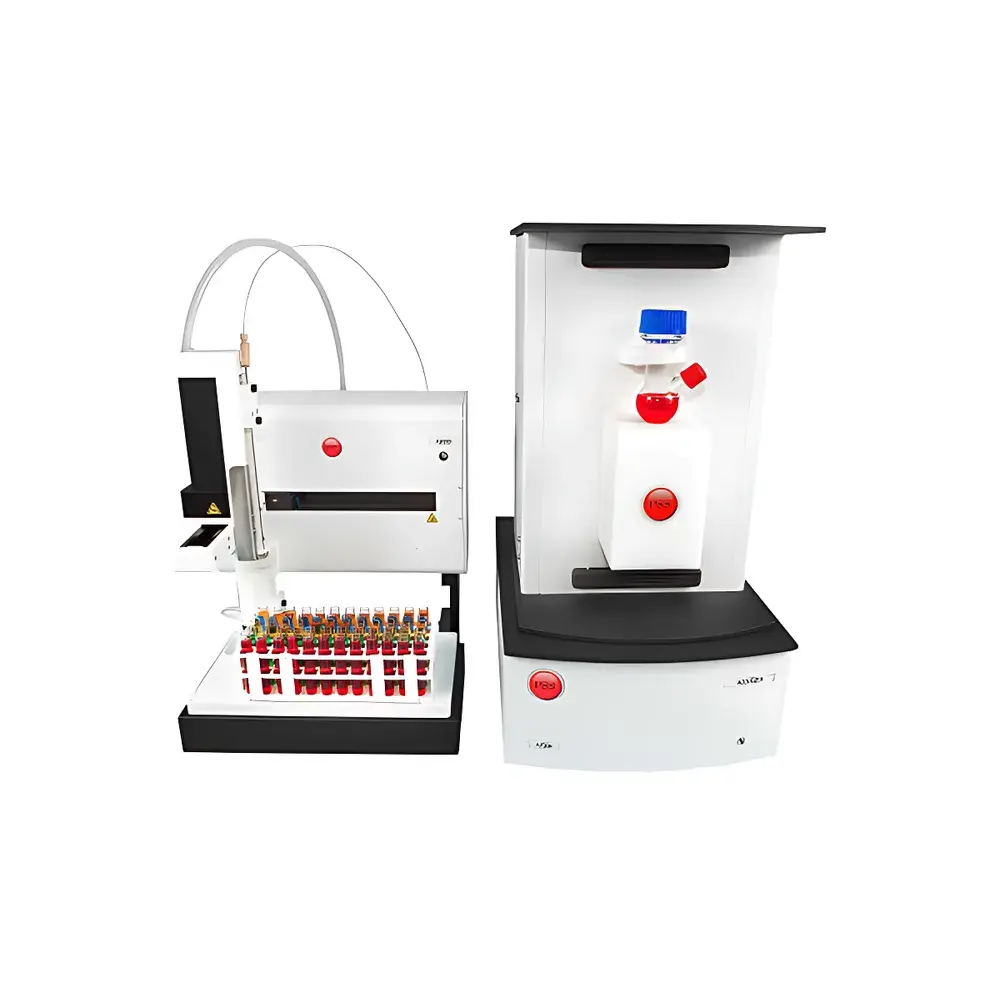
Particle Sizing Systems AccuSizer 780 A7000 AD Optical Particle Counter
| Brand | Particle Sizing Systems (PSS) |
|---|---|
| Origin | USA |
| Model | AccuSizer 780 A7000 AD |
| Detection Principle | Single Particle Optical Sensing (SPOS) |
| Measurement Range | 0.5 µm – 400 µm |
| Channel Resolution | 512 logarithmic channels |
| Maximum Sample Concentration | 10⁹ particles/mL |
| Particle Counting Accuracy | ≥90% |
| Size Accuracy | ≥98% |
| Sensitivity | ≤10 ppt (particles per total volume) |
| Compliance | USP <788>, USP <789>, CP <0903>, CE Marked |
| Automation Features | Auto-dilution, auto-sampling, auto-flushing, auto-calibration |
Overview
The Particle Sizing Systems AccuSizer 780 A7000 AD is a high-precision optical particle counter engineered for quantitative, high-fidelity analysis of particle size distribution (PSD) and concentration in liquid suspensions. It employs Single Particle Optical Sensing (SPOS), a direct-counting methodology that detects and sizes individual particles as they pass through a focused laser beam—leveraging both light extinction (optical blocking) and light scattering signals within a single sensor platform. Unlike ensemble-averaging techniques such as laser diffraction (LD) or dynamic light scattering (DLS), SPOS delivers statistically robust, number-based distributions with exceptional sensitivity to low-abundance, large-diameter particles in the critical “tail” region (e.g., >10 µm). This makes the A7000 AD uniquely suited for quality-critical applications where trace oversized particles directly impact product safety, stability, or regulatory compliance—including parenteral drug formulations, CMP slurries, pigment dispersions, and inkjet inks.
Key Features
- 512-logarithmic-channel resolution: Enables granular binning across the full 0.5–400 µm range—with sub-micron spacing at small sizes (e.g., 1.586–1.675 µm) and progressively wider bins at larger diameters—preserving true population structure without data smoothing or interpolation.
- Integrated auto-dilution system: Dynamically adjusts sample concentration in real time to maintain optimal particle flux (≤10,000 particles/sec), eliminating manual dilution errors and enabling accurate quantification of highly concentrated suspensions up to 10⁹ particles/mL.
- Dual-signal LE-series sensor: Simultaneously captures extinction and scattering signatures per particle, improving sizing fidelity for non-spherical or refractive-index-variable materials (e.g., liposomes, polymer emulsions, metal oxides).
- On-site calibration capability: Supports NIST-traceable PSL standard verification and system recalibration without instrument return to factory—reducing downtime and maintaining measurement continuity under GLP/GMP environments.
- Modular architecture: Sensor, fluidics, and software modules are independently serviceable and upgradeable—supporting long-term investment protection and technology refresh cycles aligned with evolving pharmacopeial requirements.
- Regulatory-ready automation: Full sequence control—including priming, sampling, dilution, measurement, cleaning, and data export—ensures procedural consistency and audit-trail integrity compliant with FDA 21 CFR Part 11 and Annex 11 expectations.
Sample Compatibility & Compliance
The A7000 AD accommodates aqueous and organic-phase suspensions with viscosities up to 20 cP and refractive index contrasts ≥0.02 relative to the dispersant. Validated use cases include pharmaceutical nanosuspensions, vaccine adjuvant formulations, semiconductor CMP slurries, toner dispersions, and food-grade colloidal systems. Its measurement protocol aligns with compendial standards for particulate matter testing: USP (injectables), USP (ophthalmics), Chinese Pharmacopoeia (CP) Chapter 0903, and ISO 21501-4 for light extinction particle counters. All firmware and data handling modules support ALCOA+ principles—ensuring attributable, legible, contemporaneous, original, accurate, complete, consistent, enduring, and available records required for regulatory submissions and inspection readiness.
Software & Data Management
AccuSizer Software v8.x provides a validated, role-based interface supporting IQ/OQ/PQ documentation templates, electronic signature workflows, and secure database storage with configurable retention policies. Raw pulse data (time-stamped extinction/scatter amplitudes) is preserved alongside processed histograms, cumulative distributions, and statistical summaries (D10, D50, D90, % >X µm). Export formats include CSV, PDF, XML, and ASTM E2917-compliant structured data packages. Audit trails log all user actions—including method edits, calibration events, and result approvals—with immutable timestamps and operator IDs. Optional integration with LIMS via ASTM E1482 or HL7 interfaces enables seamless data flow into enterprise quality management systems.
Applications
- Pharmaceutical QC/QA: Detection and quantification of subvisible particles (>2 µm and >5 µm) in sterile injectables per USP , including monitoring aggregation kinetics during stability studies.
- CMP slurry qualification: Identification of abrasive agglomerates >30 µm that cause wafer scratching—where SPOS demonstrates 1,500–25,000× greater sensitivity than LD for tail-end contamination.
- Emulsion & suspension development: Resolving multimodal distributions in complex formulations (e.g., oil-in-water nanoemulsions with coexisting micelles and droplets) without signal averaging artifacts.
- Ink & pigment manufacturing: Ensuring absence of >10 µm pigment clusters that cause nozzle clogging in high-resolution printing systems.
- Vaccine & biologics process monitoring: Real-time assessment of particle shedding from stainless-steel or single-use bioreactor surfaces during cell culture or purification steps.
FAQ
How does SPOS differ from laser diffraction for tail-end particle detection?
Unlike LD—which infers size from ensemble scattering patterns and inherently under-reports large-particle counts due to signal dominance by smaller species—SPOS physically enumerates each particle above threshold, delivering absolute counts and true size values for every event in the 0.5–400 µm range.
Can the A7000 AD analyze opaque or highly colored samples?
Yes—the dual-signal LE sensor compensates for absorption effects using scatter/extinction ratio correction; however, samples with optical density >2.0 at 650 nm may require pre-filtration or dilution optimization.
Is method validation support provided for GMP environments?
Particle Sizing Systems supplies comprehensive validation documentation kits—including URS, FRS, DQ/IQ/OQ protocols, and performance qualification reports aligned with ICH Q5A(R2) and USP .
What maintenance is required for long-term operational reliability?
Quarterly sensor cleaning with isopropanol and annual pump tubing replacement are recommended; full fluidic path sanitization (using 0.5 N NaOH) is supported via automated cleaning sequences.
Does the system meet FDA 21 CFR Part 11 requirements out-of-the-box?
All software versions v7.5 and later include built-in electronic signature controls, audit trail generation, and role-based access—validated per internal SOPs and compatible with third-party Part 11 compliance audits.



