
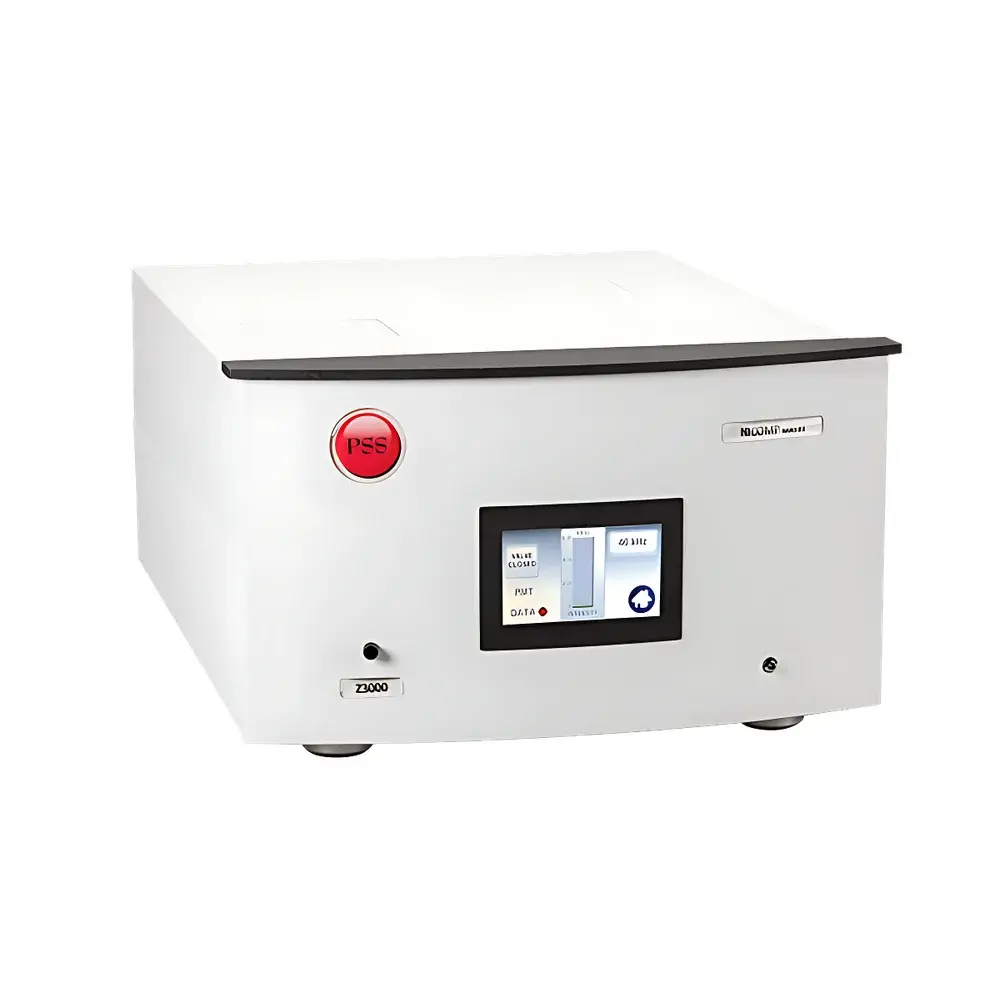
PSS Nicomp Z3000 Standard Nanoparticle Size Analyzer
| Brand | Particle Sizing Systems (PSS) |
|---|---|
| Origin | USA |
| Manufacturer Type | Authorized Distributor |
| Product Origin | Imported |
| Model | PSS Nicomp Z3000 Standard |
| Particle Size Range | 0.3 nm – 10 µm |
| Size Measurement Reproducibility | ±99% (RSD < 1%) |
| Temperature Control Range | 0–90 °C |
| Temperature Stability | ±0.1 °C |
| Measurement Method | Wet Dispersion |
| Sample Volume Range | 10 µL – 4 mL |
| Sample Concentration Range | Up to 400% w/v |
| Zeta Potential Range | –500 mV to +500 mV |
| Measurement Time | 1–10 min per run |
| Molecular Weight Range | 342 Da – 20 MDa |
| Detection Angles | 10°–175° (0.7° step) |
| Laser Source | 35 mW, 635 nm red diode |
| Detectors | APD (Avalanche Photodiode) + PMT |
| Analysis Algorithms | Gaussian single-peak & patented Nicomp multimodal distribution |
| Software Compliance | 21 CFR Part 11, USP <729>, EP 2.9.30, ISO 22412 |
| pH Range | 2–12 |
| Solvent Compatibility | Aqueous and most organic media |
Overview
The PSS Nicomp Z3000 Standard Nanoparticle Size Analyzer is a high-performance, dual-mode characterization platform engineered for rigorous physicochemical analysis of colloidal and macromolecular systems in liquid dispersion. It integrates two orthogonal, laser-based optical techniques—Dynamic Light Scattering (DLS) for hydrodynamic size distribution and Doppler Electrophoretic Light Scattering (DELS), implemented via Phase Analysis Light Scattering (PALS), for zeta potential determination—within a single, thermally stabilized optical bench. Unlike conventional DLS instruments constrained by Gaussian assumptions, the Z3000 employs a proprietary multimodal algorithm that resolves true polydispersity without prior knowledge of component number or shape, enabling quantitative deconvolution of complex, multi-component samples such as protein aggregates, liposomal formulations, polymeric micelles, and biopharmaceutical conjugates. Its operational range spans from sub-nanometer species (0.3 nm) to coarse colloids (10 µm), covering the full spectrum of nanomedicine carriers, CMP slurries, catalyst dispersions, and industrial emulsions.
Key Features
- Patented Nicomp multimodal particle size distribution algorithm—capable of resolving components with size ratios as low as 1:2 (e.g., 93 nm/150 nm mixtures) with high fidelity, surpassing standard Gaussian fitting in resolution and physical relevance.
- Dual-detector architecture: High-gain Avalanche Photodiode (APD) for low-scatter systems (e.g., proteins, surfactant micelles at ≤1 mg/mL) and high-sensitivity PMT for broad dynamic range; combined gain exceeds 7× over conventional PMT-only systems.
- Variable-angle detection (10°–175°, 0.7° incremental resolution): Optimizes scattering signal-to-noise for particles >100 nm where isotropic scattering diminishes, improving accuracy for multimodal dispersions and high-refractive-index materials (e.g., TiO₂, SiO₂).
- Integrated zeta potential module with PALS detection: Uses palladium planar electrodes housed in reusable, dual-row DIP cuvettes; electrode lifetime exceeds 10,000 measurements; field strength dynamically adjustable per sample conductivity and stability requirements.
- Modular hardware design: Supports optional auto-dilution (patented, handles up to 50% w/v stock solutions), automated multi-sample injection (76-position carousel), and high-power laser options (15–100 mW, 514 nm / 635 nm) for challenging low-scatter or highly absorbing matrices.
- Thermal precision: Peltier-controlled sample chamber with ±0.1 °C stability across 0–90 °C—critical for accurate Stokes-Einstein-derived sizing and temperature-dependent aggregation studies.
Sample Compatibility & Compliance
The Z3000 accommodates diverse sample chemistries and physical states. It supports aqueous buffers (pH 2–12), polar organics (e.g., DMF, ethanol, THF), and mixed solvent systems without optical interference. Minimum sample volume is 10 µL using the micro-cuvette (1 cm pathlength, high-transmission quartz or disposable plastic); standard cuvettes accept 4 mL. The system meets regulatory requirements for quality control in regulated environments: software architecture complies with FDA 21 CFR Part 11 (electronic signatures, audit trails, role-based access), and analytical methods align with USP (liposome size), EP 2.9.30 (nanoparticle characterization), and ISO 22412 (DLS principles). All calibration-free operation eliminates routine NIST-traceable standardization—performance validation is achieved via built-in reference standards and system suitability checks per ICH Q5A and Q5E guidelines.
Software & Data Management
Nicomp Software v4.x provides a validated, Windows-based interface compliant with GLP/GMP workflows. It features real-time correlation function monitoring, batch processing, customizable reporting (PDF, CSV, XML), and embedded statistical tools for trend analysis and SPC charting. Raw autocorrelation data is archived with full metadata (temperature, angle, laser power, detector gain, viscosity, refractive index). The software implements automatic baseline correction and adaptive noise filtering, ensuring robustness against dust artifacts and thermal drift. For enterprise integration, it supports LIMS connectivity via OPC-UA and offers API-driven scripting for automated method execution and result export. All user actions—including parameter edits, report generation, and instrument configuration—are logged in an immutable, time-stamped audit trail meeting ALCOA+ (Attributable, Legible, Contemporaneous, Original, Accurate, Complete, Consistent, Enduring, Available) data integrity criteria.
Applications
The Z3000 delivers actionable data across R&D, QC, and manufacturing support functions. In nanomedicine, it quantifies liposome PDI, monitors PEGylated nanoparticle stability under thermal stress, and detects early-stage protein aggregation in monoclonal antibody formulations. For semiconductor CMP slurries, it verifies silica/alumina particle uniformity and absence of micron-scale agglomerates that cause wafer scratching. In polymer science, it characterizes block copolymer micelle CMC, evaluates dendrimer branching density via hydrodynamic radius shifts, and validates emulsion polymerization kinetics. Industrial applications include ceramic slurry homogeneity assessment, inkjet ink particle control (to prevent printhead clogging), cosmetic emulsion shelf-life prediction, and lubricant contamination tracking via ferrous/non-ferrous particle profiling. Its ability to resolve multimodal distributions without fractionation makes it indispensable for quality-by-design (QbD) implementation in FDA-submitted drug master files.
FAQ
Does the Z3000 require daily calibration?
No. It operates on a calibration-free principle—size and zeta potential are derived directly from first-principles physics (Stokes-Einstein and Henry’s equation), not empirical calibration curves. System performance is verified using internal reference standards and built-in diagnostics.
Can it analyze opaque or highly concentrated samples?
Yes. The optional auto-dilution module handles stocks up to 400% w/v and delivers statistically representative sub-samples at optimal scattering concentration; multi-angle detection further mitigates multiple scattering effects in turbid systems.
How does Nicomp multimodal analysis differ from standard DLS software?
Standard DLS assumes monomodal, Gaussian-distributed scatterers—a physically unrealistic simplification for most real-world samples. Nicomp’s algorithm applies non-negative least squares (NNLS) with regularization to extract physically meaningful, multi-peak intensity distributions—validated against TEM and SEC-MALS cross-correlation.
Is temperature control necessary for accurate sizing?
Absolutely. Hydrodynamic radius is inversely proportional to solvent viscosity and directly dependent on absolute temperature per the Stokes-Einstein relation. ±0.1 °C stability ensures reproducible diffusion coefficient calculation—critical for detecting subtle aggregation onset or conformational transitions.
What sample preparation steps are required?
Minimal preparation is needed: filtration (0.1 µm) to remove dust, degassing (optional for volatile solvents), and pH adjustment if outside 2–12. No centrifugation, sonication, or dilution is required unless sample concentration exceeds instrument linear range—auto-dilution eliminates manual intervention.



