
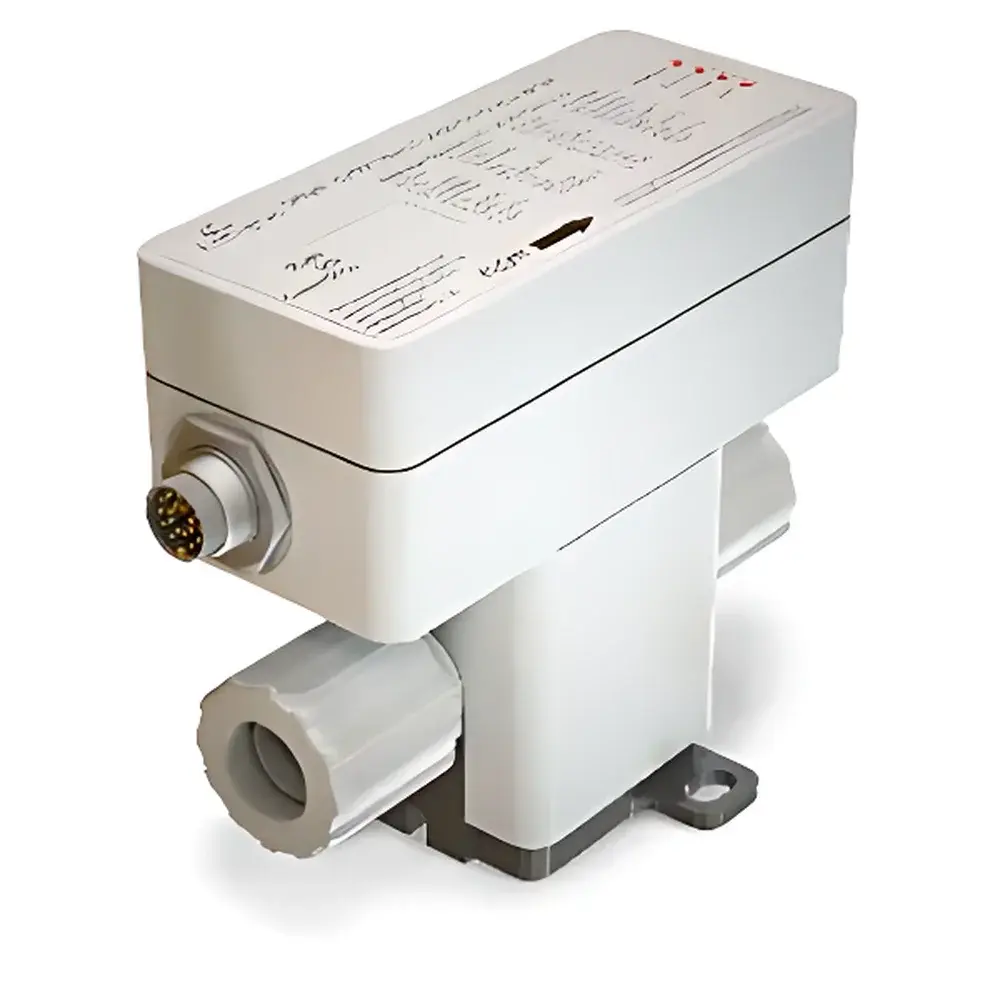
InVue GV148 Online Refractometer
| Brand | Pharmsteri |
|---|---|
| Origin | USA |
| Manufacturer Type | Authorized Distributor |
| Import Status | Imported |
| Model | InVue GV148 |
| Product Type | Online Refractometer |
| Temperature Control | None |
| Digital Display | Yes |
| Measurement Range | 1.32–1.40 nD |
| Accuracy | ±3×10⁻⁶ nD (@20°C in DI water) |
Overview
The InVue GV148 Online Refractometer is an industrial-grade, process-integrated optical instrument engineered for continuous, non-invasive measurement of liquid concentration via refractive index (RI) detection. Based on the principle of critical angle refraction at a solid–liquid interface—specifically between a sapphire optical window and the process fluid—the GV148 detects minute changes in reflected light intensity across a photodiode array (PDA). A proprietary algorithm interprets these intensity gradients to determine the precise critical angle, from which the refractive index is calculated with sub-micro-RIU resolution. This RI value, combined with real-time fluid temperature measurement, enables accurate derivation of solute concentration using pre-calibrated or user-defined correlation models (e.g., sucrose, H₂O₂, glycol, or proprietary chemical formulations). Designed for deployment in semiconductor front-end (FEOL) and back-end (BEOL) wet processing, CMP slurry management, and high-purity chemical blending lines, the GV148 operates without flow interruption, electrode contact, or consumables—ensuring long-term stability, metrological traceability, and compatibility with ultra-clean environments.
Key Features
- High-resolution refractive index measurement: ±3×10⁻⁶ nD accuracy in DI water at 20°C; repeatability of ±5×10⁻⁵ nD in transparent liquids
- Integrated dual-sensor architecture: Simultaneous acquisition of refractive index and fluid temperature (20–40°C process range)
- Chemically inert wetted materials: Single-crystal sapphire optical window, PTFE flow cell body, PVDF housing, and PP mounting plate—compliant with SEMI F57 and ASTM D1250 standards for purity-critical applications
- Robust sealed enclosure rated IP54 for protection against dust and low-pressure water ingress
- Background-light rejection algorithm ensures stable operation under ambient illumination common in fab tool bays
- Optional N₂/DI automatic in-situ lens cleaning system minimizes manual intervention, especially in abrasive or hydrophilic slurries
- Modular mechanical interfaces: Flaretek®, PrimeLock®, and stem-tube port options (¼″ to 1″) support seamless integration into existing piping manifolds
- LED status indicators provide real-time diagnostics for communication link integrity, sensor health, and alarm conditions
Sample Compatibility & Compliance
The GV148 is validated for use with non-conductive, optically transparent to semi-transparent process fluids—including hydrogen peroxide solutions, CMP slurries, post-CMP cleaning chemistries, dielectric etchants, and proprietary additive blends. It excludes opaque, highly scattering, or strongly absorbing media where signal-to-noise ratio falls below operational thresholds. The instrument complies with RoHS Directive 2011/65/EU and meets electromagnetic compatibility requirements per IEC 61326-1. Its design supports GLP/GMP-aligned process validation: all configuration changes, calibration events, and alarm triggers are timestamped and logged within the HMI software with audit-trail capability. While not FDA 21 CFR Part 11–certified out-of-the-box, the data export functionality (CSV, XML) and configurable user access levels enable integration into validated systems requiring electronic record integrity.
Software & Data Management
The Windows®-based HMI application provides full local control and visualization without external PLC dependency. Core functionalities include real-time RI/temperature/concentration dashboards, customizable temperature compensation curves, zero-point calibration routines, analog output mapping (4–20 mA), discrete I/O configuration, and event-driven alarm scripting. Historical data is stored locally with configurable retention policies and exportable for SPC analysis (e.g., Cpk, X-bar/R charts). The software supports dual communication protocols: RS-422/RS-485 Modbus RTU for integration into SCADA/MES platforms, and direct USB connection for commissioning and firmware updates. All parameter modifications generate immutable log entries including operator ID, timestamp, pre-change value, and post-change value—facilitating compliance with ISO 9001 clause 8.5.2 and internal QA documentation requirements.
Applications
- Real-time H₂O₂ dilution control in wafer surface oxidation and cleaning processes
- Concentration monitoring of silica-based and ceria-based CMP slurries during recirculation
- Batch-to-batch consistency verification in proprietary additive mixing (e.g., surfactants, chelators, inhibitors)
- End-of-life detection for reclaim tanks based on RI drift trends over time
- In-line verification of post-CMP deionized water rinse purity
- Closed-loop feedback control of chemical dosing pumps via 4–20 mA analog output
- Multi-point concentration profiling across global and local recirculation loops
FAQ
What is the maximum allowable process pressure for the GV148?
The sensor is rated for continuous operation up to 80 psi at 40°C.
Can the GV148 measure conductive electrolytes such as KOH or TMAH?
No—it is designed exclusively for non-conductive fluids; ionic solutions may cause erroneous readings due to interfacial polarization effects.
Is temperature compensation mandatory for accurate concentration calculation?
Yes. Since RI is temperature-dependent, the integrated Pt1000 RTD must be functional; built-in polynomial compensation (ASTM D1250–22 compliant) applies by default.
How often does the sapphire window require cleaning?
Under typical semiconductor wet bench conditions with optional N₂ purge, cleaning intervals exceed 72 hours; manual cleaning via the dedicated port is recommended when RI baseline drift exceeds ±1×10⁻⁴ nD over 24 h.
Does the GV148 support custom calibration curves for proprietary chemicals?
Yes—users can import multi-point RI–concentration–temperature lookup tables or define third-order polynomial relationships within the HMI software.




