
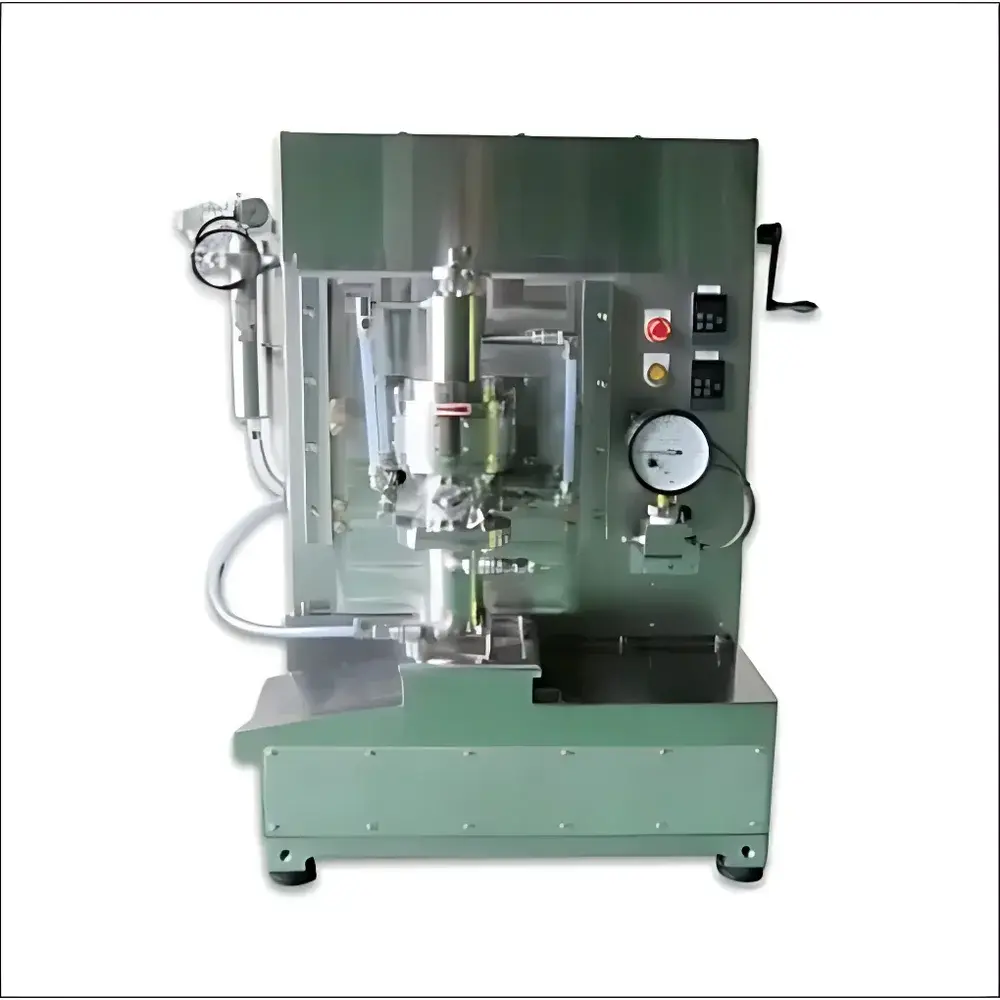
HM&M Dual Apex Mill Wet Bead Mill
| Brand | HM&M |
|---|---|
| Origin | Japan |
| Model | Dual Apex Mill |
| Type | Wet Bead Mill (Laboratory-Scale) |
| Output Particle Size | < 0.01 mm (≤10 µm, down to 20 nm in optimized dispersion) |
| Bead Size Range | Φ15 µm – Φ0.8 mm |
| Bead Separator Tip Speed | 6–12 m/s |
| Agitator Tip Speed | 2–12 m/s |
| Available Capacities | 0.15 L (DAM-015), 3.7 L (DAM-1), 7.5 L (DAM-5), 10 L (DAM-10) |
| Motor Power | 2.2–11 kW |
| Compliance | Designed for ISO/IEC 17025-aligned lab environments |
Overview
The HM&M Dual Apex Mill is a precision-engineered laboratory-scale wet bead mill designed for high-fidelity particle size reduction and stable colloidal dispersion of advanced functional materials. Unlike conventional co-axial agitator–separator configurations, the Dual Apex Mill implements a true dual-drive architecture: the agitator shaft and centrifugal bead separation rotor operate on independent drive systems, enabling simultaneous optimization of mechanical energy input and solid–liquid phase separation efficiency. This architecture directly addresses a fundamental limitation in nanoscale processing—namely, the trade-off between low agitator speed (to minimize crystal lattice disruption, amorphization, or surface defect generation in sensitive ceramics and pigments) and sufficient centrifugal force for reliable retention of sub-50 µm grinding media. By decoupling rotational control, the system maintains >99.9% bead retention at agitator tip speeds as low as 2 m/s while sustaining separator tip speeds up to 12 m/s—ensuring robust media containment without compromising dispersion gentleness. The mill operates on the principle of shear-dominated attrition within a confined chamber, where controlled hydrodynamic forces generated between moving beads and stationary chamber walls induce progressive particle deagglomeration and size refinement.
Key Features
- Dual independent drive system: Separately controlled agitator and centrifugal bead separator enable precise decoupling of dispersion intensity and media retention performance.
- Ultra-fine media compatibility: Certified operation with grinding beads as small as Φ15 µm—enabling nanoscale dispersion (20–300 nm final D50) with minimal crystallinity loss in piezoelectric oxides (e.g., BaTiO₃), photocatalysts (e.g., TiO₂ anatase), and conductive nanomaterials (e.g., Ag nanoparticles).
- Wide operational flexibility: Agitator tip speed adjustable from 2–12 m/s; bead separator tip speed independently set from 6–12 m/s—supporting both gentle nanodispersion and aggressive micron-level comminution in a single platform.
- Modular chamber design: Four standard volumes (0.15 L, 3.7 L, 7.5 L, 10 L) share identical fluid dynamics and shear profile scaling, ensuring direct process transferability from screening to pilot-scale development.
- Sealed, jacketed grinding chamber: Enables precise temperature control (±0.5 °C) during extended runs—critical for thermally sensitive organic pigments, polymer nanocomposites, and battery electrode slurries.
Sample Compatibility & Compliance
The Dual Apex Mill accommodates aqueous and non-aqueous suspensions with viscosities up to 5,000 mPa·s and solid loadings of 10–40 wt%. It is routinely deployed for processing electronic-grade ceramic precursors (BaTiO₃, ITO, hollow SiO₂), quantum dot dispersions, conductive inks (Ag, Cu, Ni nanoinks), and high-refractive-index pigment formulations. All wetted components are constructed from corrosion-resistant stainless steel (SUS316L) or ceramic-lined variants per customer specification. The system supports traceable operation under GLP-compliant environments: digital motor controllers log timestamped speed, torque, and thermal data; optional Ethernet/IP interface enables integration into LIMS and audit-ready electronic lab notebooks. While not intrinsically certified for FDA 21 CFR Part 11, its deterministic control architecture and immutable event logging meet foundational requirements for regulated R&D workflows aligned with ISO/IEC 17025 and ASTM E2500-18.
Software & Data Management
The mill is operated via a dedicated industrial HMI panel with password-protected parameter sets, run-time monitoring (real-time torque, chamber temperature, agitator/separator RPM), and automated shutdown triggers (over-temperature, over-torque, flow interruption). Optional PC-based software (HM&M LabControl Suite v3.2) provides CSV-exportable session logs, comparative batch analytics, and configurable SOP templates. All operational events—including parameter changes, start/stop commands, and alarm states—are time-stamped and stored in non-volatile memory for ≥12 months, satisfying basic traceability requirements for method validation and internal quality audits.
Applications
- Electroceramic slurry development: Low-damage dispersion of BaTiO₃ for MLCC dielectrics; preservation of tetragonality and domain structure.
- Next-generation battery materials: Homogeneous distribution of SiOₓ/C composites and LiNi₀.₈Co₀.₁₅Al₀.₀₅O₂ cathode precursors without transition metal dissolution.
- Functional pigment formulation: Deagglomeration of high-chroma organic pigments and inorganic colorants (e.g., Cr₂O₃, Fe₂O₃) while retaining hue fidelity and lightfastness.
- Nanocoating precursor synthesis: Stable 20–80 nm TiO₂ and ZnO dispersions for sol-gel hybrid coatings and UV-shielding films.
- Pharmaceutical nanosuspensions: Milling of BCS Class II/IV APIs where polymorphic stability and surface chemistry must be preserved.
FAQ
What minimum particle size can be achieved with the Dual Apex Mill?
Under optimized conditions using Φ15–Φ30 µm zirconia beads and low-agitation protocols, D50 values of 20–50 nm are routinely attained for brittle oxide nanoparticles; median sizes ≤100 nm are reproducible across multiple material classes.
Is the system suitable for heat-sensitive materials?
Yes—the jacketed chamber allows connection to external chillers (e.g., −10 to +40 °C range), and real-time temperature feedback enables dynamic speed modulation to maintain thermal budgets below critical degradation thresholds.
Can the Dual Apex Mill handle abrasive slurries like silicon carbide or tungsten carbide?
With optional ceramic-lined chambers (Al₂O₃ or SiC), the system processes highly abrasive feedstocks; wear rate data per 100 kg processed is available upon request for specific bead–slurry combinations.
How is bead contamination prevented during product discharge?
The centrifugal separator retains >99.97% of beads ≥Φ15 µm during continuous discharge; post-run chamber flush protocols (with solvent or water) are validated to achieve <1 ppm residual bead carryover in final product.
Does HM&M provide application support for method development?
Yes—application engineers offer remote and on-site protocol optimization, including bead selection matrices, energy input modeling (kWh/kg), and dispersion stability assessment (DLS, zeta potential, sedimentation kinetics).



