
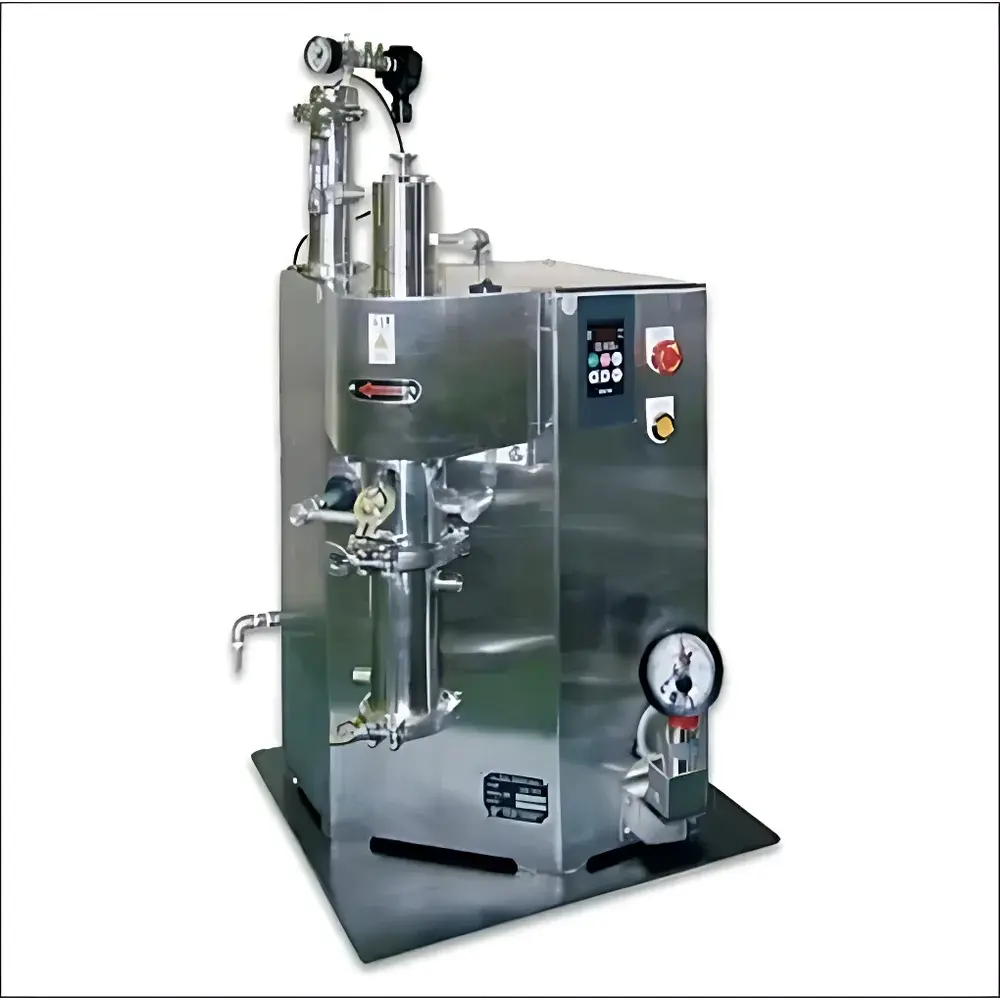
Ultra Apex Mill Bead Mill / Sand Mill by HM&M (Japan)
| Key | Brand: HM&M (Japan) |
|---|---|
| Origin | Japan |
| Model | Ultra Apex Mill |
| Instrument Type | Bead Mill / Sand Mill |
| Sample Applicability | Hard Materials |
| Feed Particle Size | <15 µm |
| Discharge Particle Size | <1 µm |
| Final Output Particle Size | <100 nm (down to 20 nm) |
| Batch Processing Volume | 60 mL |
| Bead Size Range | Φ15 µm – Φ1 mm |
| Bead Separator Type | Centrifugal |
| Peripheral Speed of Separator | 8–12 m/s |
| Compliance | Designed for GMP/GLP-aligned cleanroom and pharmaceutical-grade processing |
Overview
The Ultra Apex Mill is a high-precision, vertically oriented bead mill engineered by HM&M (Japan) for sub-micron to nanoscale particle size reduction and dispersion. It operates on the principle of wet grinding via high-energy collision and shear forces between rotating media (grinding beads) and suspended particles in a liquid slurry. Unlike conventional stirred-media mills relying on screen-based or dynamic gap separation, the Ultra Apex Mill integrates a patented centrifugal bead separator—designed to retain beads as small as Φ15 µm while permitting unrestricted discharge of nano-dispersed slurry. This architecture enables stable, scalable processing of ultra-fine slurries without clogging, bead loss, or cross-contamination—critical for applications demanding strict particle size distribution control (PSD), reproducibility, and regulatory traceability.
Key Features
- Centrifugal Bead Separation Technology: Eliminates mechanical sieves or membranes; separates beads solely via rotational inertia—enabling use of Φ15 µm to Φ1 mm media without hardware adjustment or downtime.
- Nanoparticle Dispersion Capability: Achieves consistent d50 values below 100 nm (as low as 20 nm) in validated process conditions, particularly effective for inorganic oxides (e.g., ZnO, Al2O3, SiO2), ceramic precursors, conductive nanoparticles (ITO, ATO, Ag), and organic pigment dispersions.
- Modular Media Flexibility: Single-unit compatibility with wide-ranging bead diameters supports multi-stage processing—e.g., coarse pre-grinding with Φ0.5–1 mm beads followed by nano-dispersion using Φ0.015–0.1 mm beads—within identical equipment footprint.
- Cleanability & Hygienic Design: Minimized dead-leg geometry, polished 316L stainless-steel wetted surfaces, sanitary clamp joints (DIN 11851 / ISO 2852), and fully drainable chamber facilitate CIP/SIP validation per FDA 21 CFR Part 11 and EU GMP Annex 15 requirements.
- Scalable Platform Architecture: Available in seven standard configurations (UAM-015 to UAM-30), supporting lab-scale development (60 mL batch) through pilot-scale feasibility studies (up to 30 L chamber volume), with linear torque and energy input scaling.
Sample Compatibility & Compliance
The Ultra Apex Mill processes hard, brittle, and agglomerated materials—including metal oxides, piezoelectric ceramics (e.g., barium titanate), pharmaceutical active ingredients (APIs), UV-filtering pigments, and conductive nanocomposites. Its ability to reduce API particle size to <200 nm has been documented in commercial pharmaceutical manufacturing under ICH Q5A and Q5D guidelines. The system complies with ISO 8573-1 (compressed air purity), meets IP54 enclosure rating, and supports audit-ready documentation packages aligned with GLP, GMP, and ISO/IEC 17025 quality management systems. All models are CE-marked and conform to JIS B 8711 (Japanese Industrial Standard for grinding equipment safety).
Software & Data Management
While the base Ultra Apex Mill operates via analog/manual control (digital tachometer, pressure monitoring port, temperature sensor interface), optional digital upgrade kits integrate with third-party SCADA or MES platforms via 4–20 mA analog outputs and Modbus RTU/RS485 communication. Process parameters—including rotor speed, slurry inlet/outlet pressure differential, jacket temperature, and cumulative energy input (kWh/L)—are logged with timestamped metadata to support 21 CFR Part 11-compliant electronic records when paired with qualified LIMS or ELN software. Audit trails, user access controls, and electronic signatures are implemented at the host system level.
Applications
- Pharmaceutical: Nanosizing of poorly soluble APIs to enhance bioavailability and dissolution kinetics.
- Electronics: Production of uniform ITO/ATO dispersions for transparent conductive films and antistatic coatings.
- Coatings & Inks: Stabilization of pigment dispersions for inkjet inks, LCD color filters, and anti-reflective layers.
- Advanced Ceramics: Deagglomeration of BaTiO3, AlN, and SiC nanopowders prior to sintering.
- Personal Care: Transparent ZnO and TiO2 suspensions for UV-blocking cosmetics meeting ISO 24443 photostability criteria.
- Energy Storage: Controlled milling of cathode/anode active materials (e.g., NMC, LFP) to optimize tap density and electrode homogeneity.
FAQ
What minimum particle size can be achieved with the Ultra Apex Mill?
Consistent d50 values down to 20 nm have been demonstrated in validated protocols using Φ15–50 µm beads and optimized residence time, slurry viscosity, and energy density.
Is the system suitable for GMP pharmaceutical manufacturing?
Yes—the design supports cleaning validation, material traceability, and electronic record generation when integrated with compliant software infrastructure and operated under controlled environmental conditions.
Can the same unit handle both coarse grinding and nano-dispersion?
Yes—by switching bead sizes (e.g., Φ0.5 mm for initial size reduction, then Φ0.03 mm for final dispersion) without mechanical reconfiguration, enabling seamless multi-step wet milling workflows.
How is bead wear monitored and managed?
Bead integrity is assessed via periodic slurry analysis (ICP-MS for metallic leachables) and visual inspection during scheduled maintenance; HM&M provides certified calibration beads and wear-rate reference data per material class.
What documentation is supplied for regulatory submissions?
Factory acceptance test (FAT) reports, material certifications (EN 10204 3.1), electrical safety certificates (PSE/JIS), and mechanical design calculations are included; IQ/OQ protocol templates are available upon request.



