
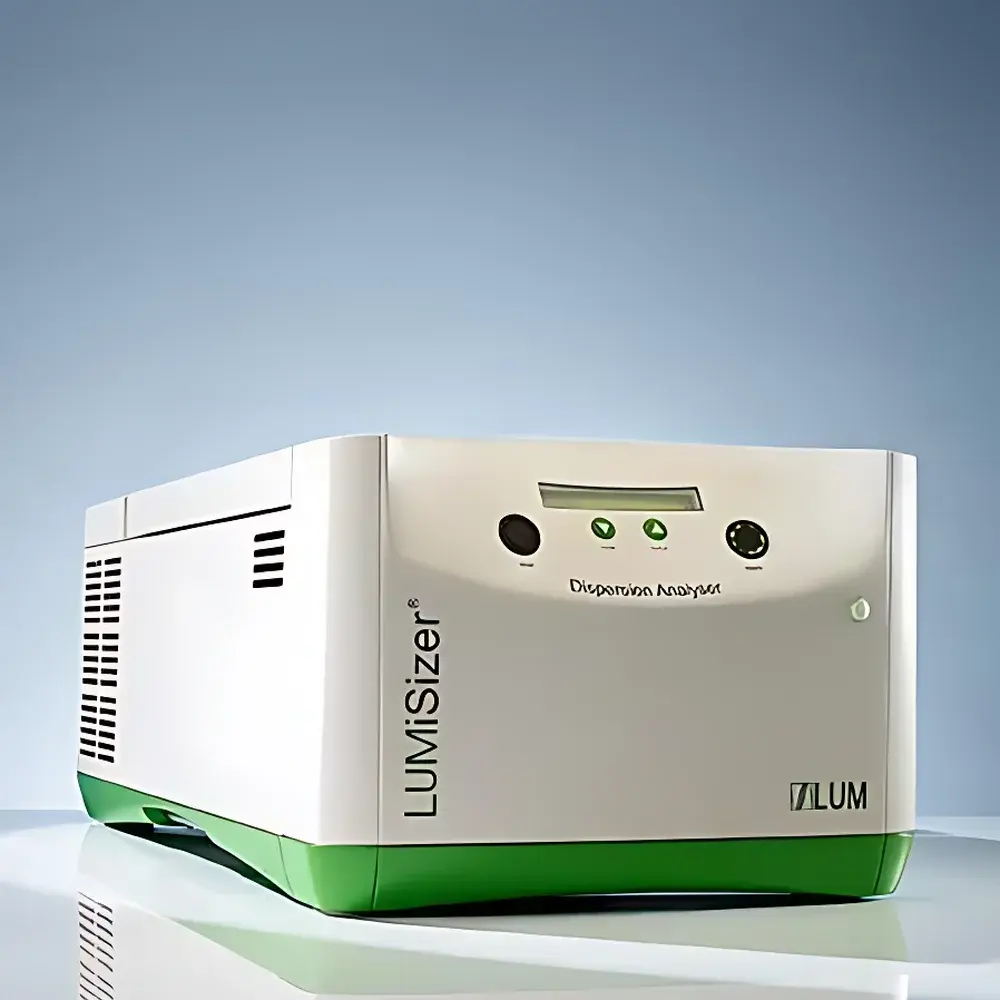
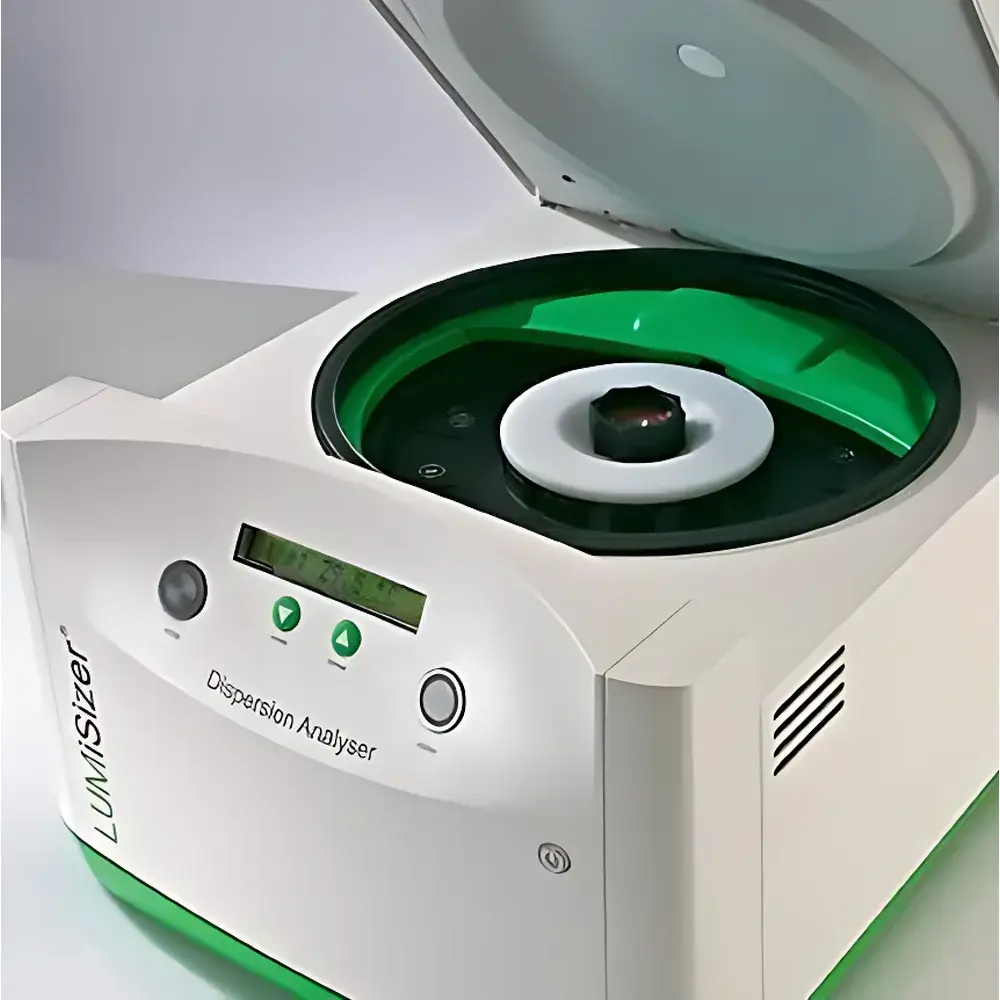
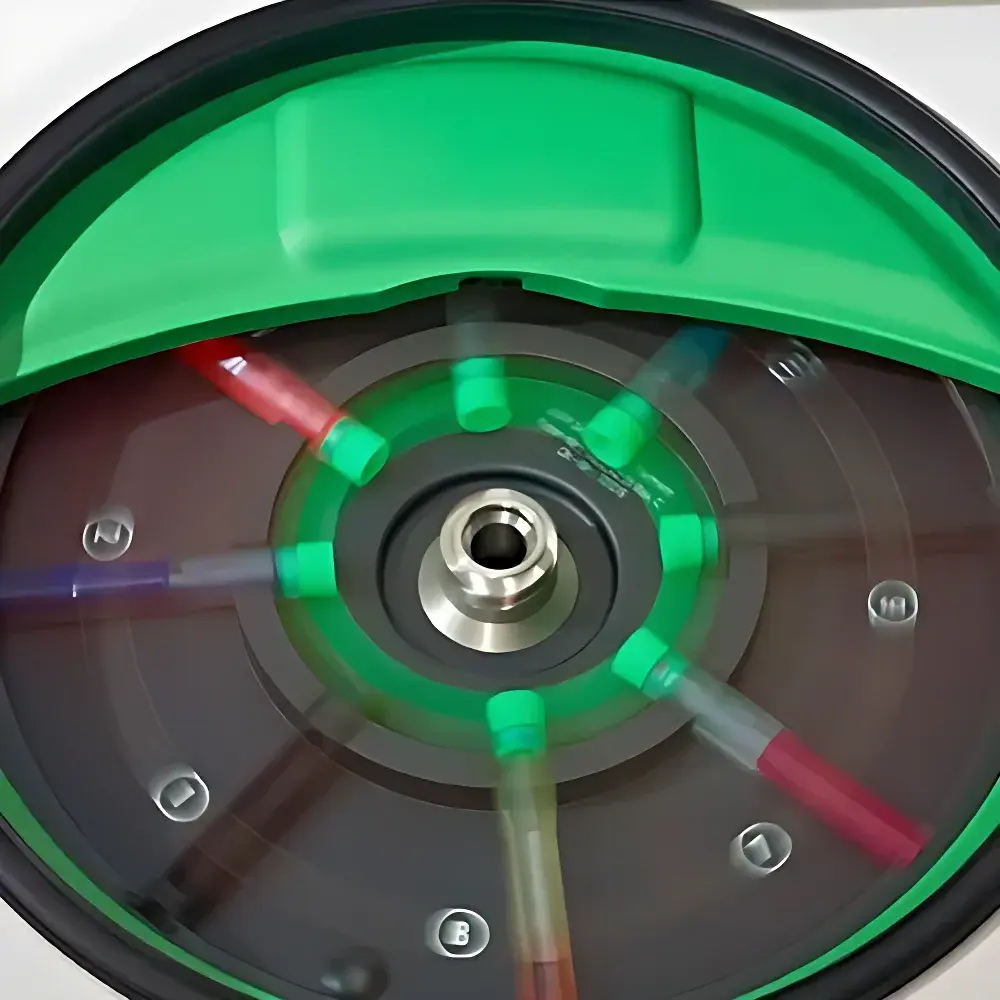
LUM GmbH LUMiSizer 65X Multi-Wavelength Particle Dispersion Analyzer
| Brand | LUM GmbH |
|---|---|
| Origin | Germany |
| Model | LUMiSizer 65X |
| Measurement Principle | STEP-Technology (Spatial and Temporal Extinction Profiles) |
| Sample Throughput | 12 positions simultaneously |
| Temperature Control Range | 4 °C to 60 °C (±1 K) |
| Particle Size Range (ISO 13318-2) | 20 nm – 100 µm |
| Stability & Sedimentation Velocity Range | 10 nm – 1000 µm |
| Concentration Range | 0.00015 % – 90 % w/w |
| Density Range | up to 22 g/cm³ |
| Viscosity Range | 0.8 – 10⁸ mPa·s |
| Acceleration Force | 6 × g to 2300 × g |
| Optical Wavelength Options | 470 nm (blue) and 865 nm (NIR) |
| Sample Volume | 0.05 – 2.0 mL |
| Compliance | ISO/TR 13097, ISO 13318-2, FDA 21 CFR Part 11 (via SEPView software audit trail), GLP/GMP-ready |
Overview
The LUM GmbH LUMiSizer 65X is a high-performance, multi-wavelength analytical centrifuge engineered for the quantitative characterization of colloidal and particulate dispersion stability, sedimentation behavior, and particle size distribution under accelerated conditions. Unlike conventional light-scattering or laser diffraction systems, the LUMiSizer employs Spatial and Temporal Extinction Profiling (STEP™) technology — a patented optical analytical method based on real-time transmission measurement across the full length of a sample cell during centrifugal acceleration. This enables direct, non-invasive monitoring of concentration gradients, phase separation kinetics, and particle migration velocities without requiring prior knowledge of material constants (e.g., refractive index, density difference, or viscosity). The instrument operates in full compliance with ISO 13318-2 for particle size analysis by centrifugal liquid sedimentation and ISO/TR 13097 for dispersion stability assessment. Its dual-wavelength capability (470 nm blue and 865 nm NIR) allows optimized detection across diverse dispersion types — from highly absorbing carbon nanotube inks and gold nanoparticle suspensions (NIR mode) to low-absorbance dairy emulsions and polymer latices (blue mode).
Key Features
- Simultaneous analysis of up to 12 heterogeneous samples — differing in concentration, viscosity, temperature, and chemical composition — within a single run.
- Full-sample-height resolution: STEP technology captures extinction profiles at 1,270 spatial data points per sample, enabling layer-by-layer quantification of creaming, sedimentation, flocculation, coalescence, and crystallization dynamics.
- Multi-wavelength optical system: Selectable 470 nm (blue) or 865 nm (NIR) illumination via software-controlled LED sources; eliminates guesswork in wavelength selection for opaque, colored, or high-absorption dispersions.
- Extended operational range: Supports concentrations from 0.00015 % to 90 % w/w, densities up to 22 g/cm³, and viscosities up to 10⁸ mPa·s — suitable for undiluted industrial pastes, slurries, and battery electrode slurries.
- Precise thermal control: Integrated Peltier-based temperature regulation (4 °C–60 °C, ±1 K) ensures reproducible stability testing under physiologically or industrially relevant storage conditions.
- High-acceleration capability: Adjustable centrifugal force from 6 × g to 2300 × g enables rapid simulation of long-term storage behavior — compressing months or years of shelf-life evaluation into hours or days.
Sample Compatibility & Compliance
The LUMiSizer 65X accommodates a broad spectrum of dispersion types without dilution or pre-treatment, including oil-in-water and water-in-oil emulsions, aqueous and non-aqueous suspensions, organogels, ceramic slurries, pharmaceutical nanosuspensions, food matrices (e.g., flavored milk, plant-based beverages), and conductive inks. Sample tubes are chemically inert (glass, quartz, or polymer variants) and compatible with aggressive solvents, acids, bases, and high-salinity media. All hardware and software comply with international standards for analytical instrumentation: ISO 13318-2 (centrifugal sedimentation particle sizing), ISO/TR 13097 (colloidal dispersion stability classification), and FDA 21 CFR Part 11 (electronic records and signatures), implemented via SEPView’s role-based user access, full audit trail, electronic signature support, and secure data archiving. The system meets GLP and GMP documentation requirements for regulated R&D and QC environments.
Software & Data Management
SEPView software provides a validated, intuitive platform for method development, automated SOP execution, raw data visualization, and quantitative reporting. Users define test parameters (wavelength, acceleration, temperature, duration), assign samples to positions, and launch fully unattended runs. Real-time extinction profile animations allow immediate visual assessment of instability mechanisms. Built-in algorithms calculate sedimentation velocity distributions, particle size distributions (PSD), depletion zones, interface velocities, clarification rates, and flocculation indices — all traceable to ISO 13318-2 protocols. Stability ranking (e.g., “stable”, “partially unstable”, “unstable”) is generated automatically using normalized instability indices. Export formats include CSV, PDF, and XML for LIMS integration. All processing steps, user actions, timestamps, and instrument states are recorded in an immutable audit trail compliant with 21 CFR Part 11.
Applications
The LUMiSizer 65X serves as a core stability screening tool across academia and industry. In materials science, it characterizes SiO₂, TiO₂, ZrO₂, and Au nanoparticle dispersions — distinguishing primary particles from aggregates and quantifying shell thickness in core-shell systems. In battery R&D, it assesses cathode/anode slurry homogeneity and sedimentation resistance under shear-free conditions. In food & beverage, it evaluates shelf-life of protein-stabilized emulsions, cocoa suspensions, and fruit pulp dispersions — differentiating creaming from flocculation. In pharma, it supports formulation development of nanosuspensions and liposomal drug carriers per ICH Q5C guidelines. In coatings and agrochemicals, it validates anti-settling additives and predicts long-term storage performance of high-solids pigment dispersions. Its ability to handle undiluted, high-viscosity, and optically complex samples makes it indispensable for process development, quality control, and regulatory filing.
FAQ
How does STEP technology differ from dynamic light scattering (DLS)?
STEP measures time-resolved transmission across the entire sample height under centrifugal force — yielding direct, absolute sedimentation velocity data. DLS infers size from Brownian motion in equilibrium, requiring dilute, optically transparent samples and assuming spherical, non-interacting particles.
Can the LUMiSizer measure particle density?
Yes — by analyzing sedimentation velocity under multiple acceleration forces and applying Stokes’ law inversely, the instrument calculates effective particle density relative to the continuous phase, provided viscosity and temperature are known.
Is calibration required before each measurement?
No routine physical calibration is needed. System integrity is verified via built-in reference measurements and standardized NIST-traceable polystyrene latex standards (optional); all optical and mechanical parameters are factory-characterized and digitally stored.
Does the instrument support Good Manufacturing Practice (GMP) workflows?
Yes — SEPView includes electronic signatures, role-based permissions, change control logs, and 21 CFR Part 11-compliant audit trails, enabling deployment in regulated QC laboratories.
What sample tube options are available for aggressive solvents?
Quartz and fluoropolymer-coated glass tubes are available for use with strong acids, halogenated solvents, and high-pH formulations — ensuring chemical compatibility without compromising optical path integrity.



