
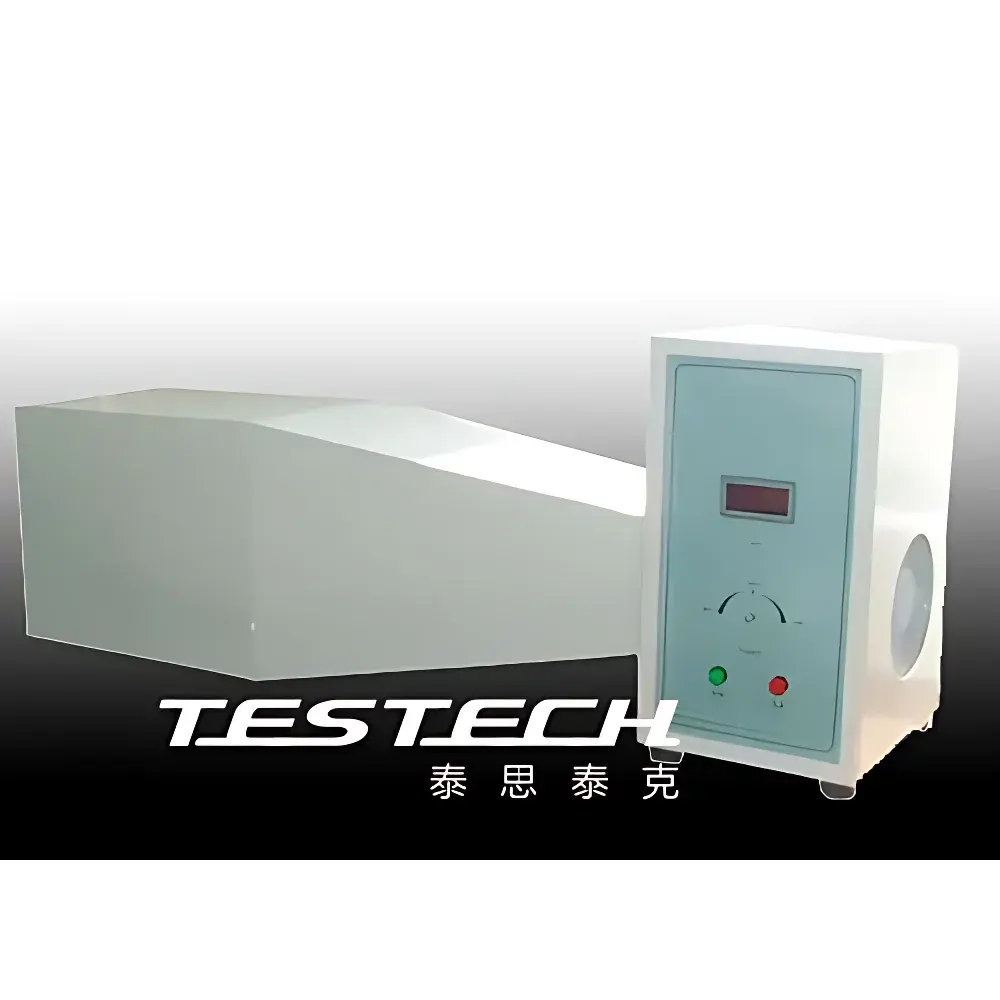
TESTech TTech-GBT9779 Initial Drying Crack Resistance Tester
| Brand | TESTech |
|---|---|
| Origin | Jiangsu, China |
| Manufacturer Type | Direct Manufacturer |
| Model | TTech-GBT9779 |
| Wind Speed Range | 0–10 m/s |
| Controlled Test Wind Speed | (3.0 ± 0.3) m/s |
| Ambient Temperature Control | 23 ± 2 °C |
| Relative Humidity Requirement | ≥50 ± 5 % RH |
| Power Supply | AC 220–240 V, 50 Hz |
| Total Power Consumption | 0.3 kW |
| Dimensions (L×W×H) | 1.3 × 0.31 × 0.44 m |
| Net Weight | 30 kg |
Overview
The TESTech TTech-GBT9779 Initial Drying Crack Resistance Tester is a precision-engineered physical property testing instrument designed to evaluate the early-stage drying behavior and surface crack formation tendency of architectural coatings and putties under controlled airflow conditions. It operates on the principle of accelerated forced-air drying simulation—mimicking real-world environmental exposure during the critical initial drying phase where tensile stresses induced by rapid solvent/water evaporation may exceed the cohesive strength of the wet film, resulting in microcracking or macroscopic fissures. Compliant with GB/T 9779–2005 Compound Architectural Coatings and referenced in JG/T 24–2000 Synthetic Resin Emulsion Sand-Texture Architectural Coatings, this tester provides standardized, repeatable assessment for quality control laboratories, R&D departments, and third-party certification bodies engaged in building material performance evaluation.
Key Features
- High-stability axial-flow fan with continuously variable speed control, enabling precise wind velocity adjustment across the full 0–10 m/s range;
- Optimized aerodynamic test duct engineered to ensure laminar, uniform airflow parallel to the specimen surface—minimizing turbulence-induced edge effects;
- Dedicated specimen holder assembly with adjustable positioning, accommodating standard test panels per GB/T 9779 (typically 150 mm × 70 mm × 3 mm wood or metal substrates);
- Integrated digital anemometer calibrated to NIST-traceable standards, providing real-time wind speed feedback with resolution ≤0.1 m/s;
- Precision programmable timer with automatic shutdown function, supporting user-defined drying durations from 1 to 99 minutes;
- Thermohygrometric monitoring capability—designed for operation within a conditioned laboratory environment maintained at 23 ± 2 °C and ≥50 ± 5 % RH, as specified in ISO 3270 and ASTM D609;
- Robust stainless-steel and powder-coated steel construction ensuring long-term dimensional stability and resistance to ambient corrosion;
- Low-noise, energy-efficient design (0.3 kW total load) compliant with IEC 61000-3-2 harmonic emission limits.
Sample Compatibility & Compliance
The TTech-GBT9779 accepts coated test panels prepared in accordance with GB/T 9779–2005 Section 5.3: specimens must be applied uniformly using a draw-down bar or applicator blade, dried under standard ambient conditions (23 ± 2 °C, ≥50 % RH) for 24 hours prior to testing, then placed into the wind tunnel immediately before initiation of the forced-drying cycle. Compatible substrate types include planed pine wood, cold-rolled steel, and aluminum alloy plates meeting GB/T 9271 specifications. The instrument satisfies functional requirements for regulatory conformance testing under China’s CCC certification framework for architectural coatings and supports documentation traceability aligned with GLP principles—including audit-ready operational logs when integrated with external data acquisition systems.
Software & Data Management
While the base TTech-GBT9779 operates via hardware-based controls (mechanical timer, analog wind-speed dial, and digital anemometer display), optional RS-485/Modbus RTU interface enables integration with laboratory information management systems (LIMS) or SCADA platforms. When paired with TESTech’s optional DataLog Pro module (sold separately), users can record timestamped wind speed, elapsed time, and ambient temperature/humidity metadata for each test run—generating CSV-exportable reports compliant with FDA 21 CFR Part 11 electronic record requirements when deployed with appropriate user access controls and audit trail configuration. All firmware updates adhere to IEC 62443-2-4 secure update protocols.
Applications
- Quality assurance of interior/exterior architectural latex paints, acrylic emulsions, and silicone-modified coatings;
- Formulation screening for crack-resistant additives (e.g., film-forming aids, rheology modifiers, and coalescing agents);
- Comparative evaluation of dry-film integrity between conventional and low-VOC, high-solid, or bio-based coating systems;
- Pre-certification validation for compliance with GB/T 9779–2005, JG/T 24–2000, and related provincial construction material technical specifications;
- Root-cause analysis of field-applied cracking failures through controlled replication of drying stress conditions;
- Supporting technical dossiers for green building rating systems (e.g., China Green Building Label, LEED MR credits) requiring documented coating durability metrics.
FAQ
What standards does the TTech-GBT9779 explicitly support?
GB/T 9779–2005 “Compound Architectural Coatings” and JG/T 24–2000 “Synthetic Resin Emulsion Sand-Texture Architectural Coatings” are fully implemented in test procedure logic and physical configuration.
Is calibration documentation included with shipment?
Yes—each unit ships with a factory calibration certificate for the integrated anemometer, traceable to CNAS-accredited metrology labs; annual recalibration is recommended per ISO/IEC 17025 guidelines.
Can the device operate outside the specified 23 ± 2 °C / ≥50 % RH environment?
No—deviations beyond these limits invalidate test compliance per GB/T 9779–2005 Clause 4.1; environmental control must be externally maintained using dedicated HVAC or climate chambers.
What panel dimensions and substrates are required for valid testing?
Standard panels are 150 mm × 70 mm × (3 ± 0.2) mm, prepared on wood (GB/T 9271 Class W1) or metal (GB/T 9271 Class M1); substrate preparation must follow GB/T 9271 Section 6.
Does the instrument meet electromagnetic compatibility (EMC) requirements for lab use?
Yes—the unit conforms to GB/T 18268.1–2010 (IEC 61326-1:2012), including radiated and conducted emissions, electrostatic discharge immunity, and surge immunity testing.



