
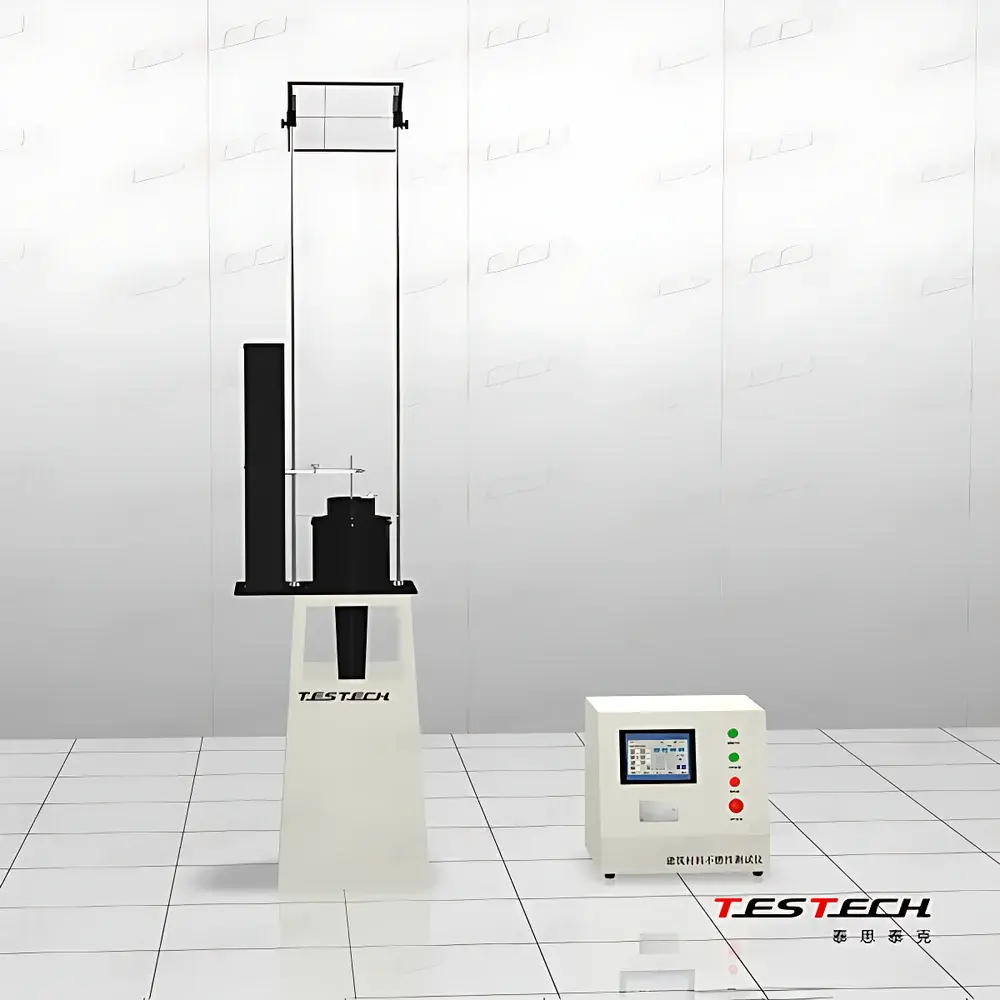
TESTech TTech-GBT5464 Non-Combustibility Furnace for Building Materials (Compliant with GB/T 5464–2010 and ISO 1182)
| Brand | TESTech |
|---|---|
| Model | TTech-GBT5464 |
| Standards Compliance | GB/T 5464–2010, ISO 1182, ASTM E136, BS 476-4 & BS 476-11 |
| Furnace Dimensions | Φ95 mm × Φ75 mm × 150 mm |
| Heating Element | Ni80Cr20 Resistance Band (3 mm × 0.2 m) |
| Airflow Shroud | Φ75 mm × 500 mm |
| Thermocouple | Insulated K-type Armored (Φ3 mm sheath / Φ0.3 mm wire) |
| Temperature Range | 0–1000 °C (±5% accuracy) |
| Equilibration Time | ~35 min |
| Power Supply | 220 V, 50 Hz, 1500 W |
| Dimensions (W×D×H) | 500 × 500 × 1500 mm |
| Weight | 50 kg |
| Control System | PLC-based PID with 7″ embedded touchscreen HMI |
| Data Output | Real-time & historical temperature curves, alarm logging, CSV data export |
Overview
The TESTech TTech-GBT5464 Non-Combustibility Furnace is a precision-engineered thermal testing system designed to determine the non-combustibility classification of building materials in accordance with mandatory regulatory frameworks—including China’s GB/T 5464–2010 and the internationally harmonized ISO 1182 standard. It operates on the principle of controlled high-temperature exposure (up to 900 °C) under defined airflow conditions, measuring material response through temperature evolution, mass loss, and flame propagation behavior. As stipulated in GB 8624–2012—the foundational standard for fire performance classification of construction products—non-combustibility testing is a prerequisite for Class A1 (non-combustible) certification. The furnace replicates standardized thermal stress profiles while maintaining strict compliance with test sequence timing, thermocouple placement, specimen geometry, and environmental conditioning requirements outlined in both GB/T 5464 and ISO 1182.
Key Features
- Patent-pending intelligent control architecture integrating programmable logic controller (PLC) with solid-state relay (SSR)-driven PID temperature regulation, ensuring stable thermal output and eliminating voltage fluctuation effects on heating performance.
- Stainless steel combustion chamber (Φ95 mm inner × Φ75 mm outer × 150 mm height) engineered for corrosion resistance, thermal uniformity, and ease of post-test residue removal.
- Dual-stage heating system utilizing high-stability Ni80Cr20 resistance band (3 mm × 0.2 m), capable of achieving and sustaining 900 °C within ≤35 minutes from ambient start-up.
- Integrated airflow shroud (Φ75 mm × 500 mm) ensures laminar, reproducible air velocity across the specimen zone per ISO 1182 Annex A specifications.
- Embedded 7-inch industrial touchscreen HMI provides real-time visualization of temperature profiles, configurable test parameters, automated data logging, and secure storage of calibration records and test reports.
- Triple-mode thermal ramping: dedicated programs for new-furnace conditioning, periodic calibration verification, and routine test execution—each with independent setpoint scheduling and dwell time control.
- Comprehensive safety interlocks including audible alarm, visual fault display, over-temperature cutoff, and emergency power disconnect aligned with IEC 61000-6-2/6-4 EMC and low-voltage directive (LVD) requirements.
Sample Compatibility & Compliance
The TTech-GBT5464 accommodates cylindrical specimens (45 mm diameter × 50 mm height) prepared per GB/T 5464 Section 6 and ISO 1182 Clause 7. Specimen preparation includes conditioning at 23 °C ± 2 °C and 50% ± 5% RH for ≥48 h prior to testing. The furnace supports full traceability for GLP/GMP-aligned laboratories: all temperature readings are acquired via calibrated, insulated K-type armored thermocouples (Φ3 mm sheath, 0.3 mm wire diameter) mounted per ISO 1182 Figure 1. Test reports generated by the system include timestamps, operator ID, ambient conditions, furnace calibration status, and raw thermocouple data—facilitating audit readiness for CNAS, CMA, or UKAS accreditation bodies. The instrument meets functional equivalence criteria under ASTM E136 (Standard Test Method for Determining Combustibility of Building Materials) and BS 476-4 (Fire Tests on Building Materials and Structures: Non-Combustibility Test).
Software & Data Management
Firmware-controlled data acquisition operates at 1 Hz sampling resolution with automatic timestamping synchronized to internal RTC. All test sessions are saved as encrypted binary files with checksum validation; export options include CSV (for Excel analysis) and PDF (formatted per ISO/IEC 17025 reporting templates). Audit trail functionality logs user actions (e.g., parameter edits, calibration events, report generation) with immutable timestamps and operator credentials. The system supports 21 CFR Part 11–compliant electronic signatures when integrated with enterprise identity management platforms. Calibration certificates—including thermocouple drift verification and furnace uniformity mapping—are stored alongside test records and can be exported with digital signature embedding.
Applications
This furnace is deployed in national building material inspection institutes (e.g., CNBMC, CICM), third-party certification labs (SGS, TÜV, Intertek), and R&D centers developing fire-rated insulation, structural composites, cladding systems, and interior finishes. Typical use cases include pre-certification screening for CE marking (EN 13501-1), technical documentation support for CCC certification in China, and formulation optimization of mineral wool, calcium silicate boards, expanded perlite panels, and cementitious coatings. Its adherence to multiple international protocols enables cross-border acceptance of test data without retesting—reducing time-to-market for global construction product portfolios.
FAQ
What standards does the TTech-GBT5464 fully comply with?
GB/T 5464–2010, ISO 1182:2010, ASTM E136–22, BS 476-4:1970+A2:2020, and BS 476-11:1982.
Is the furnace suitable for routine quality control in production environments?
Yes—its robust mechanical design, rapid thermal equilibration (~35 min), and automated reporting reduce operator dependency and support high-throughput daily testing.
How is temperature uniformity validated across the furnace chamber?
Uniformity mapping is performed during initial commissioning using a 5-point thermocouple array per ISO/IEC 17025 clause 6.4.3; results are documented in the factory calibration certificate.
Can test data be integrated into LIMS or ERP systems?
Yes—CSV exports and optional MODBUS TCP interface enable seamless integration with laboratory information management systems (LIMS) and enterprise resource planning (ERP) platforms.
Does the system support remote monitoring or diagnostics?
Remote access is available via secure Ethernet connection with optional VPN configuration; firmware updates and diagnostic logs can be retrieved without physical site visits.



