
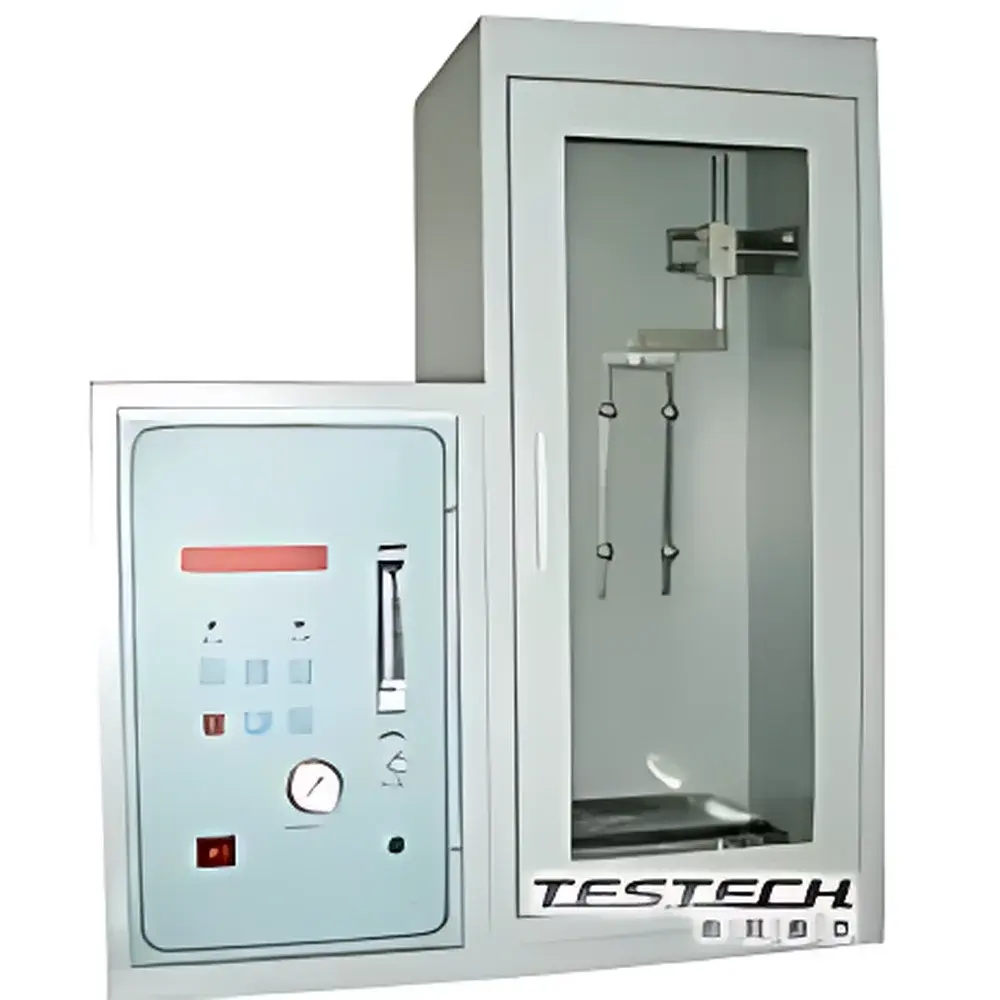
TESTech TTech-GBT9775 Fire Stability Test Chamber for Gypsum Board (Compliant with GB/T 9775–2008)
| Brand | TESTech |
|---|---|
| Origin | Jiangsu, China |
| Manufacturer Type | Direct Manufacturer |
| Country of Origin | China |
| Model | TTech-GBT9775 |
| Price | Upon Request |
| Power Supply | AC 220 V ±10 V, 50 Hz |
| Fuel Source | Liquefied Petroleum Gas (LPG) or Town Gas |
| Flame Length Range | 10–100 mm |
| Flame Application Time | 0–999.9 s |
| Timing Accuracy | ±0.1 s |
| Temperature Range | Ambient to 1000 °C (Class 0.5 accuracy) |
| Temperature Stabilization | >3 min at 800 ±30 °C |
| Burner Inner Diameter | Φ9.5 ±0.5 mm, Length ≈100 mm |
| Chamber Dimensions (L×W×H) | 0.7 × 0.4 × 0.72 m |
| Weight | 25 kg |
Overview
The TESTech TTech-GBT9775 Fire Stability Test Chamber is a purpose-built, standards-compliant apparatus engineered for evaluating the fire resistance performance of paper-faced gypsum board under controlled thermal exposure—specifically in accordance with the Chinese national standard GB/T 9775–2008. This standard defines test methods to assess the structural integrity and dimensional stability of non-load-bearing interior wall and ceiling gypsum board assemblies when subjected to direct flame impingement. The chamber implements a defined radiant-convective heating protocol using a calibrated Bunsen-type burner, delivering reproducible thermal input to simulate early-stage fire exposure conditions. Its design emphasizes measurement fidelity, operational repeatability, and regulatory traceability—critical requirements for building material certification labs, quality assurance departments, and third-party testing facilities operating under GB, ISO, or ASTM-aligned quality management systems.
Key Features
- Integrated modular architecture combining combustion test section and PLC-based control unit—minimizing field commissioning time and ensuring mechanical/thermal alignment.
- Large-dimension tempered observation window with heat-resistant coating enables real-time visual monitoring of sample deformation, charring, cracking, and flame propagation without compromising chamber integrity.
- Ergonomic industrial enclosure with stainless-steel outer shell (AISI 304 grade) and internal high-temperature resistant components—resistant to acidic combustion byproducts, soot deposition, and thermal cycling degradation.
- PLC + 7-inch HMI touchscreen control system supporting full automation: programmable flame-on duration (0–999.9 s), digital gas pressure & mass flow display, pulse high-voltage auto-ignition, and synchronized temperature/time logging.
- Precision gas delivery subsystem featuring imported pressure regulators, stainless steel needle valves, and thermal mass flow controllers—ensuring stable, repeatable fuel-air mixture across all flame length settings (20–100 mm).
- Calibrated thermocouple array with Class 0.5 accuracy (IEC 60584) and integrated digital readout provides continuous temperature profiling during stabilization and exposure phases.
- Automatic timing module with ±0.1 s resolution captures critical event timestamps—including ignition confirmation, flame application onset, and structural failure indicators (e.g., sagging beyond 15 mm or through-penetration).
Sample Compatibility & Compliance
The TTech-GBT9775 accommodates standard specimen dimensions per GB/T 9775–2008: 450 mm × 450 mm × nominal thickness (typically 9.5 mm or 12.7 mm), mounted vertically in a rigid steel frame with defined edge support conditions. It supports both single-layer and laminated gypsum board configurations used in residential and commercial interior construction. The system meets essential safety and metrological requirements for accredited fire testing laboratories, including traceable calibration paths for temperature sensors and flow meters. While GB/T 9775–2008 is the primary compliance reference, the chamber’s controllable thermal flux profile and documented repeatability make it suitable for comparative studies aligned with ISO 834-1 (fire resistance tests), ASTM E119 (standard fire tests of building construction), and EN 1364-1 (non-loadbearing elements), subject to procedural adaptation and validation per ISO/IEC 17025.
Software & Data Management
The embedded HMI firmware records timestamped data streams—including gas pressure (kPa), mass flow rate (L/min), chamber ambient and surface temperatures (°C), and elapsed flame exposure time (s)—to internal non-volatile memory. Export is supported via USB interface in CSV format for post-test analysis in Excel, MATLAB, or LIMS platforms. All user actions (parameter changes, start/stop commands, calibration entries) are logged with date/time stamps and operator ID fields—supporting audit readiness under GLP and internal QA protocols. Though not natively 21 CFR Part 11 compliant, the system architecture allows integration with external electronic lab notebooks (ELNs) or validated data acquisition software to fulfill regulated environment requirements.
Applications
- Fire stability qualification of paper-faced gypsum board for CE marking, CCC certification, and local building code approvals.
- R&D evaluation of fire-retardant additives, core formulation variants, and face paper treatments affecting char formation and thermal insulation retention.
- Batch release testing in gypsum board manufacturing plants to verify consistency against production specifications.
- Failure mode analysis—correlating observed deformation patterns (edge curl, center sag, blistering) with thermal exposure profiles and substrate composition.
- Inter-laboratory proficiency testing and round-robin validation studies among national fire testing centers.
FAQ
What standards does the TTech-GBT9775 strictly comply with?
It is fully configured and validated for GB/T 9775–2008. Optional procedural adaptations may support ISO 834-1, ASTM E119, and EN 1364-1 testing—subject to method verification per ISO/IEC 17025.
Can the chamber operate with natural gas instead of LPG?
Yes—provided gas supply pressure and Wobbe index fall within the calibrated range of the mass flow controller; recalibration of the gas delivery system is required for alternate fuels.
Is remote monitoring or Ethernet connectivity available?
The base configuration includes only local HMI operation and USB data export; optional RS-485 or Ethernet modules can be integrated for SCADA or centralized lab network deployment.
What maintenance intervals are recommended for long-term accuracy?
Thermocouple calibration every 6 months, burner tip inspection after every 50 test cycles, and annual verification of gas flow meter linearity using NIST-traceable reference standards.
Does the system include test report generation templates?
Preformatted CSV output files contain all raw parameters required to generate GB/T 9775–2008–compliant reports; users must apply their laboratory’s certified report template and sign-off workflow.



