
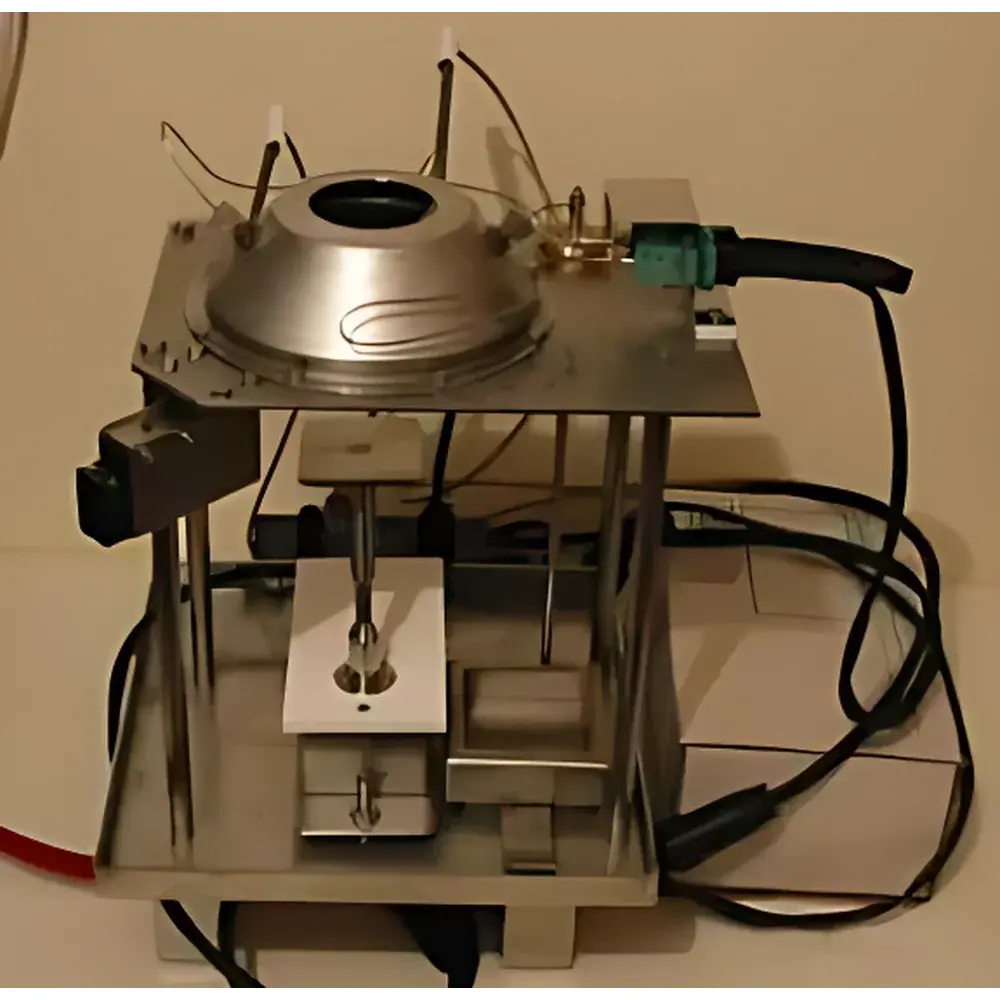
TESTech TTech-GBT14523 Radiant Ignition Performance Tester
| Brand | TESTech |
|---|---|
| Origin | Jiangsu, China |
| Manufacturer Type | Direct Manufacturer |
| Product Category | Domestic |
| Model | TTech-GBT14523 |
| Price | Upon Request |
| Radiation Source | 3000 W conical heater |
| Radiant Heat Flux Range | 0–70 kW/m² |
| Resolution | 0.5 kW/m² |
| Thermopile Heat Flux Meter | Metherm (USA), water-cooled, ±3% accuracy, 0.5% repeatability |
| Calibration Plate | Ceramic fiber board, 165 mm × 165 mm × ≥20 mm, density 200 ± 50 kg/m³ |
| Ignition System | Automated propane pilot with flame supervision and check valve |
| Gas Flow Control | Imported mass flow meter with inline filter |
| Temperature Monitoring | 0–1000 °C, ±2 °C control resolution |
| Sample Holder | Stainless steel, wall thickness 1.5 mm |
| Balance | 5000 g capacity, 0.1 g readability |
| Control System | PLC + industrial touchscreen HMI |
| Enclosure | Powder-coated steel cabinet, internal fixtures in 304 stainless steel |
| Compliance Standard | GB/T 14523–2007 |
Overview
The TESTech TTech-GBT14523 Radiant Ignition Performance Tester is a precision-engineered instrument designed to evaluate the ignition behavior of solid materials under controlled radiant heat exposure, in strict accordance with the Chinese national standard GB/T 14523–2007. This standard specifies test methods for determining the critical radiant heat flux required to ignite flat, non-metallic materials—commonly used in building products, transportation interiors, and industrial composites. The system operates on the principle of calibrated radiant heating using a high-stability conical heater, enabling reproducible thermal loading across sample surfaces. Unlike open-flame ignition tests, this method isolates radiant energy as the sole ignition stimulus, eliminating convective interference and providing quantifiable, physics-based ignition thresholds. The apparatus integrates thermally stable mechanical architecture, traceable metrology-grade sensors, and closed-loop environmental controls to ensure measurement integrity across repeated trials and inter-laboratory comparisons.
Key Features
- High-power conical heater (3000 W) delivering adjustable radiant flux from 0 to 70 kW/m² with 0.5 kW/m² resolution—engineered for uniform irradiance distribution over the 165 mm × 165 mm test area.
- Metherm (USA) thermopile-type heat flux meter, water-cooled and NIST-traceable, certified to ±3% absolute accuracy and ≤0.5% repeatability—mounted upstream of the specimen plane for real-time incident flux monitoring.
- Stainless steel (304) construction throughout critical zones: radiation cone housing, sample holder frame (1.5 mm wall thickness), fixture components, and calibration plate support—ensuring dimensional stability and oxidation resistance at elevated temperatures.
- Automated propane ignition system with flame detection, integrated check valve, and particulate filtration—minimizing gas-path contamination and mitigating backflash risk during startup and shutdown cycles.
- PLC-based control architecture paired with an industrial-grade touchscreen HMI, enabling programmable test sequences, real-time parameter visualization, and event-triggered data logging.
- Dual-stage temperature monitoring: primary heater surface control (0–1000 °C, ±2 °C resolution) and secondary cold-junction compensation for all thermocouples—ensuring thermoelectric signal fidelity.
- Integrated analytical balance (5000 g / 0.1 g) mounted on vibration-isolated platform, synchronized with ignition timing to capture mass loss kinetics during pre-ignition and flaming phases.
Sample Compatibility & Compliance
The TTech-GBT14523 accommodates flat, rigid or semi-rigid specimens up to 150 mm × 150 mm × 50 mm, including polymers, foams, laminates, textiles, and fiber-reinforced composites. Specimens are mounted horizontally on a low-conductivity stainless steel support grid, minimizing conductive heat loss to the base. All hardware interfaces—including the ceramic fiber calibration plate (165 mm × 165 mm × ≥20 mm, 200 ± 50 kg/m³)—are dimensionally and thermophysically aligned with GB/T 14523–2007 requirements. While the standard itself does not mandate ISO/IEC 17025 accreditation, the system’s sensor traceability (via NIST-calibrated heat flux meter and reference thermocouples), automated data audit trail, and deterministic control logic support GLP-compliant operation and facilitate alignment with broader fire testing frameworks such as ISO 5660-1 (for cone calorimetry correlation) and ASTM E1321 (for critical radiant flux determination).
Software & Data Management
Data acquisition is performed via embedded PLC firmware with timestamped sampling at 1 Hz for heat flux, surface temperature, mass loss, and ignition status. Raw measurements are stored locally in CSV format with embedded metadata (test ID, operator, date/time, calibration certificate IDs, ambient conditions). The HMI interface supports user-defined pass/fail criteria, automatic calculation of time-to-ignition (TTI) and critical heat flux (CHF), and export to LIMS-compatible formats. Audit trails record all parameter modifications, system alarms, and manual overrides—supporting regulatory readiness for internal QA reviews or external GMP/GLP audits. No cloud connectivity or proprietary binary formats are employed; all outputs remain fully human-readable and interoperable with third-party statistical analysis tools.
Applications
This instrument serves laboratories engaged in fire safety engineering, material development, and regulatory compliance verification. Typical use cases include: comparative screening of flame-retardant additives in polymeric matrices; validation of intumescent coating performance under radiant exposure; assessment of ignition resistance in automotive interior trim materials per OEM specifications; benchmarking of insulation boards against Class B1/C building code requirements; and generation of input data for computational fire modeling (e.g., CFD-based pyrolysis boundary conditions). Its adherence to GB/T 14523–2007 also enables direct technical equivalence assessments with international standards where radiant ignition threshold is a key design parameter.
FAQ
What is the purpose of the ceramic fiber calibration plate?
It serves as a standardized thermal absorber for verifying incident heat flux uniformity and magnitude prior to each test session—ensuring metrological continuity with GB/T 14523–2007 Section 6.2.
Is the system compatible with ISO 5660-1 testing protocols?
While optimized for GB/T 14523–2007, its conical heater geometry, heat flux range, and thermopile calibration align closely with ISO 5660-1 Annex A; minor procedural adaptations may be required for full conformance.
How is operator safety maintained during propane operation?
Redundant safeguards include a solenoid-controlled check valve, inline particulate filtration, flame supervision circuitry, and automatic gas shutoff upon flame extinction or system fault.
Can test data be exported for statistical process control (SPC)?
Yes—CSV exports include all raw sensor channels and derived metrics (TTI, CHF, mass loss rate), enabling integration into SPC software such as Minitab or JMP.
Does the system support remote diagnostics or firmware updates?
Local USB-based firmware updates are supported; however, no remote access, telemetry, or network connectivity is implemented—consistent with secure laboratory infrastructure policies.



