
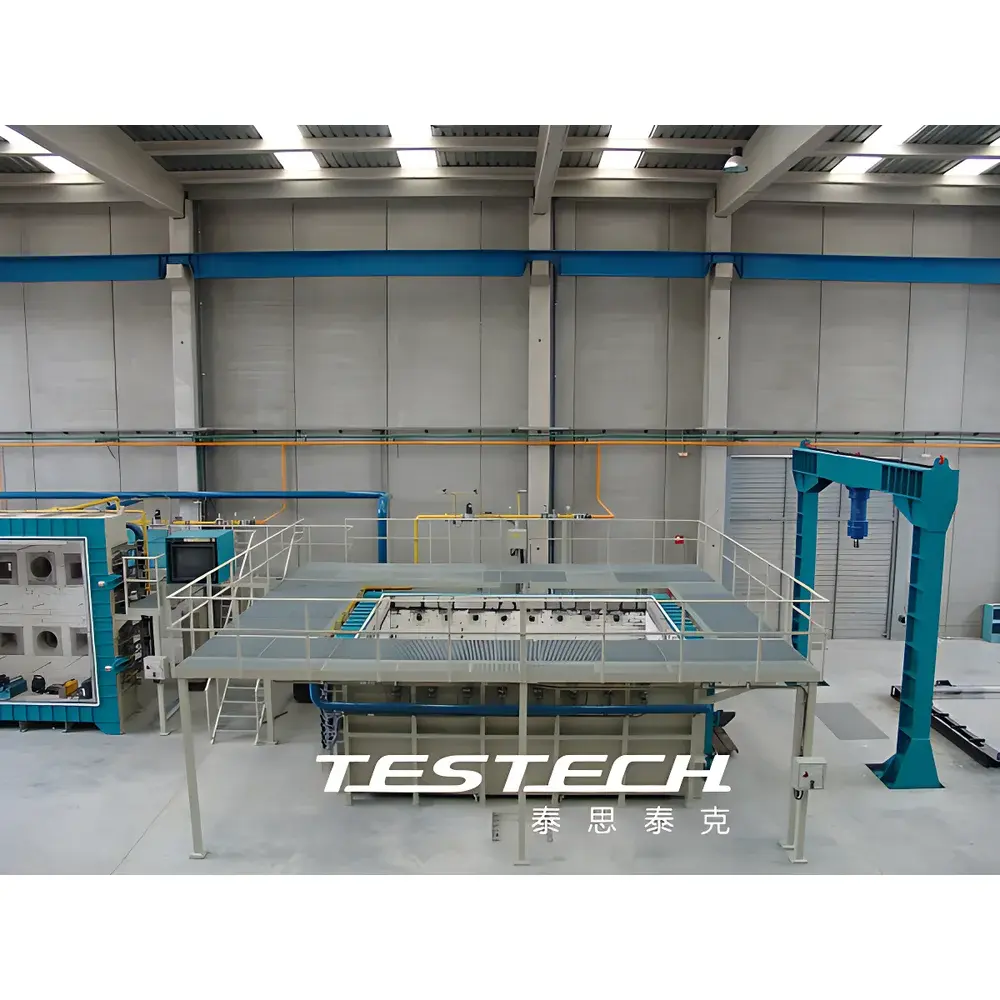
TESTech TTech-GB9978B Horizontal Furnace for Fire Resistance Testing of Building Elements per EN 1363-1, ISO 834, and GB/T 9978
| Brand | TESTech |
|---|---|
| Origin | Jiangsu, China |
| Manufacturer Type | Direct Manufacturer |
| Product Origin | Domestic (China) |
| Model | TTech-GB9978B |
| Pricing | Upon Request |
Overview
The TESTech TTech-GB9978B Horizontal Furnace is a rigorously engineered fire resistance testing system designed for evaluating the structural integrity and thermal performance of horizontally oriented building elements—including load-bearing and non-load-bearing walls, floor/ceiling assemblies, beams, columns, and support frames—under standardized fire exposure conditions. It operates on the principle of controlled hydrocarbon-fueled combustion to replicate time–temperature curves defined in EN 1363-1 (Fire Resistance Tests — General Requirements), ISO 834 (Fire Resistance Tests — Elements of Building Construction), and GB/T 9978 (Chinese national standard equivalent to ISO 834). The furnace achieves and sustains temperatures up to 1250 °C with high spatial and temporal uniformity across its test chamber, enabling precise assessment of three critical fire resistance criteria: load-bearing capacity (R), integrity (E), and insulation (I), as required by international fire classification protocols.
Key Features
- Test chamber dimensions: 3000 mm (W) × 4000 mm (H) × 1000 mm (D), optimized for full-scale horizontal specimen configurations.
- Multi-layer refractory lining: 1400 °C-rated insulating bricks, castable refractory blocks, slag wool boards, and dense 42% alumina bricks (6-hour thermal stability verified).
- Structurally reinforced low-carbon steel furnace shell with C-channel and I-beam framing to mitigate thermal deformation during prolonged high-temperature operation.
- 20 LPG-fired burners (10 per side), each equipped with flame supervision, intermittent ignition, and redundant thermocouple-based safety interlocks.
- Four quartz-glass observation ports (air-cooled, stainless steel insulated) positioned along the longitudinal wall, with sliding aluminum-fiber shutter doors for thermal isolation when not in use.
- Dual-mode control system: fully automated PLC-driven operation (Siemens S7 CPU + remote I/O) with manual override capability independent of computer functionality.
- Motorized, water-cooled stainless steel dampers (three units) integrated into vertical exhaust ducts for precise combustion chamber pressure regulation per EN 1363-1 Annex B.
- Comprehensive sensor suite: nine Class K thermocouples (positioned per EN 1363-1 Clause 6.2), one plate thermocouple, one differential pressure transducer, and ambient reference thermocouple—all calibrated to traceable NIST-equivalent standards.
Sample Compatibility & Compliance
The TTech-GB9978B accommodates both load-bearing and non-load-bearing horizontal specimens mounted within custom-engineered steel frames, with optional vertical sample support systems available. Specimen mounting interfaces comply with dimensional and mechanical anchoring requirements outlined in EN 1363-1, ISO 834-1, and GB/T 9978.1. All structural components—including refractory linings, burner manifolds, and exhaust ducting—meet material and fabrication specifications referenced in ASTM E119, BS 476 Parts 20–24, and IMO Resolution A.754(18) (Hydrocarbon Fire Curve). The furnace’s thermal profile uniformity, pressure control fidelity, and data acquisition repeatability are validated against ISO/IEC 17025 calibration procedures and support GLP-compliant reporting for regulatory submissions.
Software & Data Management
The integrated fire data management software—developed in accordance with EN 1363-1 Clause 7.3 and ISO/IEC 17025 Section 7.7—supports real-time acquisition, visualization, and archival of temperature, pressure, and time-stamped event logs. It enables pre-programmed heating curve execution (e.g., standard time–temperature, hydrocarbon, or custom profiles), automatic pass/fail evaluation against R/E/I thresholds, and export to CSV/PDF formats compliant with FDA 21 CFR Part 11 audit trail requirements. Dual redundant recording ensures continuous data capture: primary logging occurs on the control PC; secondary backup is mirrored to an isolated networked workstation. All I/O channels (240 total, dual-polarity) feature 21-bit resolution, 0.005% FS accuracy, and programmable sampling intervals from 1 ms to 3 s.
Applications
This furnace serves laboratories conducting third-party certification testing for CE marking (EU Construction Products Regulation), CCC certification (China), and UL/ETL listing. Typical applications include fire resistance validation of concrete slabs, gypsum board partitions, steel-framed composite floors, timber-concrete hybrid systems, and firestop assemblies. Its design supports extended-duration tests (up to 240 minutes) under sustained thermal loads, making it suitable for research into intumescent coatings, phase-change insulation materials, and passive fire protection systems requiring ISO 834–based qualification.
FAQ
Does the furnace meet EN 1363-1 calibration and verification requirements?
Yes—thermocouple placement, chamber temperature uniformity, and pressure control tolerances are validated per EN 1363-1 Annex A and ISO/IEC 17025-accredited procedures prior to commissioning.
Can the system be configured for vertical specimen testing?
Yes—optional vertical sample frames and lifting mechanisms are available as factory-integrated modules, maintaining compliance with EN 1364-1 and ISO 834-2.
Is the control software compliant with 21 CFR Part 11 for regulated environments?
Yes—the dual-record architecture, electronic signature support, and immutable audit trail generation satisfy FDA requirements for electronic records and signatures.
What utilities are required for installation?
Liquefied petroleum gas (LPG) supply (≥12 bar), 200–240 VAC / 50 Hz power, chilled water (for damper cooling), and compressed air (for pneumatic actuators and purge functions).
How is furnace maintenance performed without compromising refractory integrity?
Modular refractory components and field-replaceable burner nozzles allow targeted servicing; all replacement materials conform to EN 993-1 and ISO 1927-4 specifications for high-alumina castables and insulating firebrick.



