
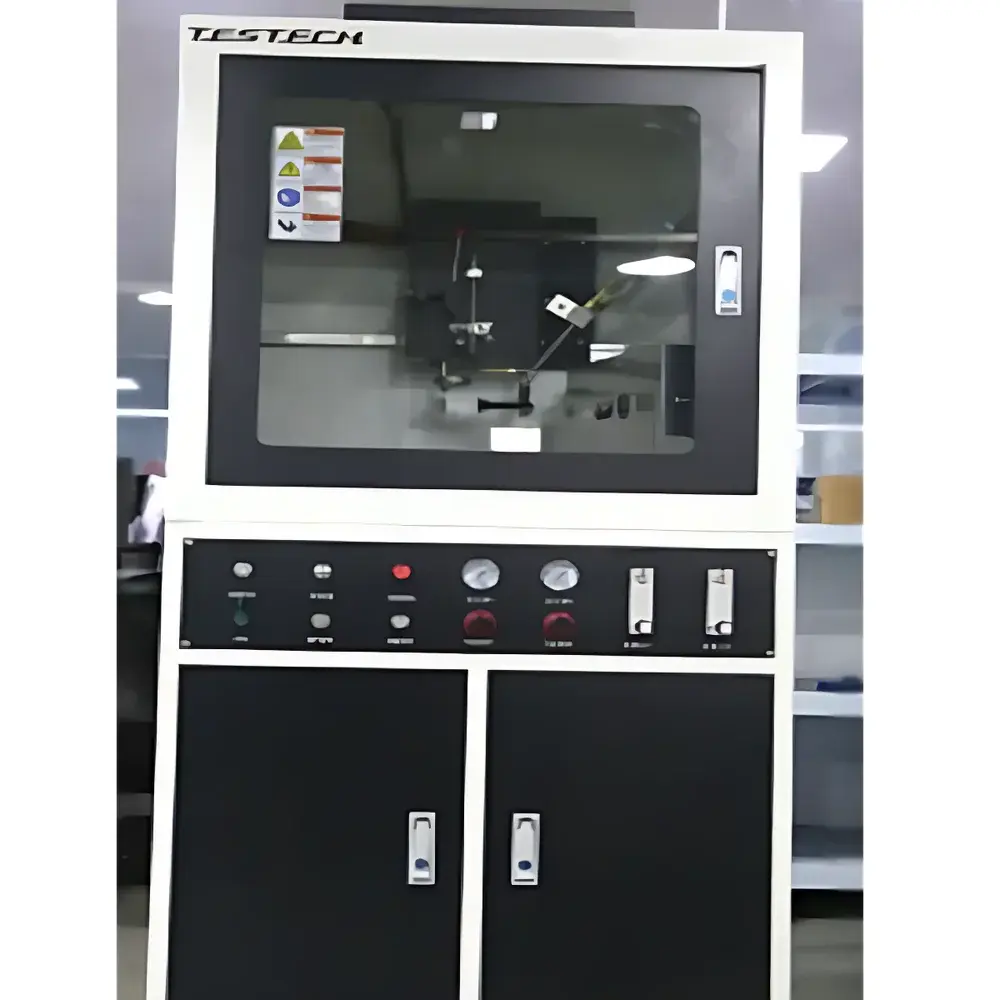
TESTech TTech-GBT40237 Foam Plastic Ignitability Tester (Arc Spark Method)
| Brand | TESTech |
|---|---|
| Model | TTech-GBT40237 |
| Standard Compliance | GB/T 40237–2021 |
| Sample Orientation | Horizontal |
| Ignition Source | CO₂-shielded arc spark (ER50 carbon steel wire, Ø1.0 mm) |
| Spark Height | (600 ± 50) mm above specimen surface |
| Combustion Chamber Dimensions | 800 mm × 800 mm × 1000 mm (W×D×H) |
| Viewing Window | 570 mm × 970 mm heat-resistant glass |
| Drip Collection | Stainless steel conical tray with 550 mm × 550 mm medical-grade absorbent cotton |
| Control System | LabVIEW-based automated acquisition with synchronized HD video recording |
| Consumables Included | 30 pcs ER50 weld wire, 5 pcs low-carbon steel plates (250 mm × 150 mm × 10 mm) |
Overview
The TESTech TTech-GBT40237 Foam Plastic Ignitability Tester (Arc Spark Method) is a purpose-built physical property testing instrument engineered to evaluate the ignition resistance of rigid and flexible polymeric foam materials under controlled, standardized arc-spark exposure. Designed in strict accordance with GB/T 40237–2021 “Test Method for Ignitability of Foam Plastics — Arc Spark Method”, this system replicates the thermal and mechanical stress conditions associated with industrial welding operations—specifically, the stochastic ejection of molten metal particles and sustained arc plasma during CO₂-shielded metal arc welding. Unlike open-flame or radiant-heating methods, the arc spark protocol subjects specimens to localized, transient thermal impulses with high peak temperature (>1500 °C) and short dwell time (milliseconds), enabling realistic assessment of material response to incidental workplace ignition sources. The apparatus operates under ambient laboratory conditions and maintains full traceability of test parameters—including spark generation stability, electrode-to-specimen geometry, and post-ignition behavior monitoring—ensuring repeatability across inter-laboratory studies and quality control workflows.
Key Features
- Integrated combustion chamber constructed from powder-coated steel, featuring a front-mounted 570 mm × 970 mm heat-resistant quartz glass viewport for real-time visual observation and optical diagnostics.
- Modular CO₂-shielded arc ignition subsystem housed in a dedicated stainless-steel enclosure, co-welded to the main chamber for electromagnetic and thermal isolation.
- Precision-adjustable sample support frame (610 mm × 610 mm stainless steel grid, 6 mm × 6 mm × 0.9 mm mesh) with calibrated vertical positioning via ergonomic knob-controlled telescopic rod—maintaining exact (600 ± 50) mm spark-to-specimen distance per GB/T 40237–2021.
- Conical stainless steel drip collection tray positioned directly beneath the specimen plane, lined with standardized 550 mm × 550 mm medical-grade absorbent cotton to detect and document flaming drips per clause 6.4 of the standard.
- Automated LabVIEW-based control interface with synchronized HD camera acquisition, timestamped event logging, and programmable spark duration sequencing (default: continuous 30 s exposure).
- Pre-configured consumables kit including 30 pieces of ER50 solid-core carbon steel welding wire (Ø1.0 mm) and five 250 mm × 150 mm × 10 mm low-carbon steel target plates—each compliant with GB/T 8110 for consistent spark morphology.
Sample Compatibility & Compliance
The TTech-GBT40237 accommodates both rigid and flexible foam specimens measuring 150 mm × 150 mm × (25 ± 1) mm (thickness per standard), cut from commercially available polymeric foams including expanded polystyrene (EPS), extruded polystyrene (XPS), polyethylene (PE), polyurethane (PU), and phenolic resin foams. Specimens are mounted horizontally on the stainless-steel grid without adhesive or mechanical fixation, preserving natural thermal expansion behavior during exposure. All operational parameters—including chamber ventilation rate, ambient temperature (23 ± 2 °C), relative humidity (50 ± 5% RH), and spark energy density—are monitored and logged to satisfy internal QA protocols and external audit requirements. The system supports documentation alignment with ISO/IEC 17025:2017 for testing laboratories and provides raw data export in CSV and AVI formats compatible with GLP-compliant electronic lab notebooks.
Software & Data Management
The embedded LabVIEW application provides deterministic real-time control of spark initiation timing, duration, and system interlocks (e.g., door-open safety cutoff, overtemperature shutdown). Video capture utilizes a GigE Vision–compliant industrial camera with 1080p resolution and adjustable shutter speed (1/1000–1/100 s), enabling clear visualization of spark impact, surface charring, flame propagation onset, and drip formation. All test sessions generate a structured metadata file containing operator ID, specimen ID, environmental readings, spark voltage/current traces (via optional current shunt integration), and annotated video timestamps. Audit trails comply with FDA 21 CFR Part 11 requirements when deployed on validated Windows OS platforms with user role management and electronic signature capability.
Applications
This tester serves critical roles in R&D validation of flame-retardant formulations for construction insulation, automotive interior components, packaging materials, and cold-chain logistics foams. It supports comparative screening of halogen-free vs. brominated FR additives, evaluation of char-forming synergists (e.g., melamine cyanurate, ammonium polyphosphate), and verification of compliance claims for building codes referencing GB 8624 or EN 13501–1. In manufacturing QA environments, it enables batch release testing against internal fire safety specifications and supports root-cause analysis of field-reported ignition incidents involving welding proximity.
FAQ
What standards does the TTech-GBT40237 strictly implement?
It is fully aligned with GB/T 40237–2021 and references methodology elements from ASTM E136 and ISO 5657 where applicable for comparative interpretation.
Is calibration certification included with delivery?
Yes—each unit ships with a factory calibration report verifying spark height tolerance, chamber dimensional conformity, and camera synchronization accuracy.
Can the system be integrated into an existing LIMS or MES platform?
Via TCP/IP API and configurable CSV/XML export, enabling bidirectional data exchange with major laboratory information management systems.
What maintenance intervals are recommended for the welding subsystem?
Weld wire feed rollers and contact tips require inspection every 50 test cycles; CO₂ gas regulator calibration is advised annually per ISO 6141.
Does the instrument support modified test durations or non-standard specimen geometries?
LabVIEW source code access is available under NDA for qualified users requiring protocol customization while maintaining traceable deviation records.



