
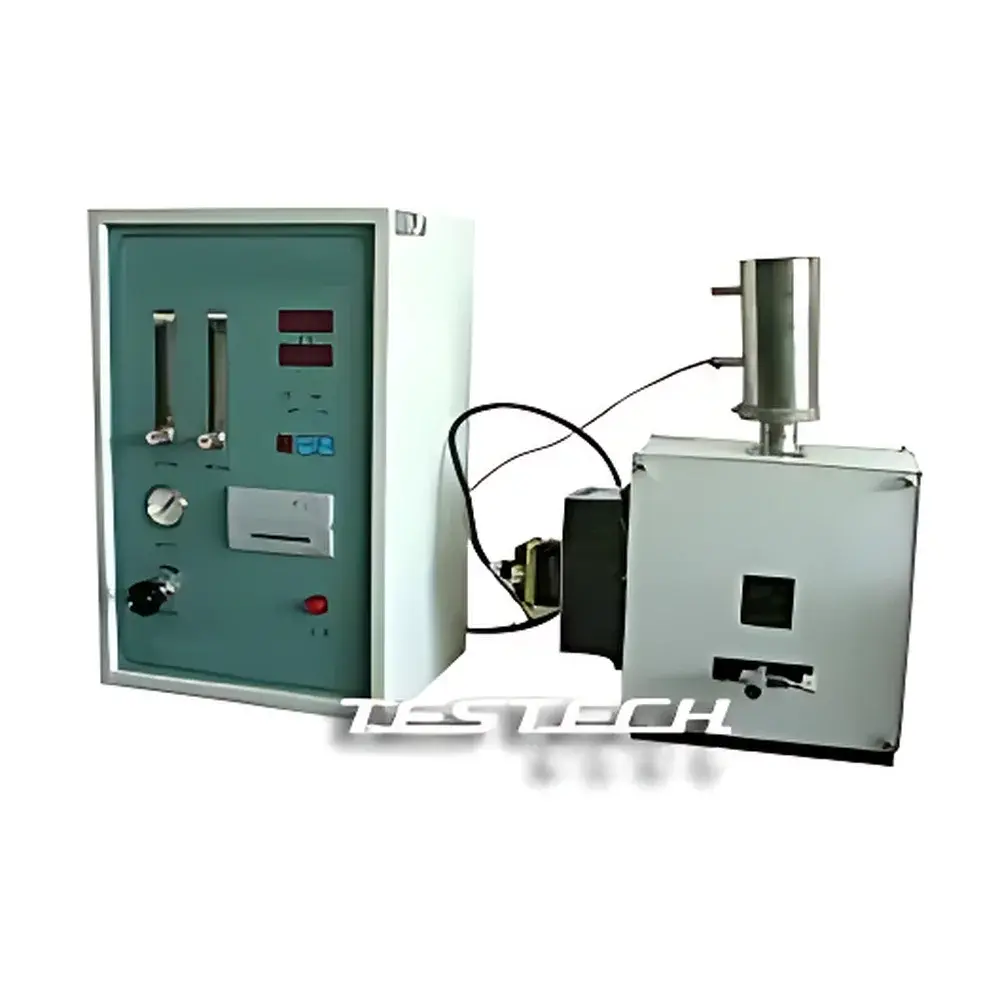
TESTech TTech-GBT17658 Flame Propagation Tester for Fire-Retardant Wood Materials (Compliant with GB/T 17658–1999)
| Brand | TESTech |
|---|---|
| Model | TTech-GBT17658 |
| Construction | Stainless steel chamber with 10 mm calcium silicate insulation |
| Air inlet | 95 mm × 25 mm |
| Observation window | 50 mm × 50 mm |
| Heating system | Four 500 W, Ø20 mm × 300 mm electric heating tubes |
| Sample holder | Calcium silicate board, outer 265 mm × 265 mm, inner 225 mm × 225 mm, corner holes Ø8 mm |
| Chimney | Ø38 mm (ID), 190 mm long, 1 mm wall thickness |
| steel cap | Ø76 mm (ID), 152 mm high, 1 mm wall thickness |
| Thermocouples | Two K-type (NiCr/NiAl) |
| Gas flowmeter | 0–2 L/min, ±0.08 L/min accuracy |
| Air flowmeter | 0–10 L/min, ±0.1 L/min accuracy |
| Pressure regulator | 0–0.4 MPa |
| Voltage meter | 0–25 kW, ±0.1 kW resolution |
| Transformer | 0–250 V AC |
| Ignition | Integrated piezoelectric gas igniter |
| Control system | PLC + 7-inch HMI touchscreen |
| Data logging | Automatic timestamped recording, report generation & thermal printer output |
| Power supply | AC 220 V, 50 Hz |
| Total rated power | 2.5 kW |
| Ambient operating temperature | 5–35 °C |
| Dimensions (L×W×H) | 300 mm × 250 mm × 450 mm |
| Net weight | 25 kg |
| Gas supply | Liquefied petroleum gas (LPG) or natural gas (user-supplied) |
| Compressed air source | Optional 0.5 MPa unit (user-supplied) |
Overview
The TESTech TTech-GBT17658 Flame Propagation Tester is a purpose-built combustion test apparatus engineered to evaluate the flame spread behavior of wood-based materials subjected to fire-retardant impregnation treatments. It implements the standardized small-scale vertical flame propagation methodology specified in GB/T 17658–1999, a Chinese national standard aligned with fundamental principles of heat flux-driven ignition and pyrolysis front advancement. The device operates under controlled convective and conductive heating conditions, simulating localized fire exposure to assess critical performance indicators—including ignition time, flame height progression, char depth development, and self-extinguishment tendency—under reproducible laboratory conditions. Its design emphasizes thermal stability, measurement repeatability, and operator safety, featuring a fully enclosed stainless-steel combustion chamber lined with high-density calcium silicate insulation to minimize heat loss and ensure uniform thermal boundary conditions during testing.
Key Features
- Robust chamber construction: 304 stainless steel housing with 10 mm thick calcium silicate board lining, providing structural integrity and thermal resistance up to 1000 °C.
- Precise thermal input control: Four independently mounted 500 W electric heating tubes (Ø20 mm × 300 mm) deliver calibrated radiant and convective energy to the specimen surface, replicating standardized ignition intensity per GB/T 17658–1999.
- Integrated gas-fired ignition system: Piezoelectric igniter paired with adjustable LPG/natural gas flow regulation (0–2 L/min, ±0.08 L/min accuracy) enables reliable, repeatable flame initiation without manual intervention.
- Real-time environmental monitoring: Dual K-type thermocouples (NiCr/NiAl) positioned at strategic locations record surface and ambient temperatures with millisecond-level synchronization to event timestamps.
- Automated test execution: PLC-based control architecture with 7-inch resistive touchscreen HMI manages ignition sequence, timing (±0.1 s resolution), data acquisition, and emergency shutdown protocols.
- Comprehensive data handling: Onboard memory stores all sensor readings, event markers, and user annotations; reports comply with internal QA documentation requirements and support traceability for GLP-aligned workflows.
Sample Compatibility & Compliance
The TTech-GBT17658 accommodates flat, rectangular specimens measuring 225 mm × 225 mm (net test area), cut from commercially treated fire-retardant wood products—including plywood, particleboard, MDF, and solid-sawn lumber. Specimen thickness shall conform to the material’s intended application and must be documented per test record. All hardware—including sample holder, chimney, and gas delivery components—is fabricated from corrosion-resistant 304 stainless steel or certified high-purity calcium silicate board to prevent contamination and maintain dimensional stability across repeated thermal cycles. The system satisfies the physical configuration, airflow, and instrumentation requirements outlined in GB/T 17658–1999 and is routinely validated against reference materials per internal SOPs. While not certified to ISO 5657 or ASTM E84, its operational parameters are technically commensurate with the flame spread index derivation logic embedded in those standards.
Software & Data Management
Data acquisition and reporting are managed via an embedded industrial PLC interfaced with a dedicated HMI interface. No external PC or proprietary software installation is required. All measurements—including gas/air flow rates, thermocouple voltages, elapsed time, and ignition status—are sampled at 10 Hz and logged with UTC timestamps. Test records include operator ID, sample identification, ambient conditions, calibration verification status, and digital signatures where enabled. Reports are generated in PDF format and printed directly via the integrated thermal printer. Audit trails retain version history of firmware updates and parameter modifications, supporting compliance with internal quality management systems (e.g., ISO 9001) and facilitating FDA 21 CFR Part 11–compatible electronic record implementation when deployed within regulated environments.
Applications
This tester serves laboratories engaged in fire performance qualification of treated timber products for construction, interior finishing, transportation interiors, and furniture manufacturing. It supports R&D validation of novel flame-retardant formulations, batch release testing for production QC, and technical substantiation for building code compliance submissions. Users include national testing institutes (e.g., CNAS-accredited labs), third-party certification bodies, and industrial R&D centers evaluating comparative flame retardancy efficacy across chemical treatment types (e.g., ammonium polyphosphate, borate salts, intumescent systems). The apparatus also functions as a teaching tool in fire science curricula, illustrating fundamental combustion dynamics in solid-phase fuels under standardized thermal insult.
FAQ
What standards does the TTech-GBT17658 strictly adhere to?
It is engineered exclusively to meet the dimensional, procedural, and instrumentation requirements of GB/T 17658–1999, with no claim of conformance to ASTM E84, ISO 5657, or EN 13823.
Is compressed air mandatory for operation?
No—compressed air is optional and only required if the user selects auxiliary purge or soot suppression functionality; base operation relies solely on natural draft and regulated gas/air mixing.
Can test data be exported to CSV or Excel formats?
Raw data export is not supported; however, full test reports (PDF) contain all recorded parameters and may be archived externally via USB drive or network share if connected to an enterprise file server.
What maintenance intervals are recommended?
Thermocouple calibration verification every 6 months; gas flowmeter and air flowmeter recalibration annually; visual inspection of calcium silicate liner integrity before each test series.
Does the system support remote monitoring or network connectivity?
No Ethernet or Wi-Fi interface is provided; all interaction occurs locally via the HMI touchscreen. Network integration requires third-party gateway hardware and custom SCADA configuration.
Related Products



