
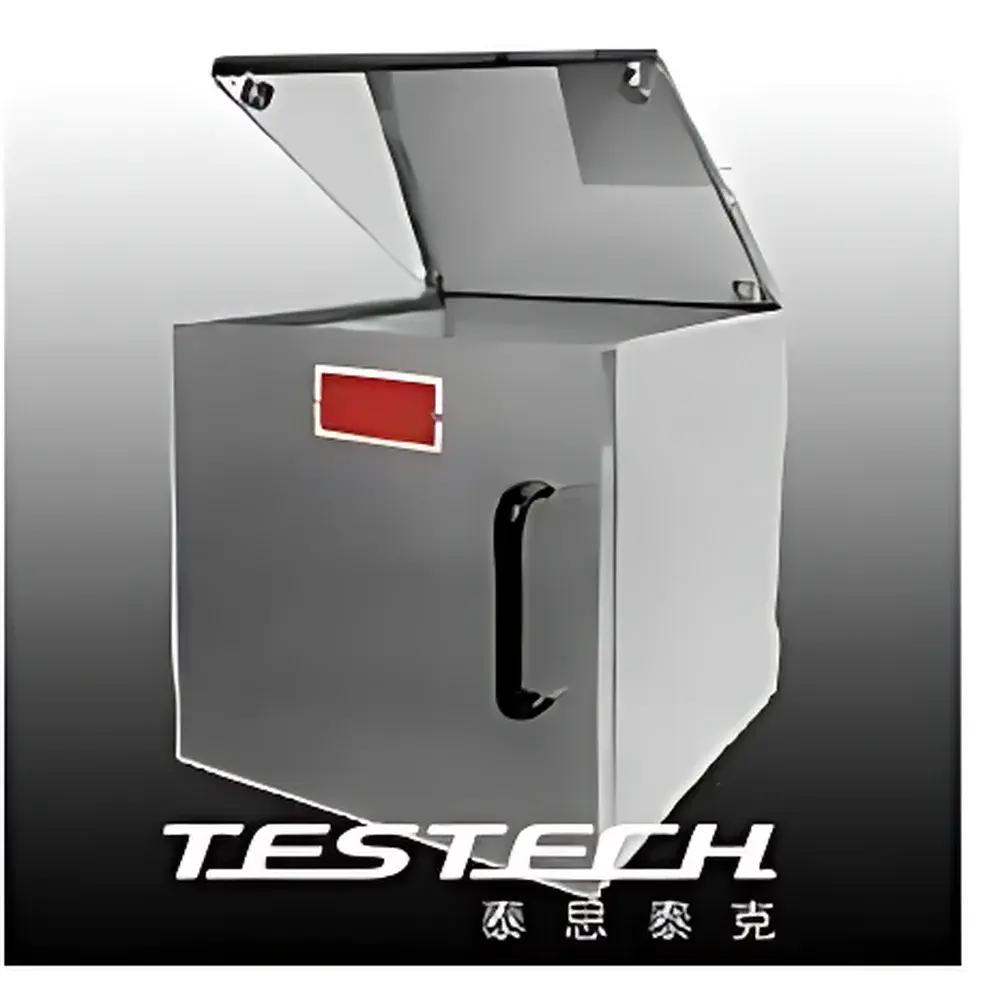
TESTech TTech-GBT11049 Carpet Flammability Tester – Hexamethylenetetramine Tablet Method
| Brand | TESTech |
|---|---|
| Model | TTech-GBT11049 |
| Standard Compliance | GB/T 11049–2008 |
| Chamber Internal Dimensions | 300 mm × 300 mm × 300 mm |
| Test Plate | Stainless Steel, 230 mm × 230 mm × 6.5 mm with 205 mm Ø central aperture |
| Ruler | Stainless Steel, 1 mm graduation |
| Timer | ±1 s accuracy |
| Ignition Device | Dedicated tablet igniter |
| Accessories | Polyethylene gloves, color-indicating silica gel desiccant |
| Optional | Fume hood integration |
Overview
The TESTech TTech-GBT11049 Carpet Flammability Tester is a precision-engineered instrument designed to evaluate the horizontal flame propagation behavior of carpet specimens under standardized small-flame ignition conditions, in strict accordance with the Chinese national standard GB/T 11049–2008, “Test Method for Flammability of Carpets — Hexamethylenetetramine Tablet Method.” This test method simulates a localized thermal insult using a defined solid fuel source—namely, a 150 mg hexamethylenetetramine (HMTA) tablet—to assess flame resistance characteristics critical for building material safety classification. The apparatus operates on the principle of controlled, reproducible ignition followed by quantitative measurement of post-ignition response: specifically, the maximum char length (i.e., damage length) and time-to-extinguishment or flame front progression across the specimen surface. Unlike open-flame or radiant panel methods, this tablet-based approach isolates ignition energy delivery, enabling high inter-laboratory repeatability for comparative evaluation of diverse carpet constructions—including tufted, woven, needle-punched, and bonded types—regardless of fiber composition (e.g., nylon, polypropylene, wool, or blended systems).
Key Features
- Robust stainless-steel test chamber (300 mm × 300 mm × 300 mm internal volume) with smooth, non-reactive interior surfaces to prevent catalytic interference and facilitate cleaning between tests.
- Calibrated stainless-steel support plate (230 mm × 230 mm × 6.5 mm), precisely machined with a centered 205 mm diameter aperture to ensure consistent specimen exposure geometry and airflow symmetry during combustion.
- Traceable linear measurement system: High-contrast stainless-steel ruler with 1 mm graduations, mounted parallel to the specimen plane for unambiguous post-test char length assessment per GB/T 11049–2008 Section 7.3.
- High-stability timing module with ±1 second accuracy, synchronized to ignition initiation for precise recording of flame spread duration and self-extinguishment intervals.
- Dedicated HMTA tablet ignition assembly, engineered to position the tablet reproducibly at the specimen center without mechanical contact or thermal preheating artifacts.
- Integrated accessory set including powder-free polyethylene gloves (to prevent oil transfer onto specimens), and color-changing silica gel desiccant (to maintain ≤50% RH preconditioning environment as required by Clause 5.2 of GB/T 11049–2008).
Sample Compatibility & Compliance
The TTech-GBT11049 accommodates standard carpet specimens measuring 230 mm × 230 mm, cut from representative production lots and conditioned per GB/T 11049–2008 (23 ± 2 °C, 50 ± 5% RH, ≥48 h). It supports heterogeneous structures—including multi-layer backings, latex-coated substrates, and fiber blends—without modification. While GB/T 11049–2008 is the primary normative reference, the test protocol aligns functionally with ISO 6927 (Textiles — Determination of flammability of textile floor coverings) and informs classification under China’s mandatory GB 8624 fire performance rating system. The device architecture permits third-party verification against ASTM E648 (Critical Radiant Flux) correlation studies, though it is not a substitute for that test. All hardware components comply with GB/T 20001.4–2015 (Standard Writing Rules — Part 4: Testing Methods) for metrological traceability and mechanical integrity.
Software & Data Management
This is a manually operated, non-automated test platform; no embedded software or digital data logging is included. All measurements—char length, flame duration, and observation notes—are recorded manually on standardized test report forms aligned with GB/T 11049–2008 Annex A. Laboratories implementing GLP or CNAS-accredited quality systems are advised to integrate the instrument into documented procedures covering: operator qualification (Clause 4.2), environmental monitoring logs (temperature/humidity), tablet lot traceability, and calibration records for the ruler and timer (per JJF 1001–2011 General Metrological Terminology). For FDA-regulated or ISO/IEC 17025 environments, audit trails must include raw observation sheets, signed technician entries, and supervisor review signatures—consistent with 21 CFR Part 11 principles where electronic records are later introduced via LIMS integration.
Applications
- Quality control release testing of commercial and residential carpet products prior to market distribution in China.
- Comparative flammability screening during R&D of flame-retardant fiber treatments, backing adhesives, and latex formulations.
- Technical due diligence for import/export compliance with Chinese building material fire safety regulations (e.g., Ministry of Housing and Urban-Rural Development notices).
- Supporting fire risk assessments in institutional settings such as hotels, hospitals, and public transport interiors where carpet specifications mandate GB/T 11049 compliance.
- Reference testing for certification bodies accredited under CNAS (China National Accreditation Service) for conformity assessment of floor coverings.
FAQ
Is the TTech-GBT11049 compliant with international standards beyond GB/T 11049–2008?
The instrument is purpose-built for GB/T 11049–2008. While its operational parameters are technically comparable to ISO 6927, formal equivalence requires cross-validation per ISO/IEC 17025 Clause 7.2.2.
Can the test chamber be used for other textile flammability standards?
No. The chamber geometry, plate design, and ignition methodology are specific to the HMTA tablet protocol. Adaptation for ASTM D2859 or BS EN ISO 11925-2 would require structural redesign and validation.
What maintenance is required for long-term accuracy?
Monthly visual inspection of chamber interior for carbon buildup; annual verification of ruler graduation fidelity and timer accuracy against NIST-traceable references.
Is fume extraction mandatory during operation?
GB/T 11049–2008 does not mandate a fume hood, but TESTech strongly recommends local exhaust ventilation (≥0.5 m/s face velocity) for operator safety and consistent combustion atmosphere control.
How is specimen conditioning verified before testing?
Laboratories must document ambient temperature and relative humidity in the conditioning room for ≥48 h using calibrated sensors (traceable to national standards), with printouts retained as part of the test record.



