
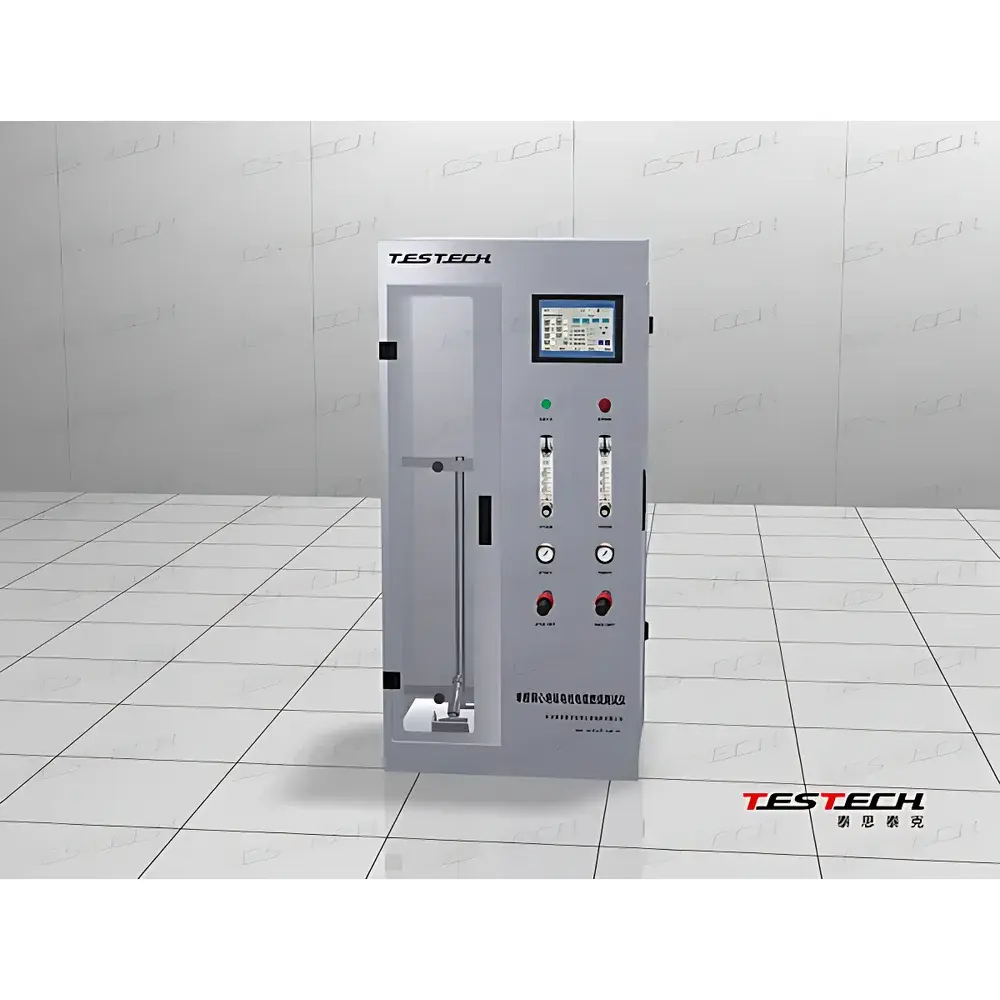
TESTech TTech-GBT18380-2 Vertical Flame Test Apparatus for Single Wire and Cable
| Brand | TESTech |
|---|---|
| Origin | Jiangsu, China |
| Manufacturer Type | OEM Manufacturer |
| Regional Category | Domestic (China) |
| Model | TTech-GBT18380-2 |
| Pricing | Upon Request |
Overview
The TESTech TTech-GBT18380-2 Vertical Flame Test Apparatus is a precision-engineered instrument designed to evaluate the flame propagation resistance of single insulated wires and cables under controlled vertical orientation, in strict accordance with international and national fire safety standards. It operates on the principle of standardized flame impingement—applying a defined pre-mixed propane/air flame to the lower end of a vertically suspended specimen for a specified duration—and quantifies flame spread behavior, char length, and whether flaming droplets ignite cotton wool placed beneath the test zone. This apparatus implements the core methodology of IEC 60332-1-1, IEC 60332-1-2, and GB/T 18380.11–12:2008 (replacing GB/T 12666.2 and GB/T 18380.1–2001), enabling laboratories to conduct repeatable, auditable, and regulatory-compliant flame retardancy assessments required for product certification, quality control, and R&D validation in wire & cable manufacturing.
Key Features
- Integrated touch-screen control system with dual-language interface (English and Chinese), supporting intuitive parameter configuration, real-time status monitoring, and automated test sequencing.
- Full automation of ignition, timing, flame application, and hold duration—with programmable ranges from 0 to 99 minutes 99 seconds—ensuring high reproducibility across operator shifts and test batches.
- Stainless-steel test chamber (1200 mm H × 300 mm W × 450 mm D) engineered for thermal stability, corrosion resistance, and long-term compliance with ISO/IEC 17025 environmental conditioning requirements.
- Precision pre-mixed burner assembly featuring a 12.0 ± 0.5 mm inner diameter nozzle, 100 mm length, and rated thermal output of 1 kW; calibrated to generate a stable blue flame of 50–60 mm height and total flame height of 170–190 mm per GB/T 18380.11–12:2008.
- Dual stainless-steel mounting rods with bolted-through-hole fixation ensure consistent specimen alignment and mechanical stability during flame exposure—critical for minimizing positional variance and meeting ASTM E622 repeatability thresholds.
- Gas delivery subsystem equipped with imported pressure gauges, precision needle valves, rotameter-based flow control (propane: 650 ± 30 mL/min; air: 10.0 ± 0.5 L/min), pressure-reducing regulators, shutoff ball valves, and integrated one-way check valves for fail-safe gas isolation.
- Onboard flame height gauge and calibrated flow meters enable daily verification and traceable calibration against NIST-traceable references—supporting GLP/GMP documentation and FDA 21 CFR Part 11 audit readiness.
- Control cabinet and test chamber are co-located in a single footprint (600 × 450 × 1250 mm), minimizing installation complexity and reducing field commissioning time by >40% compared to modular alternatives.
Sample Compatibility & Compliance
The TTech-GBT18380-2 accommodates single-core insulated cables and optical fiber cables with outer diameters up to 25 mm and lengths ≥ 600 mm. Specimen mounting follows Clause 8.2 of GB/T 18380.11–12:2008 and IEC 60332-1-1:2004, requiring vertical suspension with fixed upper clamping and free-hanging lower end. The apparatus is validated for conformance with: IEC 60332-1-1, IEC 60332-1-2, EN 50086-1:1994, GB/T 18380.11–12:2008, GB/T 5169.14–2007 (equivalent to IEC 60695-11-2:2003), and referenced clauses in UL 1581 Section 1080. All mechanical dimensions, flame geometry, gas composition, and timing logic comply with metrological tolerances defined in ISO/IEC 17025 Annex A.3 for fire testing instrumentation.
Software & Data Management
The embedded control firmware logs all critical parameters—including actual flame-on time, measured gas flows, chamber ambient temperature, and operator ID—in timestamped CSV files stored internally or exported via USB. Audit trails include event timestamps, parameter change history, and pass/fail determinations per test cycle. Data export supports direct integration into LIMS platforms compliant with ISO/IEC 17025 Clause 7.5.2. Optional software add-ons provide PDF report generation with digital signatures, electronic batch records, and 21 CFR Part 11-compliant user authentication and electronic signature workflows.
Applications
This apparatus is routinely deployed in accredited third-party testing laboratories (e.g., SGS, BV, TÜV Rheinland), cable OEM QC labs, and national metrology institutes for: qualification of halogen-free low-smoke (LSOH) compounds; validation of cross-linked polyethylene (XLPE), PVC, and ETFE insulation formulations; regulatory submission support for CCC, CE, and UL listings; root-cause analysis of flame failure modes; and comparative benchmarking of flame-retardant additives (e.g., aluminum trihydrate, magnesium hydroxide). Its design facilitates routine use in ISO/IEC 17025-accredited environments where measurement uncertainty budgets must be documented per ISO/IEC 17025:2017 Clause 7.6.3.
FAQ
Does the test chamber door remain closed during operation?
No—the chamber door is strictly for dust protection and aesthetic enclosure; per Clause 7.3 of GB/T 18380.11:2008 and IEC 60332-1-1:2004, the door must be fully open during flame application to ensure unobstructed airflow and thermodynamic equilibrium.
Can this apparatus perform tests per IEC 60332-1-3 or GB/T 18380.13?
Yes—the same mechanical platform satisfies IEC 60332-1-3 and GB/T 18380.13:2008 when configured with the optional multi-specimen holder kit (sold separately) and updated firmware version v2.4+.
What calibration documentation is provided?
Each unit ships with a factory calibration certificate traceable to CNAS-accredited reference standards, including burner flow verification, flame height verification, and timer accuracy validation (±0.1 s over 60 s).
Is air supply conditioning required?
Yes—compressed air must be oil-free, dry (dew point ≤ −40 °C), and filtered to ≤ 1 µm particle size to prevent burner clogging and maintain stoichiometric combustion consistency across 500+ test cycles.
How is dripping behavior assessed?
Flaming droplets falling from the specimen are observed for ignition of surgical cotton wool (100 mm × 100 mm × 6 mm, mass 30 ± 5 g) placed horizontally 300 mm below the lower clamp—per Clause 9.2 of GB/T 18380.12:2008.



