
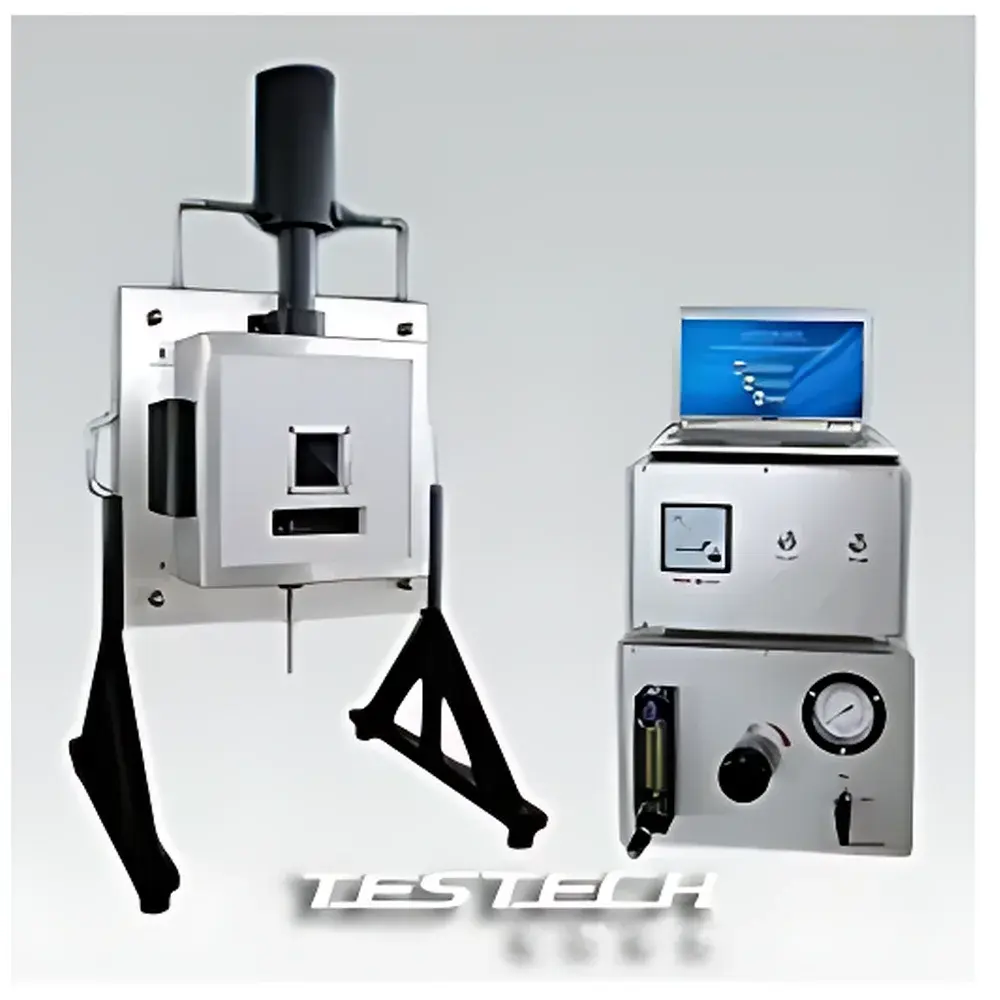
TESTech TTech-BS476 Flame Spread Index Tester (BS 476-6:2009 Compliant)
| Brand | TESTech |
|---|---|
| Model | TTech-BS476 |
| Standard Compliance | BS 476-6:2009 + A1:2009 |
| Sample Size | 225 mm × 225 mm × <30 mm |
| Construction | Stainless Steel Frame & Calcium Silicate Fireproof Chamber |
| Radiation Source | Dual Radiant Panel Assembly |
| Temperature Monitoring | K-Type Thermocouples (ΔT between flue gas and ambient) |
| Gas Control | Precision Imported Mass Flow Controller |
| Data Acquisition | Automated PC-Based System with Report Generation |
| Safety Features | Auto-Ignition, Flame-Out Detection, Interlocked Ventilation Monitoring |
| Power Regulation | Time-Programmed Output Control |
| Sample Holders | Three Configurable Stainless-Clad Mounting Fixtures |
| Exhaust | Removable Stainless Steel Flue Duct for Thermocouple Access |
Overview
The TESTech TTech-BS476 Flame Spread Index Tester is a precision-engineered apparatus designed to determine the flame spread index (I) of flat building materials in strict accordance with BS 476-6:2009, including Amendment A1:2009. This standardized test method quantifies the lateral propagation behavior of flame across the surface of vertically mounted specimens under controlled radiant heat exposure and piloted ignition—simulating real-world fire initiation conditions on interior wall linings, ceiling panels, thermal insulation composites, and architectural cladding systems. The instrument operates on the principle of calibrated radiant heating (via dual radiant panels), followed by localized gas-flame ignition at the base of the specimen. Flame front progression is monitored optically and thermally over three discrete time intervals—(0–3) min, (4–10) min, and (11–20) min—to compute individual indices i₁, i₂, and i₃. The total flame spread index I is derived as their arithmetic sum (I = i₁ + i₂ + i₃), providing a reproducible, comparative metric for regulatory classification and material benchmarking.
Key Features
- Robust stainless steel structural frame ensuring long-term dimensional stability, corrosion resistance, and compliance with laboratory hygiene requirements.
- Dual radiant panel assembly delivering uniform, traceable heat flux distribution across the specimen surface—calibrated per BS 476-6 Annex B procedures.
- Integrated pilot ignition system with electronic spark ignition, flame presence monitoring, and automatic gas shutoff upon flame extinction or system fault detection.
- Fire-resistant combustion chamber constructed from high-density calcium silicate board (≥1000 °C service temperature), lined with stainless steel internal surfaces for thermal integrity and ease of residue removal.
- Precision-engineered sample holders—three interchangeable configurations—designed to accommodate varied substrate rigidity and edge-fixation requirements while maintaining consistent thermal boundary conditions.
- K-type thermocouple array measuring differential temperature (ΔT) between exhaust flue gas and ambient laboratory air, enabling real-time calculation of convective heat release rate per BS 476-6 Clause 9.
- Automated power regulation module that dynamically adjusts radiant output intensity according to pre-programmed time-segment profiles, ensuring adherence to the prescribed heating schedule.
- Removable stainless steel exhaust duct with quick-release couplings, facilitating routine inspection, cleaning, and thermocouple recalibration without disassembly of the main chamber.
- Independent electrical control cabinet housing safety interlocks, gas solenoid valves, and isolation relays—certified to IEC 61000-6-2/6-4 EMC standards.
Sample Compatibility & Compliance
The TTech-BS476 accommodates flat, rigid or semi-rigid specimens measuring 225 mm × 225 mm × less than 30 mm thickness—including but not limited to mineral wool boards, phenolic foam panels, fiber-cement sheets, aluminum composite materials (ACM), LED display enclosures, and GRP (glass-reinforced plastic) cladding. All test configurations conform to the specimen mounting, orientation, and conditioning requirements outlined in BS 476-6 Clauses 7–8. The system supports full audit readiness for third-party certification bodies (e.g., UKAS-accredited laboratories) and satisfies documentation traceability mandates under ISO/IEC 17025:2017. It is routinely deployed in support of CE marking assessments (Construction Products Regulation 305/2011/EU), Hong Kong Building (Construction) Regulations Cap. 123F, and fire safety submissions to the UK’s Building Research Establishment (BRE).
Software & Data Management
Data acquisition and analysis are performed via a dedicated Windows-based software suite installed on an included OEM-grade laptop. The application captures time-synchronized thermocouple readings, gas flow rates, radiant power levels, and operator annotations. All raw datasets are timestamped, digitally signed, and stored in encrypted binary format compliant with ALCOA+ principles (Attributable, Legible, Contemporaneous, Original, Accurate, Complete, Consistent, Enduring, Available). Export options include PDF test reports (with header/footer branding, signature fields, and revision control), CSV for statistical post-processing, and XML for LIMS integration. Audit trail functionality records user login/logout events, parameter modifications, and report generation actions—meeting FDA 21 CFR Part 11 and EU Annex 11 expectations for regulated environments.
Applications
- Pre-market evaluation of façade systems and interior finishes for UK and Commonwealth jurisdictions requiring BS 476-6 certification.
- Comparative fire performance screening during R&D of low-flammability polymer composites and intumescent coatings.
- Quality assurance testing for batch release of certified fire-rated insulation products supplied to contractors under JCT or NEC contracts.
- Technical due diligence in fire engineering consultancy for high-rise residential and healthcare facility projects.
- Supporting evidence generation for fire strategy reports submitted to local building control authorities or fire brigades under Approved Document B (England & Wales).
FAQ
What standards does the TTech-BS476 fully comply with?
It is engineered and validated exclusively for BS 476-6:2009, including Amendment A1:2009. It does not perform tests under ASTM E84, EN 13501-1, or NFPA 255.
Is calibration traceability provided with the system?
Yes—each unit ships with a UKAS-accredited calibration certificate for thermocouples, gas flow meters, and radiant panel output, valid for 12 months from commissioning.
Can the system be integrated into an existing laboratory network?
The control software supports standard TCP/IP communication protocols and includes OPC UA compatibility for SCADA-level integration with central lab management systems.
What maintenance intervals are recommended?
Daily visual inspection of gas lines and burners; quarterly thermocouple verification; annual full recalibration and radiant panel flux mapping per BS 476-6 Annex B.
Does the system meet GLP or GMP requirements for accredited testing labs?
Yes—the hardware architecture, software validation package (IQ/OQ), and electronic record retention features satisfy GLP (OECD Series 1998) and GMP (EU Annex 11) data integrity requirements when operated within defined SOPs.



