
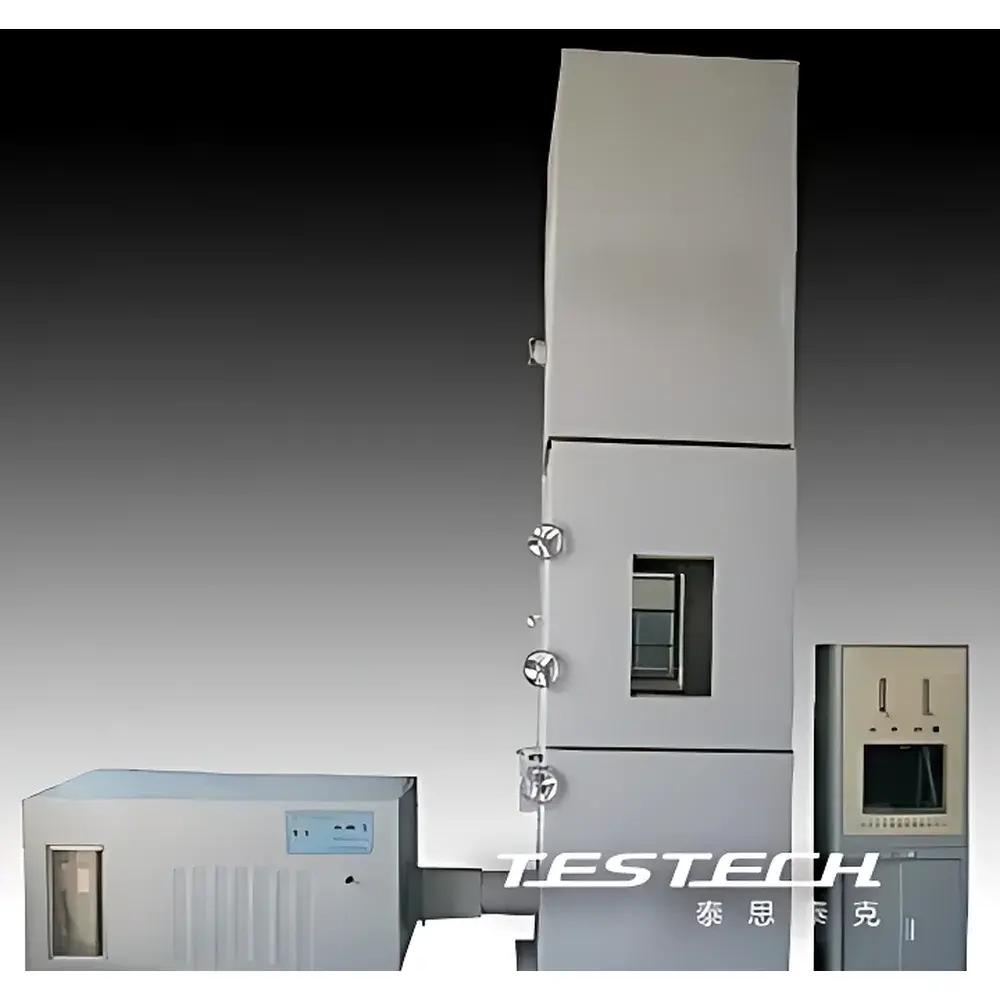
TESTech TTech-GBT8625 Non-Combustibility Test Furnace for Building Materials
| Brand | TESTech |
|---|---|
| Model | TTech-GBT8625 |
| Compliance | GB/T 8625–2005 |
| Dimensions (L×W×H) | 1020 mm × 1020 mm × 3930 mm |
| Combustion Chamber Internal Volume | 800 mm × 800 mm × 2000 mm |
| Air Supply | Ø200 mm duct, constant-rate ambient air |
| Temperature Measurement | Type K armored thermocouples (Class II, Ø ≤ 3 mm, wire diameter 0.5 mm), accuracy ±1 °C |
| Pressure Sensing | Differential pressure transmitter, Class 0.5 |
| Gas Flow Control | Methane & air mass flow meters, accuracy ≥ Class 2.5, range 0.25–2.5 m³/h |
| Control System | PLC + HMI touchscreen interface |
| Data Acquisition | Automated real-time logging, report generation, remote printing capability |
| Structural Material | Stainless steel (corrosion-resistant construction throughout) |
| Exhaust System | High-capacity axial fan with post-test purge cycle |
| Ignition | High-voltage automatic ignition system |
| Air Stabilization | Stainless steel frame with wire mesh base and multi-layer glass fiber mat |
| Flue Cross-section | 500 mm × 500 mm square duct |
| Power Requirement | AC 220 V ±10%, 50 Hz, 3.5 kVA |
Overview
The TESTech TTech-GBT8625 Non-Combustibility Test Furnace is a precision-engineered vertical combustion test apparatus designed to evaluate the non-combustibility performance of building materials in strict accordance with the Chinese national standard GB/T 8625–2005, “Test Method for Non-Combustibility of Building Materials.” This furnace implements a standardized vertical tube furnace configuration where specimens are subjected to controlled, sustained thermal exposure under defined airflow, fuel (methane), and temperature conditions. The test principle relies on quantifying material behavior—including temperature rise, flame propagation, mass loss, and residual incandescence—under prescribed thermal stress. Unlike flammability or fire propagation tests, non-combustibility assessment determines whether a material contributes to fire growth when exposed to intense radiant and convective heat. Results inform classification per GB 8624 (China’s fire performance grading system) and support regulatory submissions for architectural product certification, third-party quality assurance, and fire safety compliance documentation.
Key Features
- Stainless steel structural framework and combustion chamber components ensure long-term resistance to high-temperature oxidation and acidic combustion byproducts.
- Vertically oriented furnace geometry (3930 mm total height) enables realistic simulation of upward flame travel and thermal stratification consistent with real-world building fire dynamics.
- Integrated air stabilization module—comprising a stainless steel frame, wire mesh support, and multi-layer glass fiber mat—delivers uniform airflow distribution beneath the burner, critical for reproducible flame geometry and heat flux.
- High-precision instrumentation suite includes Class II Type K armored thermocouples (≤3 mm outer diameter), Class 0.5 differential pressure transmitters, and certified mass flow meters (Class 2.5 or better) for methane and combustion air.
- PLC-based control system with industrial touchscreen HMI provides deterministic sequencing of preheat, ignition, exposure, and cooldown phases; all operational parameters are logged with timestamped metadata.
- Automated data acquisition captures real-time temperature profiles at multiple spatial locations (including furnace wall, combustion zone, and exhaust), pressure differentials across the test zone, and gas flow rates—enabling full traceability and audit readiness.
- Post-test forced-air exhaust system rapidly clears residual gases and particulates, enhancing lab safety and enabling rapid turnaround between sequential tests.
Sample Compatibility & Compliance
The TTech-GBT8625 accommodates rigid and semi-rigid building material specimens up to 800 mm × 800 mm × 2000 mm in dimension, including insulation boards, ceiling tiles, partition panels, cladding substrates, and firestop mortars. Specimens are mounted vertically on a stainless steel support frame within the defined combustion chamber volume. The system fully satisfies the physical, thermal, and procedural requirements of GB/T 8625–2005, including minimum furnace temperature ramp rate (≥30 °C/min), stabilized exposure temperature (750 ± 5 °C), and mandatory observation windows for visual assessment of flaming, glowing, and structural integrity. While primarily aligned with Chinese national standards, the furnace’s metrological rigor, documented uncertainty budgets, and automated data handling support cross-referencing with ISO 1182 (Non-combustibility tests for building products) and ASTM E136 (Standard Test Method for Behavior of Materials in a Vertical Tube Furnace at 750 °C), facilitating international equivalency assessments.
Software & Data Management
Data acquisition and reporting are managed via an embedded Windows-based software platform interfaced directly with the PLC controller. All sensor inputs—including thermocouple readings, pressure differentials, and gas flow rates—are sampled at ≥1 Hz and time-stamped with microsecond resolution. Raw datasets are stored in CSV and proprietary binary formats, with optional encryption for GLP/GMP environments. The system generates compliant test reports containing: specimen identification, environmental conditions (ambient temperature/humidity), calibration certificates for all primary sensors, annotated temperature vs. time curves, pass/fail determination per GB/T 8625–2005 Clause 7, and digital signatures for operator and reviewer. Audit trails record all user actions, parameter modifications, and system events in accordance with 21 CFR Part 11 principles. Remote printing and secure network export (via Ethernet or USB) enable integration into centralized LIMS or QMS platforms.
Applications
- Classification testing of mineral wool, calcium silicate, cement-bonded particleboard, and other inorganic insulations for GB 8624 Class A1 (non-combustible) certification.
- Quality control verification for manufacturers supplying fire-rated assemblies to construction contractors and specifiers.
- Regulatory validation by provincial and municipal market supervision bureaus (formerly AQSIQ) for product registration and type approval.
- Research and development of novel fire-retardant composites, where iterative furnace testing informs formulation optimization and thermal stability benchmarking.
- Third-party laboratory accreditation (e.g., CNAS, CMA) requiring demonstrable measurement traceability, equipment validation records, and SOP-aligned operation.
FAQ
What standards does the TTech-GBT8625 furnace comply with?
It is engineered and validated exclusively for GB/T 8625–2005. Its design and instrumentation also permit technical alignment with ISO 1182 and ASTM E136 for comparative analysis.
Is methane the only approved fuel gas?
Yes—GB/T 8625–2005 mandates commercial-grade methane (≥95% purity) as the sole fuel source to ensure consistent calorific value and flame characteristics.
Can test data be exported for external analysis?
All raw and processed data are exportable in CSV, PDF, and XML formats; API-level integration with enterprise LIMS is supported via Modbus TCP or OPC UA upon request.
What maintenance intervals are recommended for long-term accuracy?
Thermocouple calibration is required before each test series; flow meters and pressure transmitters must undergo annual third-party recalibration with NIST-traceable standards.
Does the system include fire suppression capability?
No—per standard practice, fire suppression is handled externally using Class BC dry chemical extinguishers, as specified in the user manual and required by GB/T 8625–2005 Annex B.



