
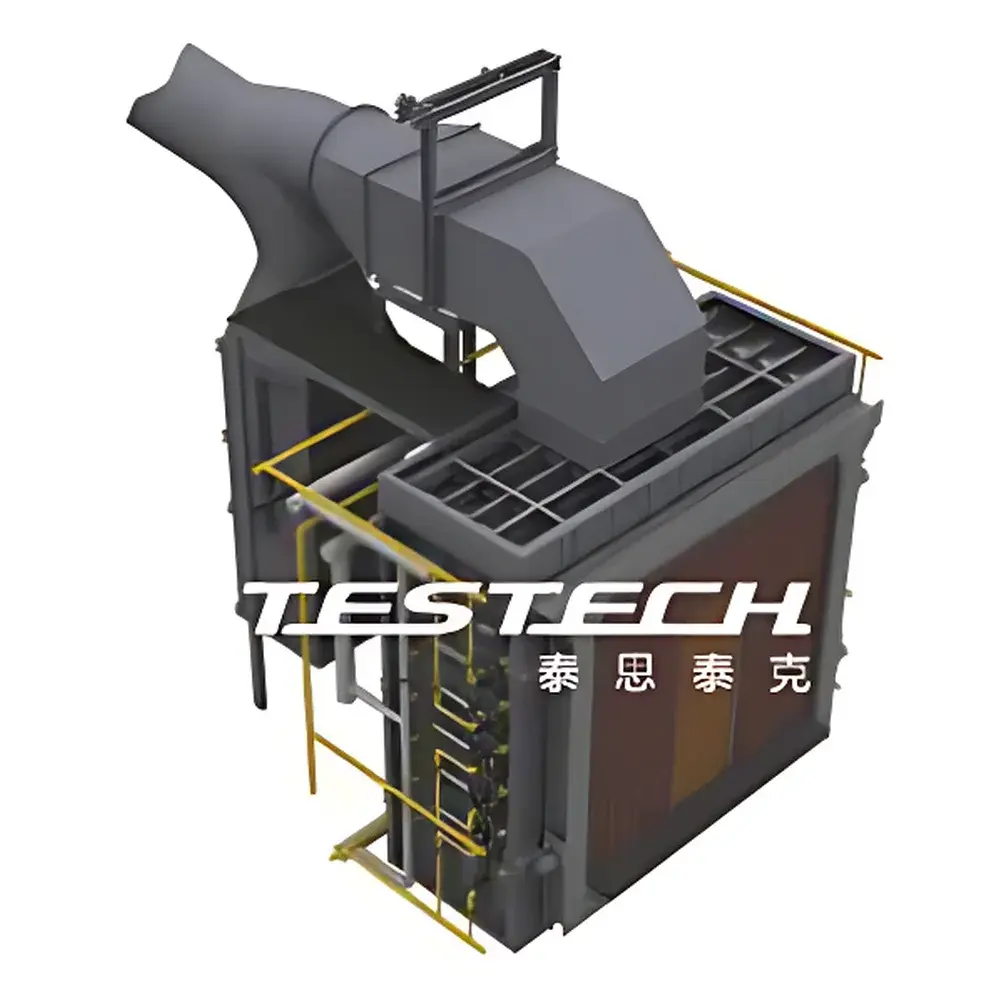
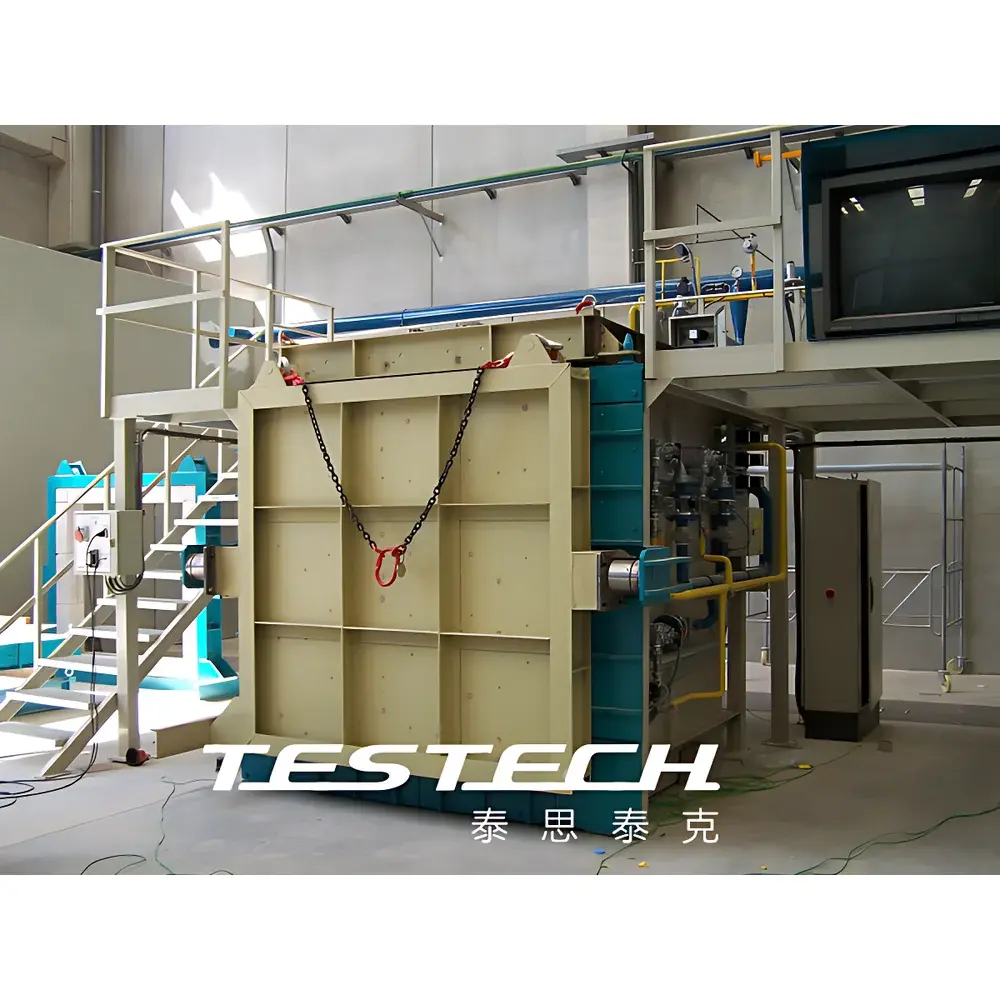
TESTech TTech-GB9978A Vertical Furnace for Fire Resistance Testing per EN 1363-1, ISO 834 & GB 9978
| Brand | TESTech |
|---|---|
| Origin | Jiangsu, China |
| Manufacturer Type | Direct Manufacturer |
| Model | TTech-GB9978A |
| Compliance | EN 1363-1, EN 1363-2 (Hydrocarbon Curve), ISO 834, GB 9978 |
| Internal Chamber Dimensions | 3000 mm (W) × 3000 mm (H) × 1300 mm (D) |
| Max Operating Temperature | 1250 °C |
| Combustion System | 12 LP Gas Luminous Flame Burners with Flame Supervision |
| Control System | Siemens PLC + Custom Fire Test Data Management Software |
| Data Acquisition | 240-channel, 21-bit resolution, 0.005% FS accuracy, RS485 interface |
| Observation Ports | 4 × heat-resistant quartz glass, air-cooled, field-adjustable positioning |
| Pressure Control | 3 motorized, water-cooled stainless steel dampers |
| Structural Frame | Low-carbon steel housing reinforced with C-channel and I-beam supports |
| Refractory Lining | 1400°C-rated insulating bricks, castable refractory blocks, slag wool boards, and high-density 42% alumina bricks in critical zones |
| Sample Mounting | Dual-frame vertical specimen support system with hydraulic/lifting trolley integration |
| Cooling Interface | Air-cooled observation port shutters, water-cooled damper shafts and thermocouple protection tubes |
| Safety Architecture | Hardwired interlock system with dedicated indicator lamps, audible alarm, fail-safe shutdown logic, and independent manual ignition sequence |
Overview
The TESTech TTech-GB9978A Vertical Furnace is a fully engineered fire resistance testing system designed to evaluate the structural integrity, thermal insulation, and flame barrier performance of building elements under standardized time–temperature exposure conditions. It operates on the principle of controlled hydrocarbon-fueled combustion to replicate the thermal profile defined in EN 1363-1 (General Requirements), EN 1363-2 (Hydrocarbon Curve), ISO 834 (Fire Resistance Tests — Elements of Building Construction), and China’s national standard GB 9978. The furnace subjects vertically mounted specimens—including load-bearing walls, fire doors, penetration seals, curtain wall assemblies, and structural connectors—to sustained heating up to 1250 °C, while monitoring critical functional criteria: load-bearing capacity (R), integrity (E), and insulation (I), as codified in EN 13501-2 and ISO 834-1. Its chamber geometry, refractory architecture, and dynamic pressure regulation are calibrated to ensure uniform thermal distribution and reproducible boundary conditions across test durations up to 240 minutes—meeting the spatial and thermal homogeneity requirements specified in Annex A of EN 1363-1.
Key Features
- Robust structural frame fabricated from low-carbon steel plates, reinforced with C-channel and I-beam members to resist thermal deformation during prolonged high-temperature operation.
- Multi-layer refractory lining system comprising 1400°C-rated insulating bricks, monolithic castable refractory blocks, slag wool boards, and 42% dense alumina bricks in high-stress zones—validated for stability over 6-hour continuous exposure at peak temperature.
- Twelve independently monitored LP gas luminous flame burners (6 per side), each equipped with flame rod detection, auto-ignition sequencing, and fail-safe gas shutoff—compliant with BS 476 Parts 20–24 and IMO hydrocarbon curve timing protocols.
- Three motorized, water-cooled stainless steel dampers integrated into vertical exhaust ducts; provide precise combustion chamber pressure control within ±5 Pa tolerance, enabling stable flame anchoring and repeatable heat flux profiles.
- Four air-cooled observation ports with heat-resistant quartz glass windows, strategically positioned along the longer furnace wall for full-field visual assessment of specimen behavior—including crack propagation, charring depth, and flame-through events—without compromising thermal integrity.
- Dual-path data acquisition architecture: primary real-time logging via Siemens PLC with embedded HMI, plus redundant storage on a secondary networked workstation—ensuring audit-ready traceability per ISO/IEC 17025 and GLP-compliant record retention.
Sample Compatibility & Compliance
The TTech-GB9978A accommodates full-scale vertical specimens up to 3000 mm in height and 3000 mm in width, including non-load-bearing partitions, fire-rated doors with frames, service penetration systems (e.g., cable trays, pipe sleeves), and façade anchorage assemblies. Specimen mounting utilizes a dual-frame stainless steel support structure—comprising a fixed front frame secured by four pneumatic door clamps and a rear lifting trolley with dual side hooks—enabling safe insertion and alignment without mechanical stress. All thermocouple placements (9 K-type sensors in rear wall, 1 plate-type sensor, and ambient reference) conform to EN 1363-1 Clause 6.2 and ISO 834-1 Annex B. Pressure tap locations (4 total, T-junction nickel-iron alloy tubing) satisfy EN 1363-1 Section 6.3. The furnace’s thermal uniformity profile has been verified per EN 1363-1 Annex A, demonstrating ≤±15 °C deviation across the central 70% test zone at all prescribed time points (e.g., 30, 60, 90 min). Certification documentation includes factory calibration reports for all thermocouples, pressure transducers, and data acquisition modules—traceable to NIM (China National Institute of Metrology).
Software & Data Management
The integrated fire test data management software—developed in accordance with IEC 62443-3-3 and aligned with FDA 21 CFR Part 11 principles—supports configurable test templates for EN 1363, ISO 834, GB 9978, and custom hydrocarbon curves. It provides real-time visualization of temperature gradients, pressure differentials, burner status, and specimen thermography inputs (when coupled with optional IR camera integration). All acquired parameters—including 240-channel analog inputs (±5 mV to ±5 V range), cold-junction compensation (±0.1 °C absolute), and timestamped event logs—are stored with digital signatures, user authentication, and immutable audit trails. Data export complies with ASTM E1317 and ISO/IEC 17025 reporting formats (CSV, PDF, XML). The system supports remote access via secure VLAN, enabling concurrent monitoring by QA personnel, third-party auditors, or certification bodies without local workstation dependency.
Applications
This furnace serves laboratories accredited to ISO/IEC 17025 and engaged in fire performance certification for construction products under CE marking (EU Construction Products Regulation No. 305/2011), CCC certification (China Compulsory Certification), and UL/ASTM recognition pathways. Typical applications include: qualification testing of fire-resistance-rated glazing systems; validation of intumescent sealants in dynamic joint configurations; evaluation of composite wall panels under combined thermal-mechanical loading; verification of firestop systems for electrical conduit penetrations; and R&D benchmarking of novel insulation materials against ISO 834-based failure thresholds. Its modular transport design—disassembled into trailer-compatible sections with pre-aligned refractory linings—facilitates installation in ISO Class 6 cleanroom-adjacent test halls or industrial-scale fire labs meeting NFPA 80 and EN 1366-1 spatial requirements.
FAQ
What standards does the TTech-GB9978A furnace explicitly comply with?
It meets the physical configuration, instrumentation, and procedural requirements of EN 1363-1, EN 1363-2 (hydrocarbon curve), ISO 834-1, and GB 9978-2008—including mandatory thermocouple placement, pressure monitoring, and chamber dimension tolerances.
Can the furnace be configured for horizontal specimen testing?
No—the TTech-GB9978A is engineered exclusively for vertical orientation per EN 1363-1 Annex C; horizontal testing requires a separate furnace model (e.g., TTech-GB9978H) with modified support framing and flame vector alignment.
Is the data acquisition system compliant with FDA 21 CFR Part 11?
Yes—the software implements electronic signatures, role-based access control, audit trail generation, and data immutability features validated per Part 11 Subpart B, supporting regulated environments in pharmaceutical facility construction or medical device infrastructure testing.
What maintenance intervals are recommended for refractory components?
Refractory inspection is required after every 50 test cycles or annually—whichever occurs first—with replacement of castable blocks and slag wool boards advised after 200 cycles or visible spalling/cracking exceeding 3 mm depth.
Does TESTech provide installation supervision and IQ/OQ documentation?
Yes—factory-trained engineers perform on-site commissioning, including thermocouple calibration verification, pressure loop validation, burner tuning, and full operational qualification (OQ) protocol execution, delivering GMP-aligned IQ/OQ binders upon project closeout.



