
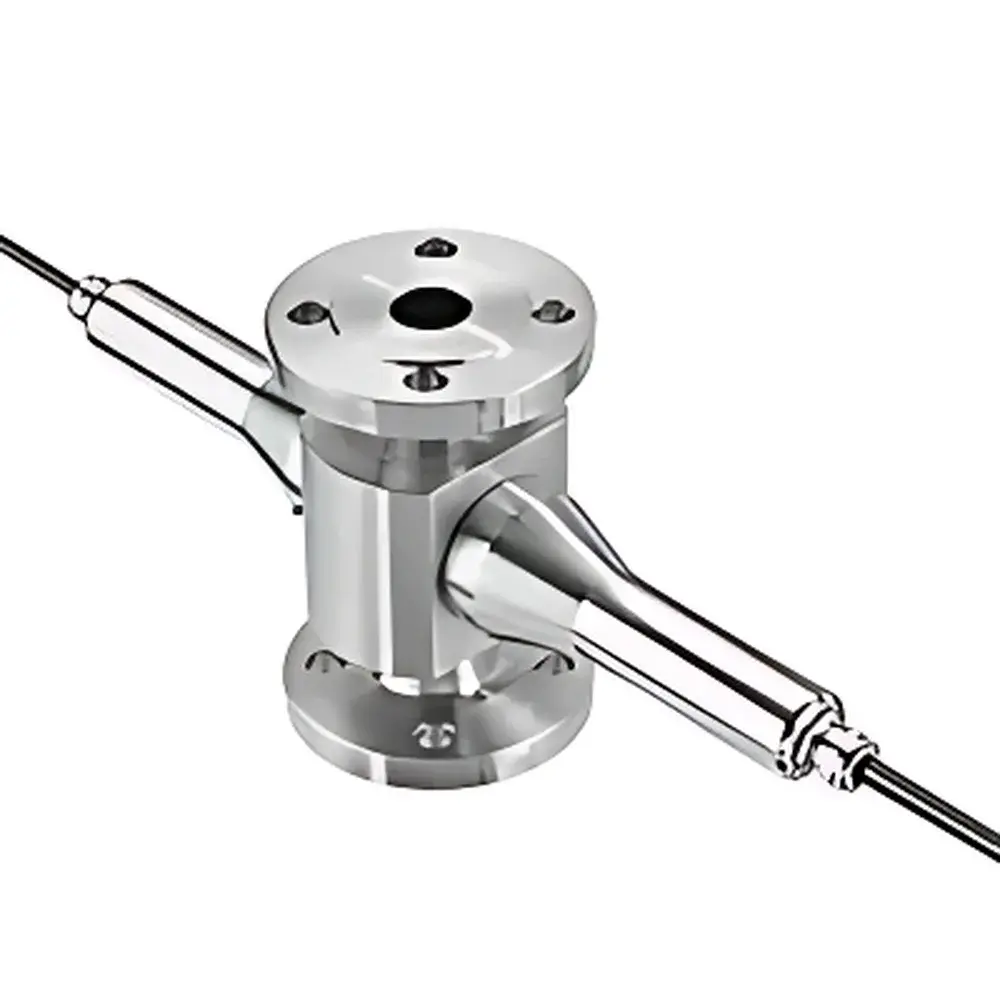
METTLER TOLEDO InPro8400 Series Turbidimeter (12° Forward Scatter / Direct Transmission)
| Brand | METTLER TOLEDO |
|---|---|
| Origin | Switzerland |
| Model | InPro8400 |
| Measurement Principle | 12° forward scatter + direct transmission |
| Optical Window Material | Sapphire |
| Wetted Materials | Stainless steel (316L), sapphire, FDA-compliant polymer gasket |
| Process Connections | DIN, ANSI, APV, NPT, milk union, Tuchenhagen Varivent, Neumo BioControl, Tri-Clamp |
| Pressure Rating | 1–16 bar (14.5–232 psi) |
| Particle Detection Threshold | ≥ 0.3 µm |
| Calibration Units | FTU, EBC, ppm, g/L |
| CIP-Compatible | Yes |
| Compliance | FDA 21 CFR Part 11 ready (with appropriate software configuration), meets ISO 7027 and ASTM D6506 requirements for turbidity measurement |
Overview
The METTLER TOLEDO InPro8400 Series is an in-line turbidimeter engineered for continuous, high-reliability turbidity monitoring in hygienic and demanding industrial process environments. It employs a dual-signal optical architecture combining 12° forward scatter detection with simultaneous direct transmission measurement — a method validated under ISO 7027 and aligned with ASTM D6506 for low-turbidity applications. This dual-channel approach enables real-time compensation for color interference and absorbance effects, significantly improving measurement fidelity in colored or semi-transparent liquids such as wort, beer, fruit juices, pharmaceutical buffers, and purified water streams. Unlike single-beam nephelometric systems, the InPro8400’s co-aligned optical path ensures intrinsic correlation between scatter and attenuation signals, minimizing drift caused by fouling, aging LEDs, or variable sample chromaticity. Its sapphire optical window — chemically inert, scratch-resistant, and thermally stable — sustains metrological integrity across repeated CIP/SIP cycles and exposure to aggressive cleaning agents (e.g., NaOH, HNO₃, peracetic acid). Designed for permanent installation in sanitary piping networks, the sensor operates without moving parts or consumables, delivering long-term stability with minimal recalibration frequency.
Key Features
- 12° forward scatter geometry optimized for detection of particles ≥ 0.3 µm — ideal for clarity verification post-filtration and emulsion break detection
- Dual-signal acquisition (scatter + transmission) enables automatic color compensation and eliminates false-high readings in yellow/brown liquids
- Sapphire optical interface rated for continuous operation up to 16 bar and temperatures up to 130 °C (depending on housing variant)
- Pre-calibrated at factory using traceable standards in application-relevant units: FTU (Formazin Turbidity Units), EBC (European Brewery Convention), ppm silica, or g/L suspended solids
- Hygienic wetted materials compliant with FDA 21 CFR §177.2420 and EC 1935/2004; surface finish Ra ≤ 0.8 µm on all process-contact stainless steel (316L)
- Supports multiple sanitary mounting interfaces including DIN 11851, ASME BPE, Tri-Clamp®, APV, and Neumo BioControl weld ends
Sample Compatibility & Compliance
The InPro8400 is validated for use in liquid-phase applications where particulate load, color intensity, and chemical aggressiveness challenge conventional turbidity sensors. It is routinely deployed in brewing (beer bright tank monitoring), dairy (cream separation validation), biopharmaceutical manufacturing (sterile filtration integrity checks), and municipal water treatment (coagulation/flocculation control). The sensor conforms to ISO 7027:2016 for instrumental turbidity measurement methodology and supports GLP/GMP data integrity when integrated with METTLER TOLEDO’s LabX or iC software platforms. Its construction meets ASME BPE-2022 surface finish and material traceability requirements, and its pressure containment design satisfies PED 2014/68/EU Category II classification for fluid service up to 16 bar.
Software & Data Management
When connected to METTLER TOLEDO’s iC Software or LabX platform, the InPro8400 provides full audit trail functionality compliant with FDA 21 CFR Part 11 — including electronic signatures, user access levels, change history logging, and secure data export (CSV, PDF, XML). Real-time analog outputs (4–20 mA, 0–10 V) and digital interfaces (HART, Profibus PA, Foundation Fieldbus, Modbus TCP) enable seamless integration into DCS, SCADA, and MES systems. Calibration events, diagnostic logs (e.g., LED intensity decay, window soiling index), and alarm thresholds (e.g., high turbidity deviation, signal loss) are time-stamped and stored with metadata for regulatory review.
Applications
- Final filter integrity verification in bioprocess skids and aseptic filling lines
- Real-time clarity assessment during beer lagering and cold stabilization
- Detection of oil-in-water emulsions in dairy processing and edible oil refining
- Monitoring of activated carbon breakthrough in pharmaceutical water-for-injection (WFI) loops
- Quantitative suspension concentration tracking in crystallization and centrifugation control loops
FAQ
What turbidity range is the InPro8400 optimized for?
It delivers highest accuracy in the 0.01–400 FTU range, with enhanced resolution below 1 FTU due to low-noise photodetector design and scatter/transmission ratio algorithms.
Can the sensor be cleaned in place (CIP)?
Yes — its sapphire window and electropolished 316L body withstand standard caustic (1–2% NaOH at 80–90 °C) and acidic (1% HNO₃ or 0.5% phosphoric acid) CIP cycles without performance degradation.
Is calibration traceable to national standards?
Factory calibration uses NIST-traceable Formazin and AMCO AEPA standards; end-user verification kits (e.g., StablCal® suspensions) support routine performance qualification per USP and EP 2.2.2.
Does it require periodic lamp replacement?
No — the InPro8400 uses solid-state LED illumination with >50,000-hour lifetime; intensity is continuously monitored and compensated in firmware.
How is signal drift from window fouling mitigated?
The dual-signal algorithm detects disproportionate attenuation relative to scatter response, triggering a soiling alert and applying dynamic correction based on historical baseline tracking.





