
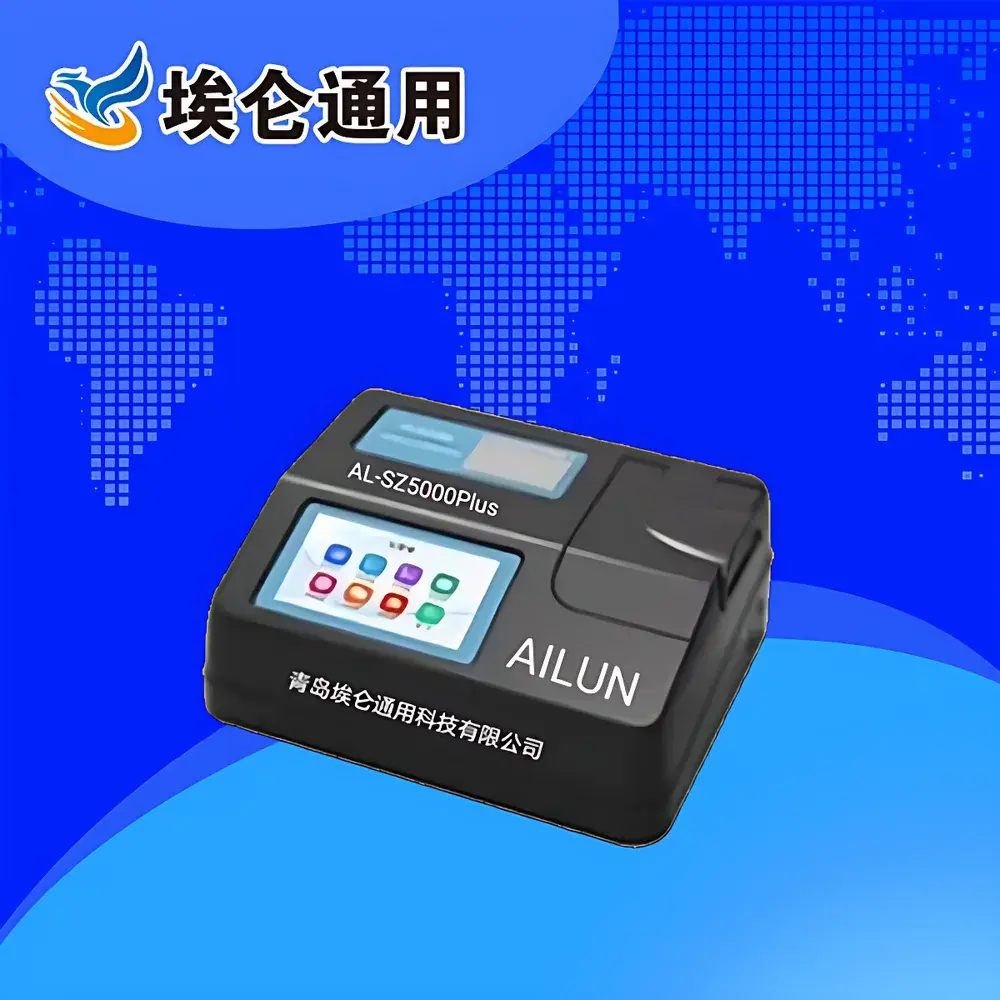
Ailun AL-SZ5000Plus Intelligent Multi-Parameter Water Quality Analyzer
| Brand | Ailun |
|---|---|
| Origin | Shandong, China |
| Model | AL-SZ5000Plus |
| Detection Parameters | COD, Ammonia Nitrogen, Total Phosphorus, Total Nitrogen, Turbidity |
| Measurement Range | COD 5–10,000 mg/L |
| Wavelength Range | 340–900 nm |
| Optical Bandwidth | 4 nm |
| Wavelength Accuracy | ±1 nm |
| Display | 7-inch color LCD touchscreen |
| Data Storage | Up to 1,000,000 measurement records |
| Pre-stored Calibration Curves | 280 standard + 50 user-fittable curves |
| Photometric System | Fiber-optic detection architecture |
| Light Source | Imported 12 V / 20 W halogen lamp (≥100,000 h lifetime) |
| Detection Modes | Rotating 360° cuvette holder (pre-filled reagent vials) + dual-channel automatic cuvette loader (powder/solid reagents) |
| Repeatability | ≤±2% |
| Accuracy | ≤±5% |
| Inter-channel Error | ≤±2% |
| Digestion Unit | Integrated 16-position heating block compliant with HJ/T 399–2007 |
Overview
The Ailun AL-SZ5000Plus Intelligent Multi-Parameter Water Quality Analyzer is a laboratory-grade spectrophotometric platform engineered for precise, standardized quantification of key water quality indicators in environmental and industrial compliance testing. It operates on the principle of visible and near-UV absorbance spectroscopy (340–900 nm), utilizing fixed-wavelength and programmable multi-point calibration to determine analyte concentrations via established colorimetric reaction chemistries—including Nesslerization for ammonia nitrogen (HJ 535–2009), ammonium molybdate reduction for total phosphorus (GB 11893–1989), and rapid digestion–spectrophotometry for chemical oxygen demand (HJ/T 399–2007). Its dual-detection architecture—comprising a motorized 360° rotating cuvette carousel for pre-filled reagent vials and a synchronized dual-channel cuvette loader for solid/powder reagents—enables high-throughput, operator-independent analysis across heterogeneous sample matrices including surface water, groundwater, municipal wastewater, and industrial effluents.
Key Features
- Fiber-optic photometric system with ±1 nm wavelength accuracy and 4 nm spectral bandwidth, ensuring high photometric reproducibility and long-term signal stability.
- 7-inch capacitive color touchscreen interface with context-sensitive, icon-guided workflow navigation—designed for intuitive operation without specialized training.
- Dual-path optical detection: Channel 1 supports standardized 16 mm round vials (pre-packaged reagent kits); Channel 2 accommodates 10 mm square cuvettes with solid-phase reagents, minimizing cross-contamination risk.
- Integrated 16-position digestion block compliant with HJ/T 399–2007 thermal profiles (e.g., 165 °C for 15 min), enabling fully automated COD digestion prior to measurement.
- Onboard calibration management: auto-zero, auto-blank, and multi-point standard curve validation with real-time residual error reporting.
- Robust data governance: 1,000,000-record internal storage with timestamp, operator ID, method ID, and raw absorbance values; exportable via USB or RS-232 to LIMS or Excel-compatible formats.
- Pre-loaded analytical methods: 280 factory-validated calibration curves aligned with Chinese EPA standards (HJ/GB series), plus 50 editable user-defined curves supporting custom assay development.
Sample Compatibility & Compliance
The AL-SZ5000Plus is validated for use with clarified, filtered, or centrifuged aqueous samples meeting standard pretreatment requirements per HJ 493–2009 (water sampling techniques) and HJ 494–2009 (sample preservation). It supports direct analysis of COD (5–10,000 mg/L), ammonia nitrogen (0.01–150 mg/L), total phosphorus (0.01–100 mg/L), total nitrogen (0.01–100 mg/L), and turbidity (0.5–2500 NTU) without dilution in most routine applications. All optical and thermal protocols comply with national standard methodologies referenced in its firmware—ensuring traceability and audit readiness for GLP-aligned environmental laboratories. While not certified to ISO/IEC 17025 out-of-box, the instrument’s documented uncertainty budget, calibration log retention, and audit-trail-capable software support formal accreditation preparation under CNAS or equivalent frameworks.
Software & Data Management
The embedded operating system provides full method lifecycle control: users may import, modify, rename, or delete calibration curves; assign unique method IDs; and lock critical parameters to prevent unauthorized changes. Each measurement record includes acquisition time, digestion temperature/duration, blank correction status, and deviation from reference curve (R² ≥ 0.999 typical). Data export supports CSV and PDF report generation with embedded QA/QC flags (e.g., “outlier detected”, “calibration expired”). USB mass storage mode allows direct file transfer to external drives; RS-232 enables integration with centralized SCADA or laboratory information management systems (LIMS). No cloud dependency or proprietary software installation is required—the unit functions autonomously with complete local data sovereignty.
Applications
- Regulatory monitoring of municipal wastewater treatment plants (WWTPs) for daily COD/NH₃-N/TP discharge compliance per GB 18918–2002.
- Industrial effluent screening in electroplating, pharmaceutical, food processing, and textile sectors where heavy metals (via optional add-on modules) and nutrient loading require verification.
- Environmental field labs conducting ambient water quality assessment across river basins, reservoirs, and groundwater wells—particularly where rapid turnaround of TN/TP ratios informs eutrophication risk modeling.
- Educational laboratories performing standardized APHA/AWWA/WEF Method 4500-series experiments with full traceability to Chinese national standards.
- Third-party testing organizations preparing reports for environmental impact assessments (EIAs) requiring auditable, repeatable photometric data.
FAQ
Does the AL-SZ5000Plus meet international metrological requirements such as ISO 8466 or US EPA Method 410.4?
It implements core photometric principles aligned with ISO 8466–1:2020 (calibration function validation) and incorporates key performance criteria from US EPA Method 410.4 (turbidity) and 365.4 (phosphorus), though formal method equivalency requires site-specific validation per local regulatory authority.
Can the instrument be used for drinking water analysis per GB 5749–2022?
Yes—when configured with appropriate low-range calibration curves and verified using certified reference materials (CRMs) traceable to NIM (National Institute of Metrology, China), it supports all required parameters except microbiological indicators.
Is remote firmware update supported?
Firmware updates are performed locally via USB drive; no internet connectivity or remote access capability is implemented, preserving data integrity and network security in regulated environments.
What maintenance intervals are recommended for the halogen light source and optical path?
The 12 V / 20 W halogen lamp is rated for ≥100,000 hours; optical alignment verification is advised annually or after 10,000 measurements, using the built-in self-diagnostic routine and NIST-traceable neutral density filters.
Are reagent kits supplied by Ailun certified to GB/T 27404–2008 (laboratory quality control)?
All factory-supplied reagent kits include batch-specific CoA documents listing purity, shelf-life, and CRM-based potency verification—fully compatible with GB/T 27404–2008 internal quality control requirements.







