
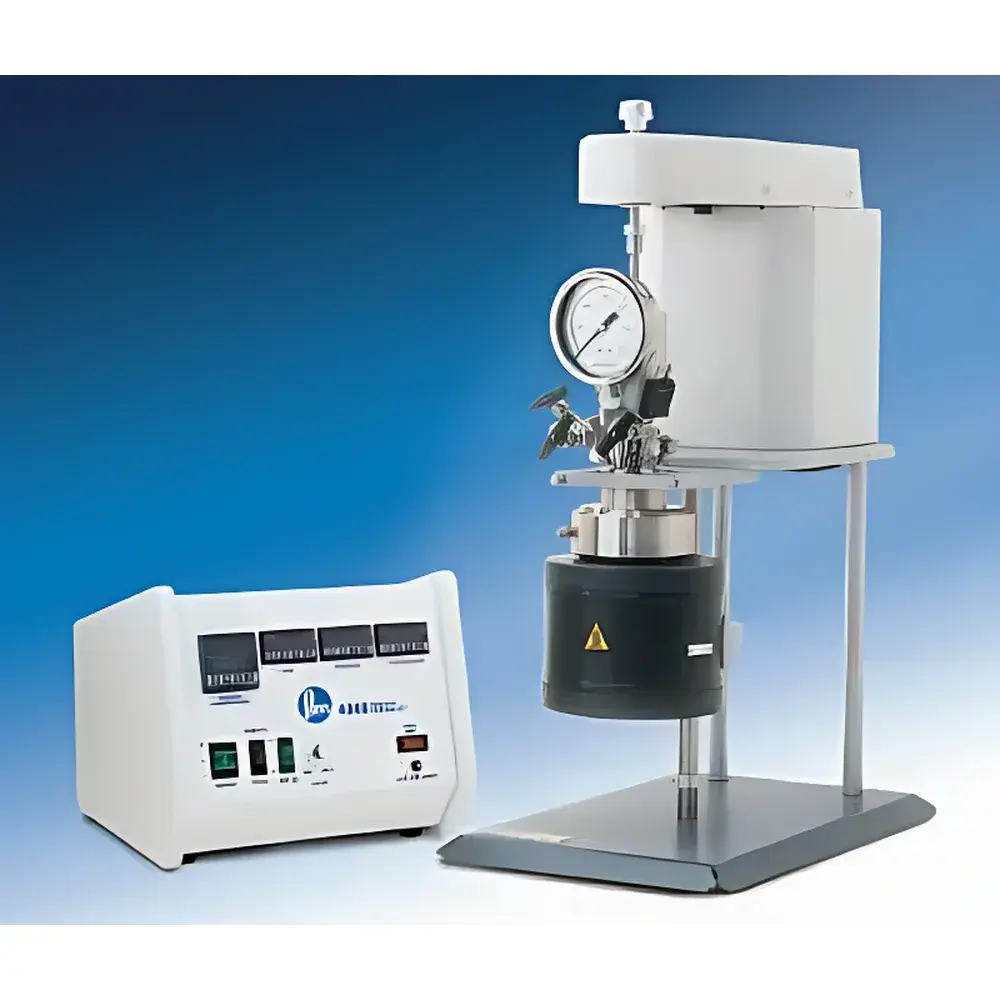
PARR 4560 Series Pressure Stirred Autoclave Reactor
| Brand | PARR |
|---|---|
| Origin | USA |
| Model | 4560 Pressure Stirred Autoclave |
| Volume Range | 100–600 mL (Models 4561–4568) |
| Max Operating Pressure | 200 bar |
| Max Operating Temperature | 225–350 °C |
| Configuration | Benchtop Miniature Autoclave System |
| Certification | ASME BPVC Section VIII Div. 1 Compliant Vessels |
| Drive Type | Magnetically Coupled or Mechanical Seal Stirring Assembly |
Overview
The PARR 4560 Series Pressure Stirred Autoclave Reactor is an engineered benchtop system designed for safe, reproducible, and scalable high-pressure/high-temperature chemical synthesis, catalytic testing, hydrogenation, oxidation, polymerization, and materials precursor development. Built upon PARR’s decades-long heritage in reaction engineering, the 4560 platform employs a robust thick-walled alloy steel pressure vessel (typically ASTM A105 or Inconel 625-lined configurations), precision-machined sealing surfaces, and dual-certified rupture disc + pressure relief valve safety architecture. Its core operational principle relies on controlled isothermal or programmed thermal ramping within a hermetically sealed environment, while maintaining continuous agitation via either magnetic coupling (for lower-torque applications) or mechanical shaft seal (for viscous or particulate-laden media). This ensures homogeneous mass and heat transfer—critical for kinetic studies, catalyst deactivation profiling, and phase behavior investigations under non-ambient conditions.
Key Features
- Benchtop footprint with integrated digital controller (PID temperature regulation, real-time pressure monitoring, stir speed control, and programmable ramp/soak profiles)
- ASME BPVC Section VIII Div. 1 certified pressure vessels; full traceability of material test reports (MTRs) and hydrostatic test certificates provided
- Modular design supporting interchangeable reactor inserts (e.g., Hastelloy C-276 liners, quartz view ports, gas dispersion spargers, thermocouple wells)
- Stirring systems rated up to 1200 rpm with torque compensation across temperature and viscosity gradients
- Dual independent safety layers: calibrated rupture disc (set point ±1% tolerance) plus spring-loaded relief valve with manual reset and leak-tight reseating verification
- Optional add-ons include online gas chromatography (GC) sampling valves, automated liquid injection modules, and corrosion-resistant pH/ORP probes with mineral-insulated (MI) cable feedthroughs
Sample Compatibility & Compliance
The 4560 series accommodates heterogeneous slurries, multiphase emulsions, solid-catalyzed reactions, and supercritical fluid media without compromising seal integrity or measurement fidelity. Vessel linings (e.g., Teflon®-lined, glass-lined, or refractory metal-clad) mitigate corrosion from halogenated solvents, strong acids (HF, HCl), or alkaline melts. All standard configurations comply with OSHA 1910.119 Process Safety Management (PSM) requirements for laboratory-scale hazardous process equipment. Data acquisition logs meet FDA 21 CFR Part 11 audit trail criteria when paired with PARR’s optional validated software package (PARRView v5.2+), including electronic signatures, user access levels, and immutable timestamped event records.
Software & Data Management
PARRView software provides closed-loop control over temperature, pressure, stirring rate, and gas flow (when interfaced with mass flow controllers). Real-time trending displays synchronized parameter overlays (e.g., exotherm onset vs. pressure rise), with export options to CSV, MATLAB (.mat), or ASTM E1447-compliant XML formats. The system supports GLP/GMP-aligned workflows through configurable validation protocols (IQ/OQ/PQ templates included), electronic batch records, and automated report generation with embedded metadata (operator ID, calibration status, environmental chamber readings). Remote monitoring via secure HTTPS interface enables off-site supervision during extended reaction runs (e.g., overnight hydrogenations).
Applications
- Kinetic modeling of Fischer–Tropsch synthesis under syngas (H₂/CO) atmospheres at 20–50 bar and 250–320 °C
- Hydrothermal carbonization of biomass feedstocks in subcritical water (200–300 °C, 80–150 bar)
- Development of MOF precursors via solvothermal crystallization (DMF, ethanol, NMP solvents)
- Catalyst screening for asymmetric epoxidation using Ti-SBA-15 under O₂ pressure
- Corrosion testing of candidate alloys in simulated geothermal brines (NaCl/CaCl₂/KCl mixtures at 250 °C, 120 bar)
- Supercritical CO₂-assisted nanoparticle precipitation (scCO₂ + organic solvent mixtures)
FAQ
What pressure and temperature ratings apply to Model 4565 versus Model 4568?
Model 4565 (300 mL) is rated to 200 bar / 350 °C with Inconel 625 cladding; Model 4568 (600 mL) maintains identical pressure rating but has a reduced max temperature limit of 300 °C due to wall thickness-to-volume scaling constraints.
Can the 4560 series be configured for corrosive halogen chemistry?
Yes—standard offerings include Monel 400 or Hastelloy C-276 vessel bodies, fluoropolymer-coated stirrers, and perfluoroelastomer (FFKM) primary seals rated for continuous exposure to Cl₂, Br₂, or HF-containing media.
Is third-party calibration certification available for pressure transducers and RTDs?
All factory-installed sensors ship with NIST-traceable calibration certificates; optional annual recalibration services include ISO/IEC 17025-accredited documentation.
How is stirring torque maintained across the full temperature range?
The magnetically coupled drive uses high-coercivity NdFeB magnets with Curie-point derating curves; mechanical drives employ graphite-filled PTFE bushings with thermal expansion compensation to preserve axial alignment from −20 °C to 350 °C.
Does PARR support integration with external analytical instrumentation?
Yes—the rear panel includes IEEE-488 (GPIB), RS-485 Modbus RTU, and Ethernet/IP interfaces for seamless synchronization with FTIR, Raman spectrometers, or micro-GC systems.



