
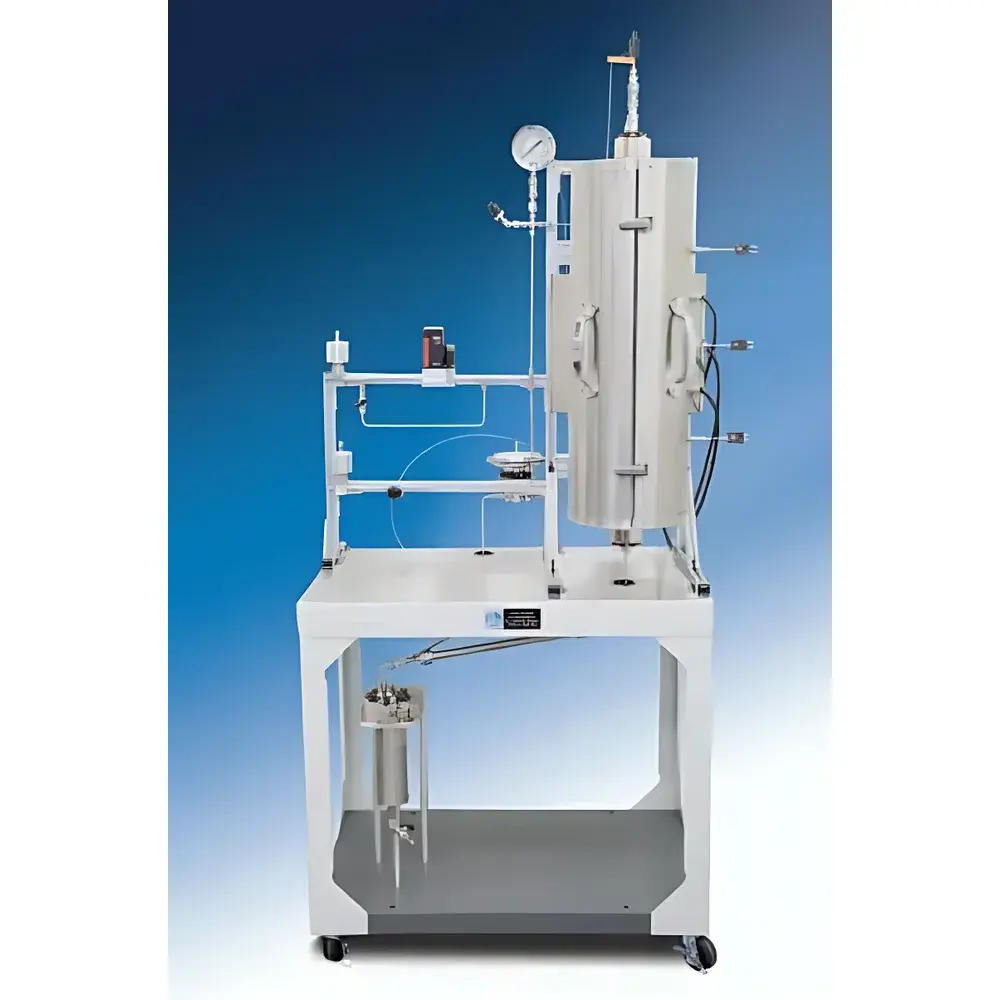
PARR Tube-Type Microreactor
| Brand | PARR |
|---|---|
| Origin | USA |
| Manufacturer Status | Authorized Distributor |
| Product Origin | Imported |
| Quotation | Upon Request |
| Sample Volume Capacity | Microscale |
| Construction Material | Stainless Steel |
| Operating Pressure | High-Pressure |
Overview
The PARR Tube-Type Microreactor is a precision-engineered high-pressure catalytic reaction system designed for laboratory-scale process development and kinetic investigation under rigorously controlled conditions. Based on the fundamental principles of heterogeneous catalysis and fixed-bed reactor hydrodynamics, this microreactor enables accurate simulation of industrial continuous-flow processes—including hydrogenation, dehydrogenation, oxidation-reduction, hydrocracking, and hydrorefining—within a compact, stainless-steel tubular architecture. Its design adheres to ASME BPVC Section VIII Div. 1 pressure vessel standards, supporting safe operation at elevated pressures typical of petrochemical, pharmaceutical, and specialty chemical R&D workflows. Unlike batch reactors, the tube-type configuration facilitates plug-flow behavior, minimizes axial dispersion, and ensures reproducible residence time distribution—critical parameters for mechanistic studies and scale-up modeling.
Key Features
- High-pressure stainless-steel reactor tube (typically 316 SS or alloy C-276 options), rated for operation up to 10,000 psi (690 bar) depending on configuration and temperature
- Integrated thermocouple wells and pressure transducers for real-time monitoring of axial temperature profiles and system pressure
- Modular gas/liquid feed system with mass flow controllers (MFCs), back-pressure regulators (BPRs), and automated valve sequencing
- Fixed-bed catalyst loading capability with standardized quartz or ceramic frits, enabling precise catalyst bed geometry and void fraction control
- Computer-controlled operation via optional PARR Reactor Control Software (RCS), supporting programmable ramp/soak temperature profiles, pressure setpoints, and multi-step gas switching protocols
- Compatible with both downflow and upflow configurations, allowing evaluation of catalyst wetting, liquid holdup, and trickle-bed hydrodynamics
Sample Compatibility & Compliance
The PARR Tube-Type Microreactor accommodates solid catalysts (e.g., supported metals, zeolites, metal oxides), liquid reagents (including corrosive organics and aqueous solutions), and gaseous reactants (H₂, O₂, CO, NH₃, syngas, etc.) in true multiphase reaction environments. It supports ASTM D3241 (jet fuel thermal oxidation stability), ISO 10101 (catalyst activity testing), and USP method validation frameworks when integrated with validated analytical interfaces (e.g., online GC or FTIR). The system’s mechanical integrity and material compatibility meet FDA 21 CFR Part 11 requirements for electronic record retention when paired with audit-trail-enabled software modules. All wetted components comply with EP/USP Class VI biocompatibility standards where applicable.
Software & Data Management
The optional PARR Reactor Control Software (RCS) provides deterministic I/O handling, real-time data logging at configurable intervals (down to 100 ms), and synchronized acquisition from up to 16 analog/digital channels—including temperature, pressure, flow rates, and reactor effluent composition (when interfaced with GC/FID or MS). Data files are stored in vendor-neutral CSV and HDF5 formats, supporting traceability, version-controlled experiment replication, and integration into LIMS or ELN platforms. RCS includes built-in calculation modules for space velocity (LHSV/GHSV), conversion yield, selectivity, and apparent activation energy via Arrhenius analysis—enabling rapid generation of kinetic datasets compliant with GLP and GMP documentation practices.
Applications
- Kinetic modeling of Fischer–Tropsch synthesis, ammonia decomposition, and selective hydrogenation of alkynes to alkenes
- Accelerated catalyst screening for hydrotreating catalysts used in diesel desulfurization (HDS) and denitrogenation (HDN)
- Process intensification studies for continuous-flow pharmaceutical API synthesis under PAT (Process Analytical Technology) guidance
- Thermal stability assessment of biomass-derived feedstocks under simulated refinery conditions
- Development of carbon capture and utilization (CCU) catalysts for CO₂ hydrogenation to methanol or formic acid
- Corrosion-resistant reaction studies involving halogenated compounds or sulfur-rich streams in polymerization-grade monomer purification
FAQ
What is the standard internal diameter and length of the reactor tube?
Standard configurations include 1/4″ OD × 0.049″ wall tubing (ID ≈ 3.2 mm) with active lengths of 100–300 mm; custom dimensions are available upon engineering review.
Can the system be operated under vacuum prior to pressurization?
Yes—integrated vacuum purge capability allows for inert gas purging and residual moisture/oxygen removal prior to high-pressure operation.
Is remote monitoring and control supported?
RCS supports Ethernet-based remote access with role-based user authentication and encrypted data transmission, compliant with enterprise IT security policies.
Does PARR provide validation documentation for IQ/OQ/PQ protocols?
Factory-issued IQ/OQ documentation packages—including calibration certificates, material test reports (MTRs), and pressure test records—are available for GxP-regulated environments.
How is catalyst loading and unloading performed without compromising reactor integrity?
A patented quick-disconnect flange system with metal-sealed gaskets enables repeatable catalyst charging and recovery while maintaining ASME pressure boundary compliance across >500 thermal cycles.



