
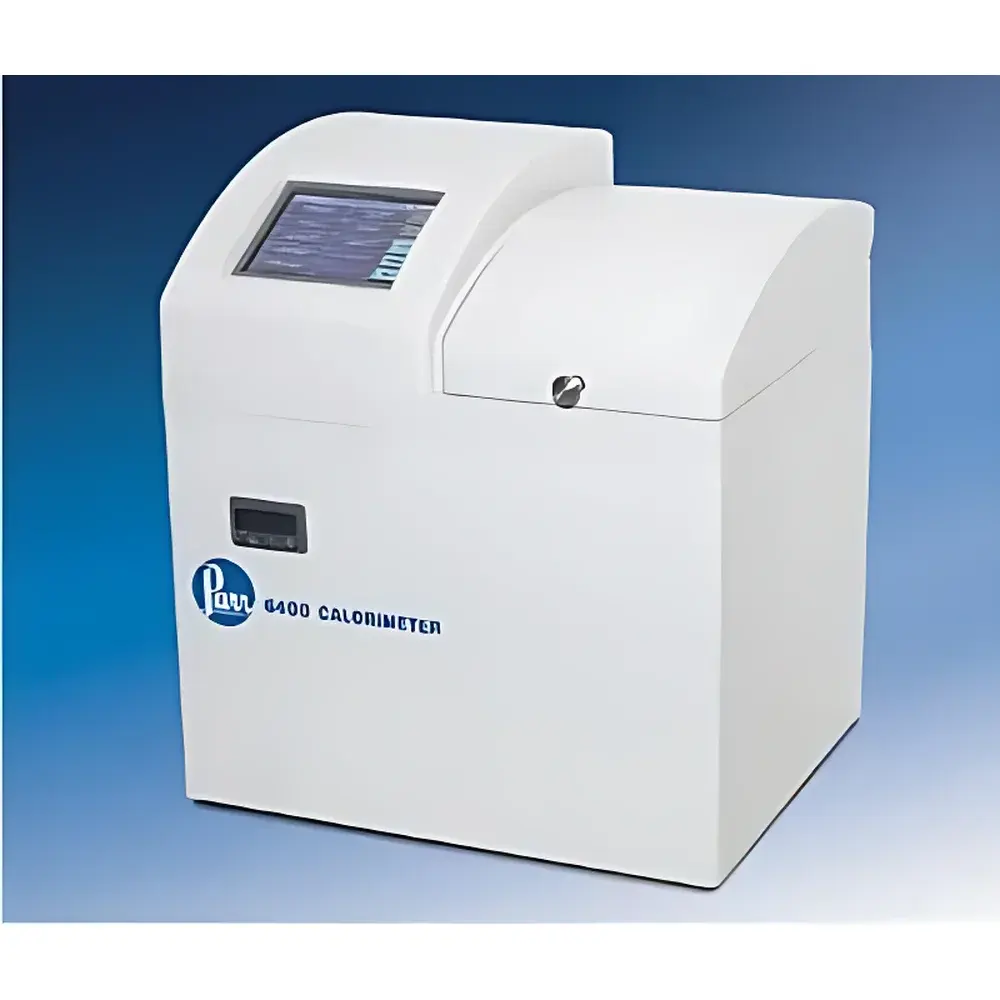
Parr 6400 Automated Isoperibol Bomb Calorimeter
| Brand | Parr |
|---|---|
| Origin | USA |
| Manufacturer Status | Authorized Distributor |
| Product Origin | Imported |
| Model | 6400 |
| Price | Upon Request |
Overview
The Parr 6400 Automated Isoperibol Bomb Calorimeter is a high-precision, fully automated instrument engineered for the accurate determination of gross calorific value (higher heating value, HHV) of solid and liquid combustible materials. Based on the principle of isoperibol calorimetry—where the outer jacket temperature is actively maintained at a constant setpoint while the inner water bath absorbs heat from the combustion reaction—the system delivers exceptional thermal stability and measurement reproducibility. Designed and manufactured in the USA by Parr Instrument Company, a pioneer in commercial bomb calorimetry since 1920 and holder of U.S. Patent No. 4,925,315, the 6400 represents over a century of refinement in combustion thermometry. Its robust architecture meets stringent international requirements for energy content analysis in quality control, regulatory compliance, and R&D environments across fuel, chemical, agricultural, and defense sectors.
Key Features
- Fully automated operation: integrated oxygen filling, ignition, pressure release, bomb rinsing, and data reporting—minimizing operator intervention and human error.
- Isoperibol configuration with active jacket temperature control via dual-mode (heating/cooling) circulation system, ensuring thermal equilibrium prior to and during combustion.
- High-pressure stainless-steel bomb rated to 200 atm (20.3 MPa), with 250 mL internal volume and quick-action bayonet closure—eliminating threaded sealing risks and enabling rapid, repeatable sealing integrity.
- Ultra-high temperature resolution of 0.0001 °C, supported by precision platinum resistance thermometers (PRTs) traceable to NIST standards.
- Microprocessor-based control system running a real-time Linux OS (Parr’s 5th-generation firmware), delivering deterministic response, audit-ready logging, and field-upgradable functionality via SD card interface.
- Automated thermal corrections for ignition wire, nitric acid formation (from atmospheric nitrogen), sulfur oxidation, and residual carbon-hydrogen combustion—calculating HHV, LHV (lower heating value), and bomb calorific value per ASTM D240, D5865, and ISO 1928.
- Integrated interfaces: RS-232/USB for balance auto-input (sample mass), parallel/serial printer output, Ethernet connectivity for LIMS or SCADA integration, and optional 21 CFR Part 11-compliant software modules.
Sample Compatibility & Compliance
The Parr 6400 accommodates heterogeneous samples ranging from pulverized coal and petroleum coke to liquid hydrocarbons (diesel, jet fuel, crude oil), biomass pellets, animal feed, explosives, and municipal waste. Its 33,000 J (8,000 cal) maximum heat capacity supports high-energy-density materials without thermal saturation. The system complies with globally recognized test methods including ASTM D240, D4809, D5468, D5865, E711; ISO 1928, ISO 9831; DIN 51900; BS 1016-5; and GJB 770B. It is certified to CE (EMC Directive 89/336/EEC, Low Voltage Directive 73/23/EEC), PED 97/23/EC for pressure equipment, CSA C22.2 No. 1010.1, and holds China’s National Metrology Type Approval Certificate. Manufacturing adheres to ISO 9001:2000 (TÜV-certified).
Software & Data Management
The embedded control software provides intuitive touchscreen navigation (10.4″ LCD), dual operational modes (rapid dynamic and equilibrium-based measurement), and configurable report templates compliant with GLP/GMP documentation requirements. All raw sensor data—including time-stamped temperature profiles, pressure traces, and calibration coefficients—are stored locally (1,000-test capacity) with automatic timestamping and user ID tagging. Export formats include CSV, XML, and PDF. Optional software packages support 21 CFR Part 11 electronic signatures, audit trails, role-based access control, and secure remote diagnostics. Data integrity is reinforced through cyclic redundancy checks (CRC) and write-once archival options.
Applications
Primary applications span energy content certification in fossil fuels (coal, coke, bunker fuel), alternative energy feedstocks (biodiesel, pyrolysis oil), and regulated waste streams (TCLP-compliant landfill assessment). In food and agriculture, it quantifies metabolizable energy in feeds per AOAC and ISO 9831. Defense laboratories use it for propellant and explosive energetics characterization under MIL-STD-170E. Cement and construction material producers apply it to determine calorific contributions of alternative fuels in kiln co-processing. Academic and metrology institutes rely on its repeatability (±0.1% RSD) for reference material certification and interlaboratory comparison studies.
FAQ
What distinguishes isoperibol from adiabatic calorimetry in the Parr 6400?
The 6400 uses an isoperibol design: the outer jacket temperature is precisely held constant, while the inner water bath temperature rises during combustion. This eliminates the need for complex adiabatic correction algorithms and improves long-term stability in variable ambient conditions.
Does the system support unattended overnight operation?
Yes—fully automated sample loading (with optional autosampler), oxygen charging, combustion, cleaning, and data export enable batch processing of up to 48 samples with minimal supervision.
How is calibration traceability maintained?
Certified benzoic acid (NIST SRM 39j or equivalent) is used for energy equivalence calibration. The system records all calibration events—including date, operator, standard lot number, and correction factor—with immutable digital logs.
Can the Parr 6400 be integrated into a centralized laboratory information management system (LIMS)?
Yes—via native Ethernet TCP/IP protocol or optional OPC UA gateway, supporting structured data exchange including sample ID, HHV result, uncertainty budget, and QC flag status.
What maintenance protocols are recommended for sustained accuracy?
Quarterly verification using certified reference materials, annual PRT calibration against a master thermometer, and biannual inspection of O-rings, ignition circuit resistance, and bomb valve actuation timing—documented per ISO/IEC 17025 internal audit checklist.




