
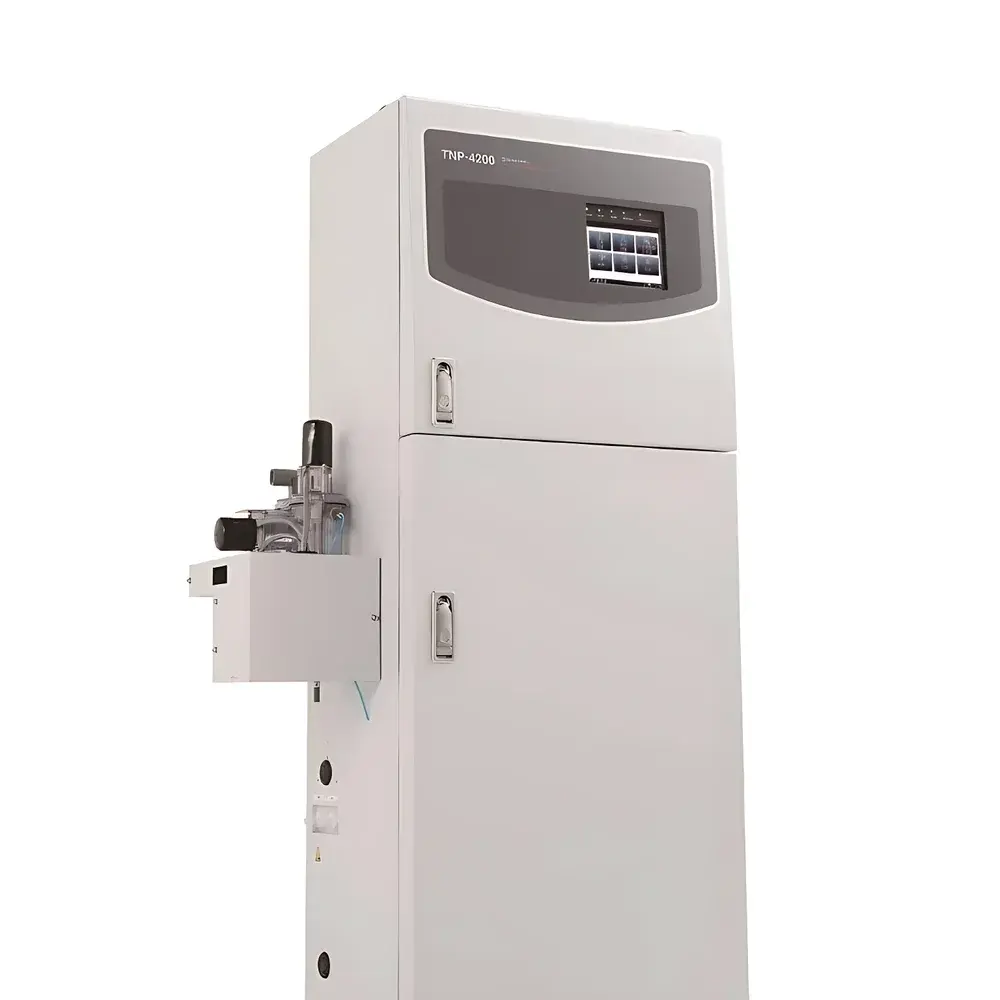
Shimadzu TNP-4200 Online Total Nitrogen and Total Phosphorus Analyzer
| Brand | Shimadzu |
|---|---|
| Origin | Jiangsu, China |
| Manufacturer Type | Manufacturer |
| Product Category | Domestic |
| Model | TNP-4200 |
| Measurement Parameters | Total Nitrogen (TN), Total Phosphorus (TP) |
| Instrument Type | Online Analyzer |
| Measurement Principle | Alkaline Potassium Persulfate UV Oxidation – UV Absorbance (TN) |
| Detection Range | TN: 0–2 / 5 / 10 / 20 / 50 / 100 / 200 mg N/L |
| TP | 0–0.5 / 1 / 2 / 5 / 10 / 20 / 50 / 100 mg P/L |
| Cycle Time | 60 min (simultaneous TN & TP) |
| Power Consumption | ≤300 VA (AC 100–240 V, 50/60 Hz) |
| Operating Environment | Indoor use only |
| Sample Pretreatment | High-speed rotary homogenizer with auto backwash filter |
| Auto-Cleaning | Scheduled distilled water flush of fluidic pathways |
| Auto-Calibration | Dual-point (zero & span) using standard solutions |
Overview
The Shimadzu TNP-4200 is an online, dual-parameter analyzer engineered for continuous, unattended monitoring of total nitrogen (TN) and total phosphorus (TP) in natural waters, wastewater effluents, and industrial process streams. Designed specifically to meet the operational and regulatory demands of China’s water quality management framework, the TNP-4200 implements two standardized wet-chemical oxidation–detection methodologies compliant with HJ 636–2012 (for TN) and HJ 671–2013 (for TP). Total nitrogen quantification employs alkaline potassium persulfate digestion under UV irradiation followed by dual-wavelength (220 nm and 275 nm) UV absorbance measurement—enabling correction for nitrate interference and ensuring high specificity. Total phosphorus determination utilizes acidified potassium persulfate UV oxidation, followed by molybdenum blue colorimetric detection at 880 nm. This principle-based architecture delivers analytical rigor aligned with national environmental monitoring protocols and supports long-term data integrity required for regulatory reporting.
Key Features
- Simultaneous TN and TP measurement within a single 60-minute cycle—eliminating sequential analysis delays and improving temporal resolution.
- Energy-optimized design: power consumption reduced by 10% versus predecessor TNP-4110 series, with maximum rated load ≤300 VA.
- Reduced waste generation: 30% lower daily effluent volume compared to prior models—lowering hazardous waste handling frequency and disposal costs.
- Durable ceramic 8-port selection valve engineered for extended service life and resistance to abrasive suspended solids.
- Integrated suspension preprocessor (optional) featuring high-speed rotary homogenization and automatic tap-water backwash filtration—minimizing clogging in turbid or sediment-laden samples.
- Real-time diagnostics: embedded motion sensors in drive mechanisms detect mechanical anomalies early, enabling predictive maintenance and minimizing unplanned downtime.
- Intuitive 7-inch color touchscreen interface—shared architecture with Shimadzu TOC-4200—supporting multilingual prompts, step-by-step guidance, and visual status indicators.
- Enhanced data governance: built-in calendar-based calibration scheduling, USB-host data export (CSV format), and timestamped audit logs compliant with GLP-aligned documentation practices.
Sample Compatibility & Compliance
The TNP-4200 accommodates raw influent, treated effluent, surface water, and recirculating cooling water—with demonstrated robustness across turbidity levels up to 500 NTU when equipped with the suspended-solids preprocessor. It meets key performance requirements outlined in China’s “Technical Specifications for Automatic Monitoring of Water Pollutants” (HJ 353–2019) and supports data traceability under HJ 354–2019 (Acceptance Testing) and HJ 355–2019 (Operational Management). While not certified to ISO/IEC 17025, its method alignment with HJ 636–2012 and HJ 671–2013 ensures metrological comparability with reference laboratory results. The system operates exclusively indoors and requires dedicated grounding per IEC 61000-6-3 (EMC immunity) and GB 4793.1 (safety standards for electrical equipment).
Software & Data Management
Firmware includes embedded calibration management with configurable zero/span intervals, drift compensation algorithms, and automatic reagent depletion alerts. All measurements are time-stamped with internal RTC (real-time clock) and stored locally on non-volatile memory (≥30 days at 1-hr interval). Data export via USB 2.0 supports direct transfer to LIMS or SCADA systems without proprietary drivers. Audit trails record operator actions—including calibration events, maintenance logs, and error resets—with immutable timestamps. Optional RS-232 serial output enables integration into centralized telemetry platforms using Modbus RTU protocol. No cloud connectivity or remote firmware updates are implemented—ensuring data sovereignty and network isolation per industrial cybersecurity best practices.
Applications
- Environmental protection agencies: Continuous emission monitoring (CEMS) at municipal and industrial wastewater discharge points.
- Water utilities: Source water surveillance at intake stations, raw water assessment at drinking water treatment plants, and effluent compliance verification at WWTP outfalls.
- Petrochemical facilities: Real-time tracking of nutrient loading in closed-loop cooling systems to prevent biofouling and corrosion.
- River basin authorities: Long-term trophic state assessment in lakes, reservoirs, and estuaries where eutrophication risk modeling depends on high-frequency TN/TP trends.
- Research institutions: Process evaluation in pilot-scale nutrient removal studies, including denitrification efficiency testing and phosphorus adsorption kinetics under variable hydraulic retention times.
FAQ
Does the TNP-4200 comply with HJ 636–2012 for total nitrogen analysis?
Yes—the instrument implements alkaline potassium persulfate UV oxidation followed by dual-wavelength (220 nm/275 nm) absorbance correction, fully satisfying the instrumental and procedural requirements of HJ 636–2012.
Can the TNP-4200 operate without the suspended-solids preprocessor?
Yes—two configurations are available: one with integrated preprocessor (recommended for rivers, sewage, or turbid sources), and a base model without preprocessor (suitable for clarified effluents or low-turbidity groundwater).
What is the minimum maintenance interval for the ceramic 8-port valve?
Under typical operation (≤100 mg/L suspended solids, 1-hr cycle), valve service is recommended every 12 months; lifetime exceeds 500,000 actuations per port.
Is the instrument compatible with third-party SCADA systems?
Yes—via RS-232 serial interface using Modbus RTU protocol; register mapping documentation is provided in the technical manual.
How is calibration traceability maintained?
Calibration standards must be prepared from NIST-traceable stock solutions (e.g., potassium nitrate for TN, potassium dihydrogen phosphate for TP); all calibration events are logged with operator ID, standard lot numbers, and measured response values.







