
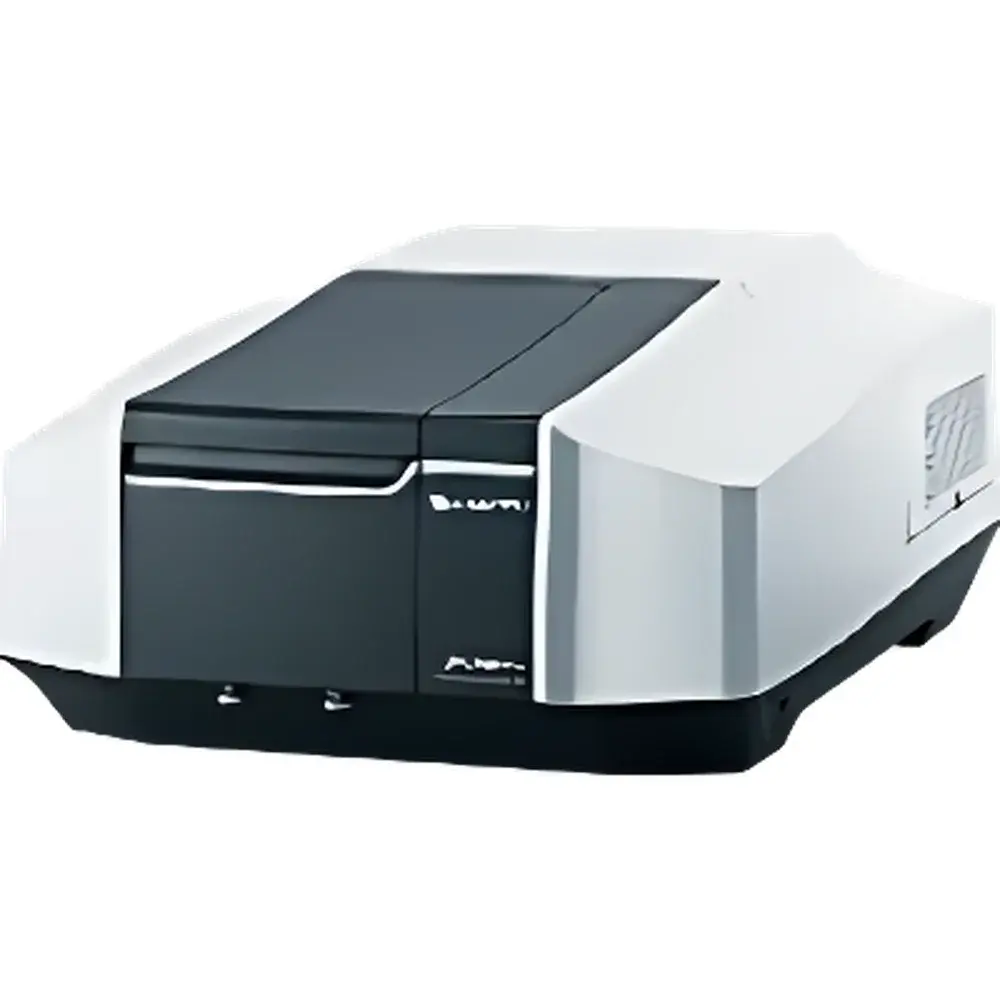
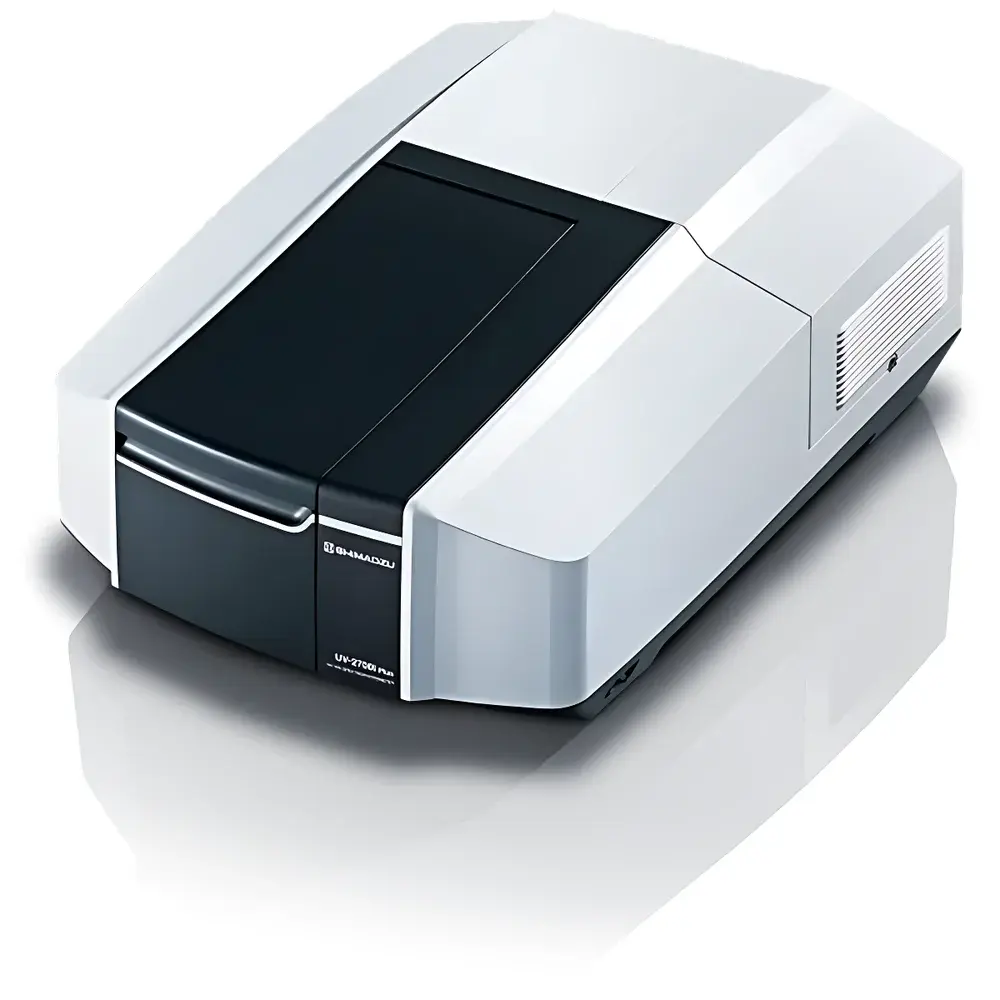
Shimadzu UV-2600i Plus and UV-2700i Plus Ultraviolet-Visible-Near Infrared Spectrophotometers
| Brand | Shimadzu |
|---|---|
| Origin | Japan |
| Manufacturer Type | Original Equipment Manufacturer (OEM) |
| Product Origin | Imported |
| Model | UV-2600i Plus / UV-2700i Plus |
| Optical System | Double-beam |
| Detector | Photomultiplier Tube (PMT) |
| Wavelength Range | 190–1400 nm |
| Wavelength Accuracy | ±0.1 nm |
| Wavelength Repeatability | ±0.02 nm |
| Spectral Bandwidth | Variable (selectable) |
| Stray Light | < 0.005% T |
| Maximum Absorbance Range | UV-2600i Plus — up to 6 Abs |
Overview
The Shimadzu UV-2600i Plus and UV-2700i Plus are high-performance double-beam ultraviolet-visible-near infrared (UV-Vis-NIR) spectrophotometers engineered for precision quantitative and qualitative analysis across academic, pharmaceutical, chemical, and materials science laboratories. Both instruments operate on the principle of Beer–Lambert law-based absorbance measurement, utilizing a stable deuterium/halogen lamp source and optimized optical path design to ensure high photometric accuracy and long-term baseline stability. The UV-2600i Plus employs a single-monochromator architecture with Lo-Ray-Ligh™ holographic gratings, extending reliable spectral acquisition from 190 nm to 1400 nm—enabling routine NIR characterization of polymers, excipients, and biological macromolecules. The UV-2700i Plus integrates a dual-monochromator configuration with cascaded grating optics and advanced stray-light suppression, achieving an extended dynamic absorbance range of up to 8 Absorbance units (Abs) and ultra-low stray light (< 0.005% T), critical for high-concentration sample analysis and trace impurity detection in compliance-driven environments.
Key Features
- Double-beam optical design with real-time reference beam correction ensures high photometric reproducibility and minimizes drift during extended measurements.
- Photomultiplier tube (PMT) detector optimized for UV-Vis sensitivity and signal-to-noise ratio, coupled with low-noise electronics for enhanced detection of minute absorbance differences (e.g., ≤0.001 Abs).
- Variable spectral bandwidth selection (e.g., 0.1, 0.2, 0.5, 1.0, 2.0, 5.0 nm) allows method-specific resolution tuning—balancing sensitivity, throughput, and peak fidelity per application requirements.
- Wavelength accuracy of ±0.1 nm and repeatability of ±0.02 nm meet stringent validation criteria defined in pharmacopeial standards (e.g., USP & EP General Chapter <857>).
- Integrated hardware-level data integrity safeguards—including electronic audit trail, user access control, and operation logging—support compliance with FDA 21 CFR Part 11 and EU Annex 11 for regulated QC/QA workflows.
- Automated spectral evaluation algorithms enable pass/fail classification of spectra against user-defined criteria (e.g., peak shape, λmax shift, baseline flatness), streamlining release testing in GMP environments.
Sample Compatibility & Compliance
These spectrophotometers accommodate standard 10-mm square cuvettes (quartz, glass, or plastic), microvolume cells (down to 50 µL), integrating sphere accessories for diffuse reflectance/transmission, and fiber-optic probes for remote or in-situ measurements. Optional Peltier-controlled temperature modules (–10 °C to +100 °C) support kinetic and thermal stability studies. Instrument qualification documentation (DQ/IQ/OQ/PQ templates), calibration certificates traceable to NIST standards, and full GxP-compliant validation support packages are available. All firmware and software comply with ISO/IEC 17025:2017 requirements for testing and calibration laboratories.
Software & Data Management
Operated via Shimadzu’s LabSolutions UV-Vis software, the systems support automated method execution, multi-point calibration, kinetics, scanning, and quantitative analysis with customizable report generation. Raw spectral data export is natively compatible with ASTM E1421-compliant formats (.jdx, .csv, .txt). Direct Excel integration enables real-time data streaming into preconfigured spreadsheets with embedded VBA macros for automated calculation (e.g., concentration, purity ratios, degradation kinetics). Audit trail records capture operator ID, timestamp, parameter changes, and raw data modifications—retained indefinitely with write-once-read-many (WORM) archiving options.
Applications
- Pharmaceutical QC: Assay determination, dissolution profiling, excipient compatibility screening, and stability-indicating methods per ICH Q5C guidelines.
- Materials science: Bandgap estimation of semiconductors, thin-film thickness calculation via interference fringes, and NIR quantification of moisture content in hygroscopic formulations.
- Environmental analysis: Nitrate/nitrite, phosphate, and heavy metal speciation using colorimetric protocols compliant with EPA Method 353.2 and ISO 15681-1.
- Life sciences: Protein quantification (Bradford/Lowry/BCA), nucleic acid purity assessment (A260/A280), and enzyme kinetics under controlled thermal conditions.
- Academic research: Teaching spectroscopy fundamentals, method development for novel chromophores, and validation of chemometric models using multivariate spectral datasets.
FAQ
What is the difference between the UV-2600i Plus and UV-2700i Plus models?
The UV-2600i Plus uses a single-monochromator design optimized for broad-range UV-Vis-NIR scanning (190–1400 nm) with excellent signal-to-noise performance. The UV-2700i Plus incorporates a dual-monochromator system with enhanced stray-light rejection, enabling accurate measurement up to 8 Abs and improved linearity at high absorbance—ideal for undiluted samples and demanding regulatory applications.
Does the system support 21 CFR Part 11 compliance?
Yes. LabSolutions UV-Vis includes role-based user authentication, electronic signatures, immutable audit trails, and data encryption—all configurable to satisfy FDA 21 CFR Part 11 and EU Annex 11 requirements for electronic records and signatures.
Can I perform kinetic measurements with variable time intervals?
Yes. The software supports programmable time-based scanning with user-defined interval steps (from 0.01 s to hours), enabling precise monitoring of rapid enzymatic reactions or slow degradation processes.
Is NIR calibration included with the 1400 nm extension?
NIR wavelength verification is performed using certified holmium oxide and didymium filters traceable to NIST SRM 2034 and SRM 2035; optional NIR-certified quartz cuvettes and reflectance standards are available for method-specific calibration.
How is instrument performance verified post-installation?
Shimadzu provides factory-installed Performance Qualification (PQ) tests including photometric accuracy (using potassium dichromate), wavelength accuracy, stray light, and baseline flatness—documented in a comprehensive IQ/OQ report signed by a certified field service engineer.
Related Products




