
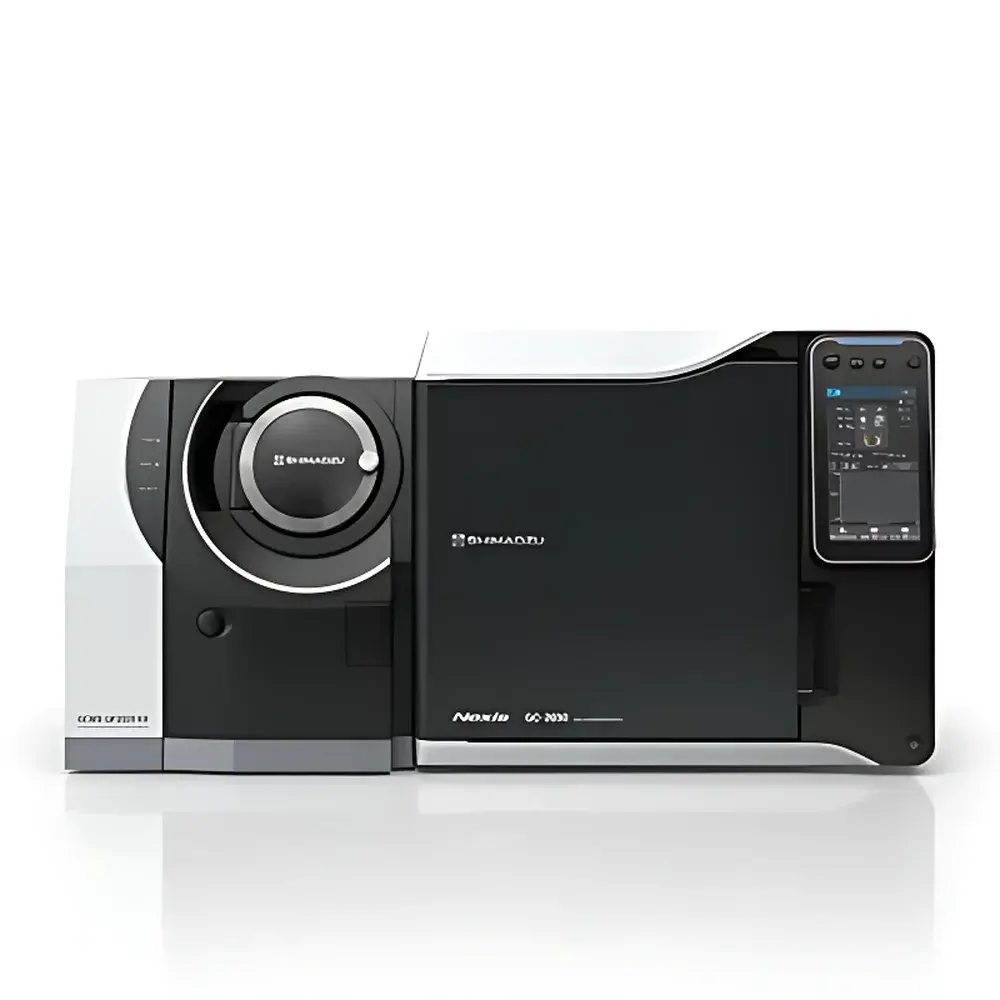
Shimadzu GCMS-QP2020 NX Single Quadrupole Gas Chromatography Mass Spectrometer
| Brand | Shimadzu |
|---|---|
| Origin | Jiangsu, China |
| Manufacturer Type | Original Equipment Manufacturer (OEM) |
| Product Category | Domestic |
| Model | GCMS-QP2020 NX |
| Price Range | USD 110,000 – 205,000 |
| Instrument Type | Single Quadrupole Mass Spectrometer |
| GC Configuration | Conventional GC-MS |
| Mass Range | 1.5–1090 u |
| Resolution | Unit Mass Resolution |
| Sensitivity | >2000:1 (S/N, 1 pg OFN, m/z 272) |
| Scan Speed | 20,000 u/sec |
Overview
The Shimadzu GCMS-QP2020 NX is a high-performance single quadrupole gas chromatography mass spectrometer engineered for robust trace-level analysis of complex matrices in regulated and research laboratories. It operates on electron ionization (EI) and optional chemical ionization (CI) principles, utilizing a radiofrequency-driven metal quadrupole mass analyzer to separate ions based on their mass-to-charge ratio (m/z). Designed for routine and high-throughput applications, the system integrates hardware innovations—including a dual-pump ultra-high-vacuum system, shielded ion source architecture, and Advanced Scanning Speed Protocol (ASSP™)—to deliver exceptional sensitivity, reproducibility, and operational stability across diverse analytical workflows.
Key Features
- Shielded Ion Source with OD Lens Technology: A fully inert, integrated ion source featuring patented shielding plates and an off-axis deflection lens (OD lens) minimizes surface adsorption and suppresses chemical noise from matrix components—enabling S/N ≥ 2000:1 (1 pg octafluoronaphthalene, m/z 272) without source replacement or reconfiguration.
- Dual-Turbopump Vacuum Architecture: Independent 200 L/sec turbomolecular pumps for ion source and quadrupole regions yield a combined differential pumping capacity of 400 L/sec, supporting stable operation under He, H2, or N2 carrier gases and enabling Twin Line MS dual-column configuration without sensitivity loss.
- ASSP™ High-Speed Data Acquisition: Proprietary scanning protocol synchronizes ion transmission efficiency with scan rate, maintaining spectral fidelity and quantitative accuracy at up to 20,000 u/sec—critical for fast-GC, FASST (Scan/SIM simultaneous acquisition), and comprehensive two-dimensional GC×GC/MS applications.
- Rapid System Readiness: Achieves operational vacuum and stable tuning within 30 minutes post-startup, reducing instrument downtime and improving lab throughput.
- Ecology Mode: Automated low-power standby state reduces daily electricity consumption by 36% (vs. legacy systems, assuming 6 h operation / 18 h standby) and lowers CO2 emissions during manufacturing by 70% compared to prior production processes.
Sample Compatibility & Compliance
The GCMS-QP2020 NX accommodates volatile and semi-volatile organic compounds (VOCs/SVOCs) across environmental, food safety, forensic toxicology, pharmaceutical metabolism, and materials science applications. Its compatibility with wide-bore capillary columns (up to 0.53 mm ID) and maximum column flow of 15 mL/min supports large-volume injection (LVI) and purge-and-trap configurations. The system meets ISO/IEC 17025 requirements for testing laboratories and supports full compliance with FDA 21 CFR Part 11, EU Annex 11, and Japan’s MHLW regulatory frameworks through audit-trail-enabled user management, electronic signatures, and configurable security policies in GCMS Insight software.
Software & Data Management
GCMS Insight is a unified, Windows-based platform that streamlines method development, acquisition, processing, and reporting. It includes embedded libraries (NIST, Wiley, Shimadzu Custom Libraries), automated peak deconvolution, retention index matching, and customizable report templates. All data files are stored in secure, timestamped, tamper-evident formats. System suitability checks, calibration tracking, and version-controlled method archiving support GLP/GMP environments. Audit trails record all user actions—including parameter changes, data reprocessing, and report generation—with immutable timestamps and operator identification.
Applications
- Residue analysis of pesticides, veterinary drugs, and mycotoxins in food and agricultural commodities (aligned with AOAC, EN 15662, and USDA methods)
- Targeted and non-targeted screening of persistent organic pollutants (POPs), PAHs, PCBs, and dioxins in soil, water, and air samples per EPA Methods 8270, 8082, and ISO 18073
- Forensic toxicology workflows including drug metabolite identification and quantification in biological fluids (urine, blood)
- Metabolomics profiling and biomarker discovery in clinical and preclinical studies
- Impurity profiling and degradation product characterization in pharmaceutical development (ICH Q2(R2), Q3B)
- Off-gas and leachate analysis for high-performance polymers and advanced battery materials
FAQ
Does the GCMS-QP2020 NX support both EI and CI ionization modes?
Yes—CI source exchange is tool-free and requires less than five minutes; both sources share identical geometry and shielding design for consistent sensitivity and calibration transfer.
Can the system operate with hydrogen carrier gas without compromising vacuum integrity or detector lifetime?
Yes—the dual-turbopump architecture maintains optimal pressure differentials even at elevated H2 flows, and the shielded ion source mitigates hydrogen-induced background noise.
Is Twin Line MS compatible with all Shimadzu GC models?
Twin Line MS functionality requires GC-2010 Plus or GC-2030 with dedicated interface firmware and dual-column oven configuration.
How does Ecology Mode affect analytical performance during transition from standby to active acquisition?
Ecology Mode preserves vacuum integrity and ion source temperature stability; full analytical readiness is achieved within 90 seconds after resuming acquisition.
Are raw data files compliant with long-term archival standards such as PDF/A or ASAM ODS?
While native .qgd files are proprietary, GCMS Insight exports processed results in CSV, XML, and PDF formats meeting ISO 19005-1 (PDF/A-1b); raw data archiving follows internal lab SOPs aligned with ALCOA+ principles.





