
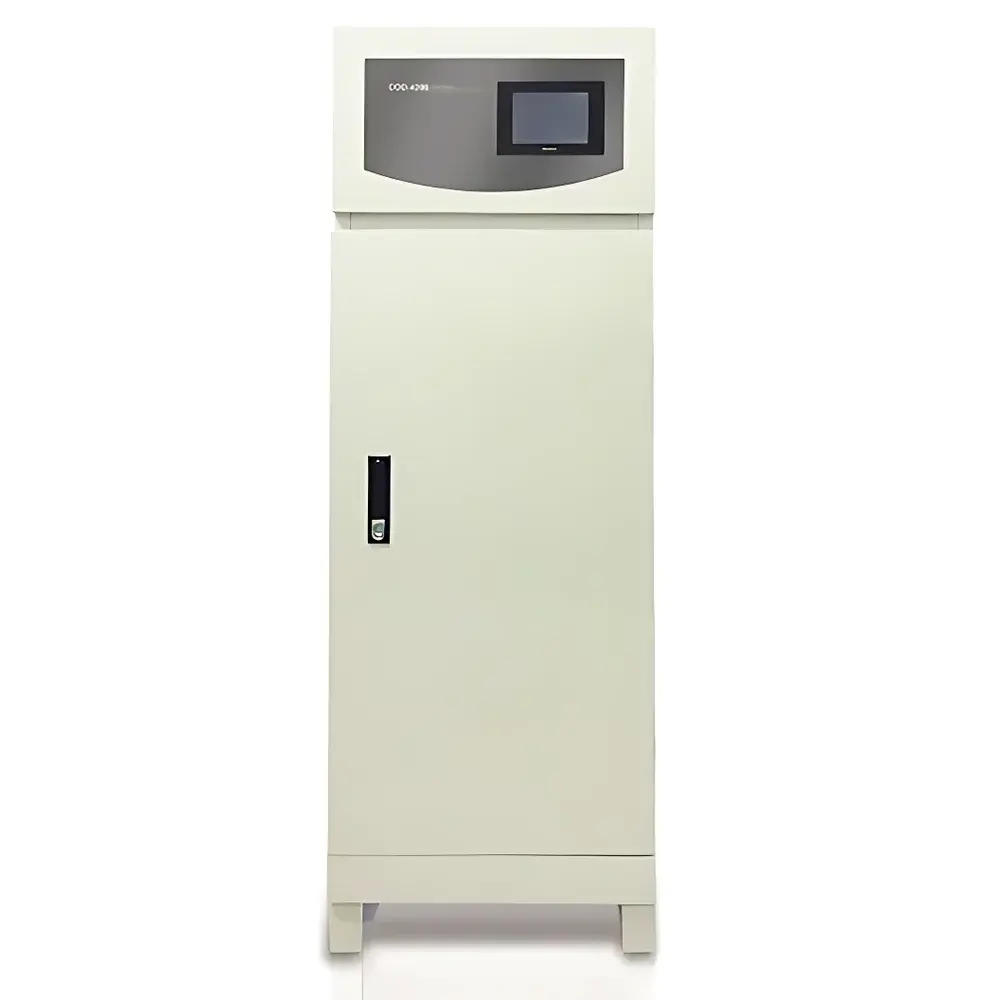
Shimadzu COD-4200 Online Chemical Oxygen Demand Analyzer
| Brand | Shimadzu |
|---|---|
| Origin | Jiangsu, China |
| Manufacturer Type | Original Equipment Manufacturer (OEM) |
| Product Category | Domestic |
| Model | COD-4200 |
| Instrument Type | Online Analyzer |
| Measurement Principle | High-Temperature Potassium Dichromate Digestion with Photometric Detection |
| Standard Range | 30–4000 mg/L COD |
| Accuracy | ±10% at ≥100 mg/L |
| Repeatability | ≤±5% |
| Zero Drift | ±5 mg/L |
| Span Drift | ≤±5% |
| Resolution | <1 mg/L |
| Minimum Measurement Cycle | 20 minutes |
| Calibration Modes | Manual and Automatic |
| Communication Interfaces | RS-232, 4–20 mA (bidirectional) |
| Power Supply | 220 VAC ±10%, 50 Hz ±5% |
| Power Consumption | ~100 VA |
| Dimensions | 500 mm × 420 mm × 1550 mm |
| Weight | ~90 kg |
Overview
The Shimadzu COD-4200 is a fully automated online chemical oxygen demand (COD) analyzer engineered for continuous, unattended monitoring of organic pollution load in wastewater and natural water bodies. It employs the standardized high-temperature potassium dichromate digestion method—aligned with ISO 6060 and EPA Method 410.4—followed by photometric quantification of the reduced Cr(III) species at 600 nm. Unlike discrete lab-based analyzers, the COD-4200 integrates real-time sample conditioning, digestion, colorimetric reaction, and optical detection within a single robust enclosure. Its design emphasizes operational resilience in harsh industrial and municipal environments, featuring corrosion-resistant fluidic pathways, self-cleaning sampling lines to inhibit biofilm or algal growth, and automatic post-measurement reagent purge cycles. The system is built around a programmable logic controller (PLC) architecture, minimizing susceptibility to electromagnetic interference and ensuring deterministic response timing—a critical requirement for regulatory compliance in continuous emission monitoring systems (CEMS).
Key Features
- Integrated auto-purging and pipeline cleaning cycle to suppress biofouling and maintain long-term hydraulic integrity
- Intelligent self-diagnostic subsystem with real-time fault logging, visual/audible alarms, and automatic recovery from power interruption or process anomalies
- Eight-position corrosion-resistant rotary valve manifold enabling precise reagent metering, low carryover, and extended service life under aggressive chemical exposure
- High-temperature digestion chamber (165 °C ± 2 °C) with PID-controlled thermal stability and integrated pressure relief for safe, reproducible oxidation of refractory organics
- Chloride ion tolerance up to 2000 mg/L Cl⁻ without requiring mercury sulfate masking—reducing hazardous waste generation and operator exposure risk
- Modular hardware architecture supporting field-upgradable firmware, remote parameter configuration, and diagnostic data export via embedded web interface
Sample Compatibility & Compliance
The COD-4200 is validated for direct analysis of raw influent, secondary effluent, surface water, and treated discharge streams with suspended solids ≤ 50 mg/L and temperature range 5–40 °C. It meets the functional requirements of China’s HJ 353–2019 standard for online water quality monitoring instruments and is compatible with international QA/QC frameworks including ISO/IEC 17025-accredited laboratories. Its measurement traceability is anchored to NIST-traceable potassium hydrogen phthalate (KHP) standards. The instrument supports audit-ready data logging per GLP/GMP principles, with time-stamped event records for calibration, maintenance, and error conditions. Optional 21 CFR Part 11-compliant software modules are available for regulated pharmaceutical or municipal utility applications requiring electronic signature and data integrity controls.
Software & Data Management
The embedded control software provides dual-mode operation: time-scheduled (e.g., every 20 min, hourly, or on-the-hour) and demand-triggered acquisition. All measurement results, system status flags, and diagnostic codes are timestamped and stored locally for ≥90 days. Data export is supported via RS-232 serial link or analog 4–20 mA output with configurable scaling (e.g., 4 mA = 0 mg/L, 20 mA = 4000 mg/L). Optional Ethernet connectivity enables integration into SCADA platforms using Modbus TCP or OPC UA protocols. Remote access allows engineers to perform zero/span verification, adjust digestion dwell time, review historical drift trends, and generate PDF-formatted compliance reports—including daily average, maximum 24-hr value, and uptime statistics—without physical site visitation.
Applications
- Regulatory compliance monitoring at national key pollution sources—especially textile, chemical, and electroplating plants subject to discharge permit enforcement
- Early-warning surveillance of riverine and lacustrine ecosystems, supporting dynamic water quality index (WQI) modeling and eutrophication risk assessment
- Influent and effluent monitoring across municipal and industrial wastewater treatment plants (WWTPs), enabling real-time process optimization and sludge loading calculation
- Research-grade longitudinal studies on biodegradability kinetics, advanced oxidation efficiency, or membrane fouling correlation with soluble COD fractions
- Validation support for decentralized treatment systems in rural water infrastructure projects where manual sampling frequency is logistically constrained
FAQ
What digestion method does the COD-4200 use, and is it compliant with international standards?
It implements the high-temperature acidic potassium dichromate digestion method, consistent with ISO 6060, APHA 5220 D, and EPA 410.4. Validation reports and method equivalence documentation are available upon request.
Can the instrument operate reliably in high-chloride wastewater without sample dilution?
Yes—it tolerates chloride concentrations up to 2000 mg/L without mercury-based masking agents, reducing analytical bias and hazardous waste disposal burden.
How is calibration performed, and what is the recommended frequency?
Both manual (via external standard solution injection) and automatic (using onboard standard reservoir) calibration modes are supported. For regulatory reporting, weekly span verification and monthly multi-point calibration are advised.
Does the system support remote diagnostics and firmware updates?
Yes—via secure HTTPS-enabled web interface or Modbus TCP. Firmware updates preserve all user-configured parameters and historical logs.
What maintenance tasks require routine operator intervention?
Primary interventions include quarterly replacement of digestion tube seals, semi-annual inspection of peristaltic pump tubing, and annual verification of photometer lamp intensity and wavelength accuracy.







