
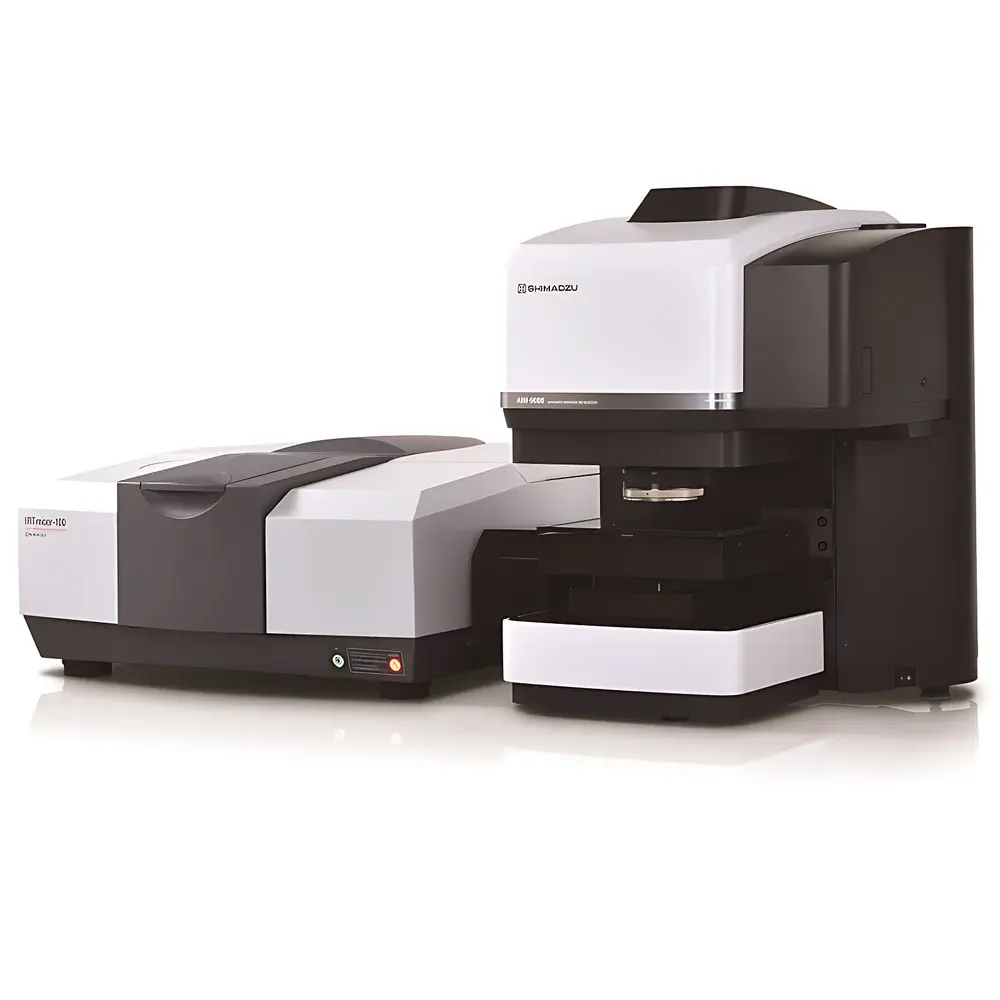
Shimadzu AIM-9000 Fourier Transform Infrared Microscope
| Brand | Shimadzu |
|---|---|
| Origin | Japan |
| Manufacturer Type | Original Equipment Manufacturer (OEM) |
| Instrument Type | Laboratory FTIR Microscope |
| Resolution | 0.25 cm⁻¹ |
| Signal-to-Noise Ratio | 30,000:1 |
| Optical Magnification Range | 330× continuous (macro to micro, 10 mm × 13 mm to 30 µm × 40 µm) |
| Detector | Liquid Nitrogen-Cooled MCT (Mercury Cadmium Telluride) |
| Automation | Fully Motorized XYZ Stage with Digital Image-Based Auto-Targeting |
| Software | IRsolution with Integrated Chemical Imaging and Automated Contaminant Identification Algorithm |
Overview
The Shimadzu AIM-9000 Fourier Transform Infrared (FTIR) Microscope is a purpose-engineered laboratory instrument designed for high-sensitivity, spatially resolved molecular identification at microscopic scales. Built upon Shimadzu’s six-decade legacy in infrared spectroscopy, the AIM-9000 integrates a high-performance FTIR spectrometer platform with a fully automated optical microscope and intelligent digital image analysis architecture. Its core measurement principle relies on interferometric detection of mid-infrared absorption (typically 4000–600 cm⁻¹), enabling label-free, non-destructive chemical characterization based on fundamental vibrational modes of functional groups. Unlike conventional point-mapping systems requiring manual region-of-interest selection, the AIM-9000 implements closed-loop automation: real-time visible-light imaging feeds into an embedded computer vision algorithm that identifies morphologically distinct particles or domains—prioritizing locations for spectral acquisition without user-defined thresholds or prior compositional assumptions. This architecture supports rigorous trace-level contaminant analysis, micro-domain phase identification in polymers, and cross-sectional layer verification in multilayer films—all within a single workflow.
Key Features
- Fully motorized XYZ translation stage with sub-micron positioning repeatability, optimized for high-throughput micro-sampling and multi-point spectral acquisition.
- Dual-optical-path design: standard high-numerical-aperture objective lens combined with an optional wide-field camera module (10 mm × 13 mm field of view), enabling seamless transition from macroscopic sample survey to targeted micro-analysis (down to 30 µm × 40 µm measurement area).
- Liquid nitrogen-cooled MCT detector delivering exceptional sensitivity and stability, critical for low-energy absorbance detection in thin sections or sub-micron contaminants.
- True 0.25 cm⁻¹ spectral resolution (unapodized), compliant with ASTM E1421 and ISO 18387 standards for quantitative FTIR microscopy validation.
- Real-time digital image recognition engine trained on >10,000 reference particle morphologies; autonomously selects analytically relevant measurement positions in <1 second per field.
- Integrated optical alignment verification system ensuring consistent beam path geometry across magnifications—eliminating recalibration drift between macro and micro modes.
Sample Compatibility & Compliance
The AIM-9000 accommodates solid, semi-solid, and thin-film specimens—including pharmaceutical tablets, polymer laminates, electronic packaging residues, forensic fibers, and biological tissue sections (cryo- or paraffin-mounted). It supports transmission, reflection, and attenuated total reflectance (ATR) micro-accessories (optional). All hardware and firmware comply with IEC 61000-6-3 (EMC) and IEC 61010-1 (safety). Data acquisition and processing workflows are structured to support GLP/GMP environments: audit trail logging, electronic signature capability (per FDA 21 CFR Part 11), and version-controlled method templates ensure regulatory traceability. Spectral libraries adhere to NIST SRM 1921b and USP referencing protocols.
Software & Data Management
IRsolution software provides unified control of imaging, spectral acquisition, mapping, and chemometric analysis. Key modules include: (1) Auto-Map—generates high-resolution chemical images via rapid point-by-point acquisition with dynamic dwell time adjustment; (2) Contaminant ID—uses hierarchical clustering and spectral correlation matching (Pearson, Euclidean, and Mahalanobis distance metrics) to deconvolute mixed-component spectra without pre-specifying component count; (3) Batch Processing Engine—enables unattended overnight analysis of multi-sample trays with auto-focus and auto-alignment per slide. Raw interferograms and processed spectra are stored in standardized JCAMP-DX v6 format; project metadata conforms to ISA-Tab specifications for interoperability with LIMS platforms.
Applications
- Pharmaceutical quality control: identification of extraneous particles in injectables per USP and .
- Failure analysis in electronics: delamination root-cause determination in PCB substrates and underfill materials.
- Polymer science: crystallinity mapping in polyethylene blends and additive distribution analysis in composites.
- Forensic trace evidence: fiber dye profiling and paint layer stratigraphy reconstruction.
- Materials R&D: catalyst surface speciation in supported metal oxides and interfacial degradation products in battery separators.
FAQ
What spectral range does the AIM-9000 cover?
The instrument operates across the standard mid-IR range of 4000–600 cm⁻¹, extendable to 7800–350 cm⁻¹ with optional beamsplitter and detector configurations.
Is ATR micro-accessory support available?
Yes—Shimadzu offers a motorized ATR objective (Ge crystal, 100 µm tip) compatible with the AIM-9000 stage and software auto-alignment routine.
Can the system perform real-time spectral library searching during acquisition?
Yes—spectral matching against user-defined or commercial libraries (e.g., SDBS, Polymer, Forensic) occurs in parallel with data collection, with hit quality indexing displayed live.
Does the software support multivariate curve resolution (MCR)?
IRsolution includes MCR-ALS (Alternating Least Squares) for unsupervised decomposition of heterogeneous spectral maps, with constraint options for non-negativity and closure.
How is calibration traceability maintained?
Wavelength accuracy is verified using polystyrene film (NIST SRM 1921b); intensity linearity is confirmed via neutral density filters traceable to NIST SRM 2036. Calibration reports are auto-generated and archived with each measurement session.





