
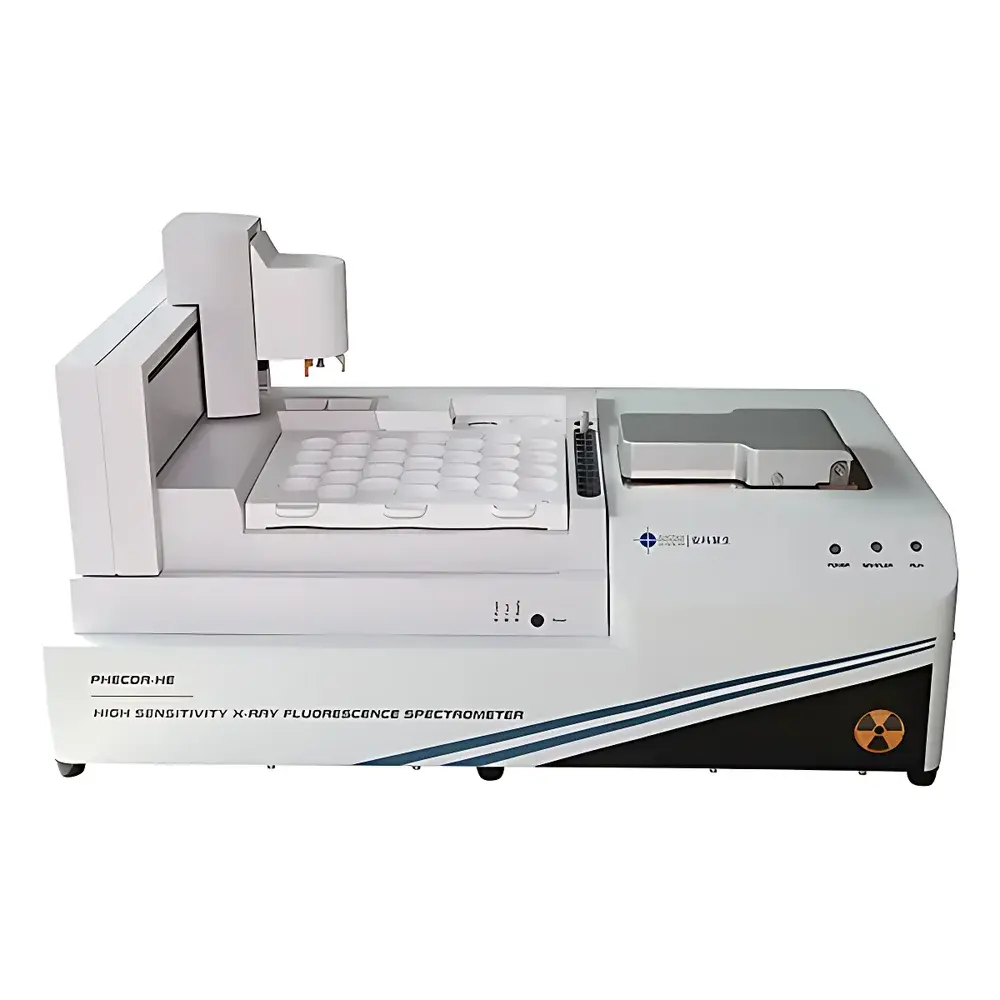
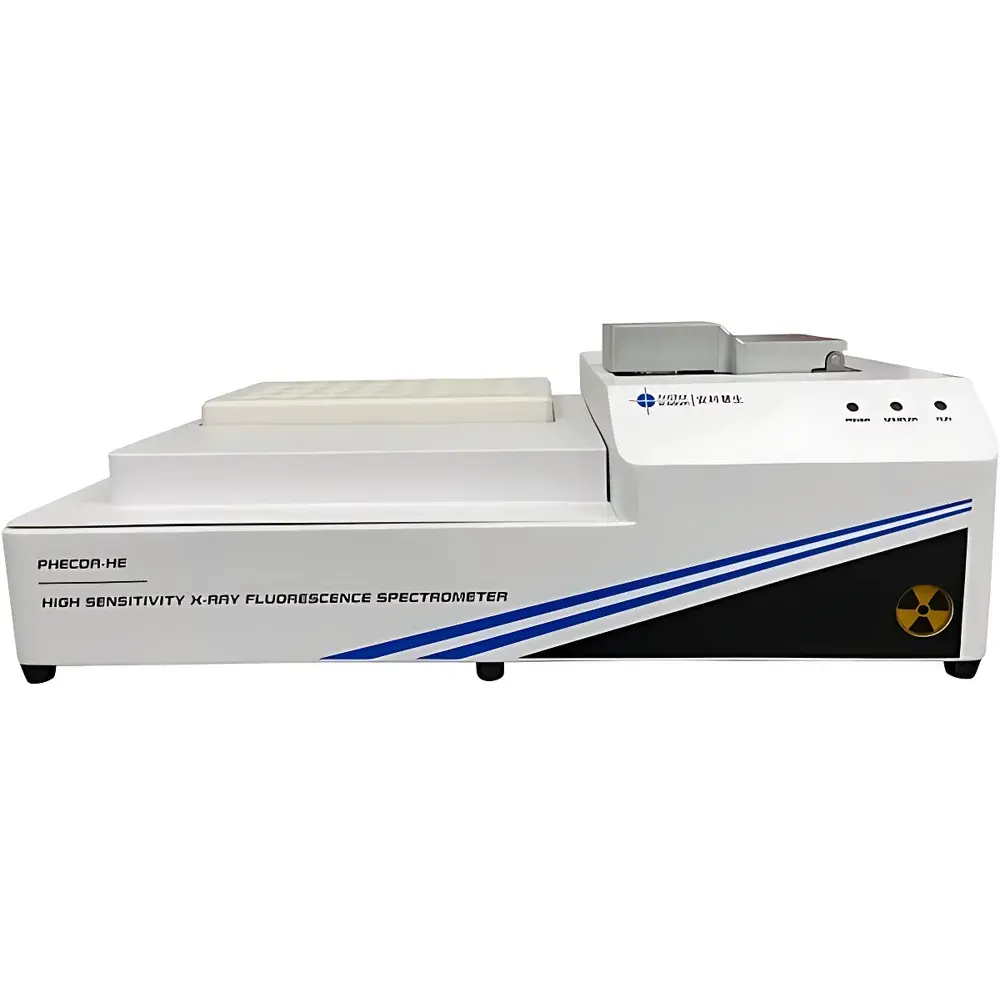
Anchor Wisdom PHECDA-HE & PHECDA-HES High-Sensitivity Single-Wavelength X-Ray Fluorescence Spectrometer (HS XRF®)
| Brand | Anchor Wisdom |
|---|---|
| Origin | Beijing, China |
| Model | PHECDA-HE & PHECDA-HES |
| Detection Limit (soil matrix, 300 s) | Cd: 0.06 mg/kg, Pb: 0.4 mg/kg, Cr: 1.0 mg/kg |
| Repeatability (Cd, soil) | RSD < 15% at 0.3 mg/kg |
| Elemental Range | Mg–U |
| Sample Types | Solid, liquid, powder, viscous |
| Detector | High-performance Silicon Drift Detector (SDD) |
| Excitation Principle | Monochromatic focused excitation via doubly curved crystal (DCC) |
| Software | Fast FP® 2.0 quantitative engine |
| Auto-sampler | 30+ positions (PHECDA-HES) |
| HMET® integration for aqueous samples (detection limit | 1–3 µg/L) |
Overview
The Anchor Wisdom PHECDA-HE and PHECDA-HES are benchtop high-sensitivity single-wavelength X-ray fluorescence spectrometers engineered for trace-level elemental quantification in complex, heterogeneous matrices. Unlike conventional energy-dispersive XRF (ED-XRF) systems that rely on polychromatic tube emission, the PHECDA platform implements monochromatic focused excitation using a doubly curved crystal (DCC) optic. This hardware architecture selects and focuses a single characteristic X-ray line—typically from a Rh or Mo anode tube—onto the sample surface with high spatial and spectral precision. As a result, the background continuum is suppressed by >90% relative to standard ED-XRF, yielding significantly enhanced signal-to-background ratios for target analytes. Coupled with a high-resolution, high-count-rate silicon drift detector (SDD), the system achieves detection limits in the sub-ppb range for key toxic elements (e.g., 0.06 mg/kg Cd in soil, measured per ISO 18227 and GB 15618-2018 protocols). The instrument operates under ambient air conditions—no vacuum or helium purge required—making it suitable for routine laboratory deployment across environmental, food safety, geological, and industrial quality control workflows.
Key Features
- Monochromatic Focused Excitation: DCC-based optics deliver wavelength-selective, diffraction-limited irradiation, eliminating Bremsstrahlung background and minimizing Compton/Rayleigh scatter contributions.
- High-Performance SDD Detection: Large-area, ultra-thin polymer window SDD with energy resolution ≤123 eV at Mn Kα (5.9 keV), optimized for low-Z to high-Z element response (Mg–U).
- Fast FP® 2.0 Quantitative Engine: A physics-based fundamental parameters algorithm that models primary excitation, secondary fluorescence, absorption, enhancement, and detector response—enabling accurate quantification with minimal calibration standards (often <5 reference materials per matrix type).
- Trace Cadmium Optimization: Dedicated spectral and geometric configuration for Cd Kα (23.1 keV), achieving certified detection limits of 0.06 mg/kg in soil per GB 36600-2018 validation protocols.
- Modular Sample Handling: Supports solids (pressed pellets, loose powders), liquids (via HMET® membrane preconcentration), slurries, and viscous samples; includes application-specific preparation kits (e.g., PM2.5 filter mounting, soil homogenization, oil filtration).
- Benchtop Automation: PHECDA-HES integrates a 30+ position robotic autosampler with barcode scanning, enabling unattended batch analysis compliant with GLP audit trails.
Sample Compatibility & Compliance
The PHECDA series accommodates diverse sample forms without destructive digestion: intact soil cores, dried sediment filters, PM2.5 Teflon membranes, solid food composites, crude oils, cement clinker powders, and herbal powder tablets. Its analytical performance meets or exceeds requirements of multiple regulatory frameworks, including: US EPA Method 6200 (XRF screening for soils), ISO 18227:2015 (ED-XRF for metals in soils and sediments), ASTM D7348–21 (metals in petroleum products), and Chinese national standards GB 15618-2018, GB 36600-2018, GB 2762-2017, and ChP 2020 (heavy metals in traditional Chinese medicine). When paired with HMET® membrane enrichment, aqueous analyses comply with HJ 829–2017 for ambient particulate matter and support rapid field-deployable water screening per environmental emergency response guidelines. All software operations—including method creation, data export, and report generation—support 21 CFR Part 11-compliant electronic signatures and audit logging when deployed on validated IT infrastructure.
Software & Data Management
Fast FP® 2.0 is embedded as the core quantification module within the PHECDA Control Suite—a Windows-based application supporting method development, real-time spectral visualization, inter-laboratory comparison tools, and automated QA/QC flagging. The software implements matrix-adaptive correction routines that dynamically adjust for absorption–enhancement effects across wide-ranging compositions (e.g., SiO2-rich soils vs. organic-rich sludges vs. CaCO3-dominant limestone). Users may perform true “standardless” quantification for semi-quantitative surveys or apply minimal calibration (e.g., 3–5 CRM-matched samples) to achieve certified-grade accuracy. Spectral libraries, calibration curves, and raw counts are stored in ACID-compliant SQLite databases with configurable backup intervals. Data export supports CSV, PDF reports, and XML formats compatible with LIMS integration (ASTM E1482, ISO/IEC 17025 Annex A.3). Remote diagnostics and firmware updates are performed over HTTPS-secured channels.
Applications
The PHECDA platform delivers validated performance across regulated and research-driven domains. In environmental laboratories, it quantifies 50+ elements in soils per GB 15618–2018 risk screening thresholds and performs rapid (<5 min/sample) heavy metal profiling in wastewater effluents using HMET®-preconcentrated filters. For air quality monitoring, it replaces labor-intensive ICP-MS for routine PM2.5 filter analysis—providing multi-element composition data directly usable in receptor modeling (e.g., PMF, CMB). In food safety, it screens rice, seafood, and spices for Pb, Cd, As, Cr, and Ni per GB 2762–2017 limits without acid digestion. Geological labs utilize its mineralogical robustness to quantify major oxides (SiO2, Al2O3, Fe2O3) and trace REEs in ores with <5% RSD. Cement producers deploy it for kiln feed homogeneity control and leachate compliance testing per HJ/T 300–2007. Each application is supported by pre-validated methods, CRM correlation datasets, and SOP documentation aligned with ISO/IEC 17025 internal audit requirements.
FAQ
Does the PHECDA require vacuum or helium purging for light-element analysis?
No. The monochromatic excitation design eliminates the need for atmospheric suppression; Mg, Al, and Si are routinely quantified in air mode with demonstrated repeatability.
Can Fast FP® be used without any certified reference materials?
Yes—Fast FP® supports fully standardless quantification for screening. However, for regulatory reporting (e.g., EPA, CNAS), 3–5 matrix-matched CRMs are recommended to validate accuracy and uncertainty budgets.
How is data integrity ensured during remote operation or multi-user access?
The software enforces role-based permissions, timestamps all user actions, and maintains immutable audit logs compliant with 21 CFR Part 11 Annex A when configured on domain-authenticated workstations.
What sample preparation is required for liquid analysis?
Aqueous samples are processed via HMET® membrane filtration (100–500 mL volume); dried membranes are loaded directly into the autosampler—no evaporation, digestion, or chemical reagents needed.
Is the system compatible with existing LIMS environments?
Yes. The PHECDA Control Suite provides ODBC and REST API interfaces for bidirectional data exchange with major LIMS platforms, including LabWare, STARLIMS, and Thermo Fisher SampleManager.




