
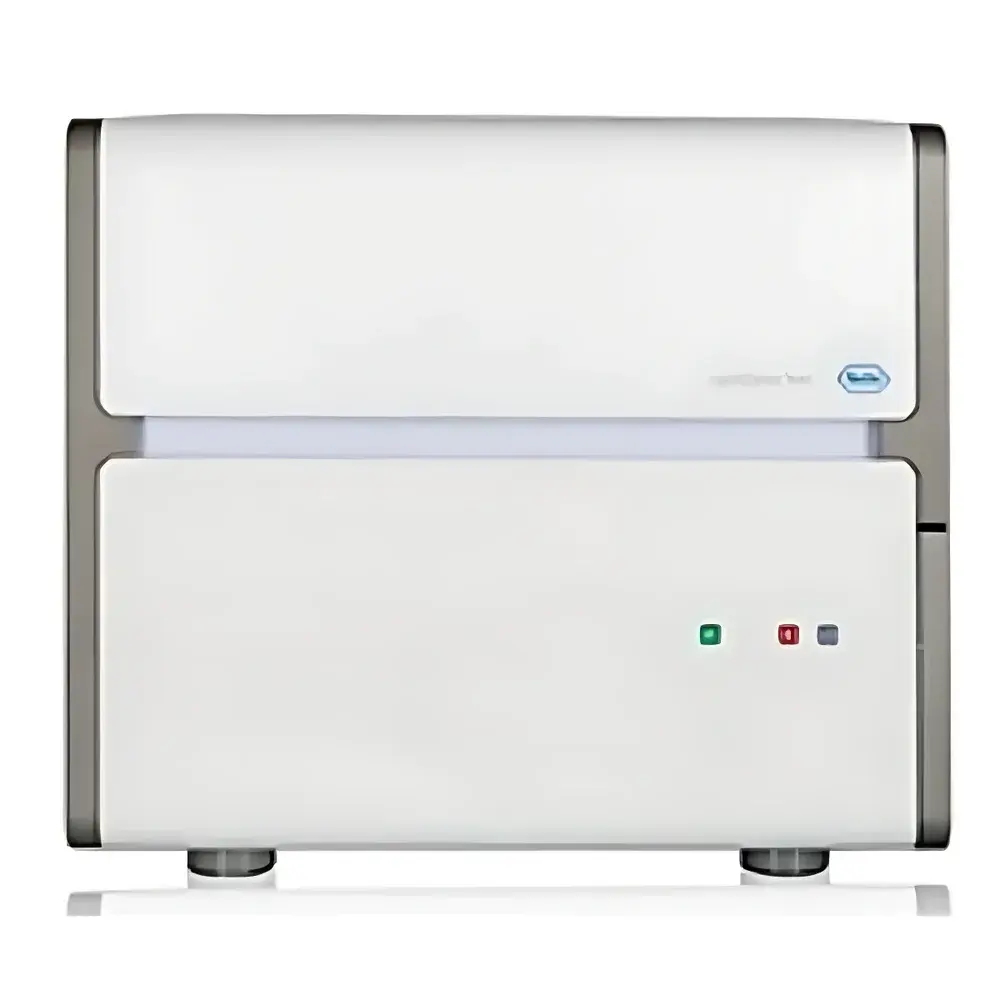
Roche LightCycler 480 Real-Time PCR System
| Brand | Roche Diagnostics |
|---|---|
| Origin | Switzerland |
| Model | LightCycler 480 |
| Instrument Type | Real-Time Fluorescence Quantitative PCR System |
| Sample Throughput | 96-well plate or 8-tube strip |
| Heating Rate | 6.8 °C/s |
| Temperature Accuracy | ±0.1 °C (37–99 °C) |
| Well-to-Well Temperature Uniformity | ±0.1 °C (37–99 °C) |
Overview
The Roche LightCycler® 480 Real-Time PCR System is a CE-IVDR–certified, ISO/IEC 17025–accredited platform engineered for high-precision nucleic acid quantification and genotyping in regulated clinical diagnostics, translational research, and industrial quality control environments. It operates on the principle of real-time fluorescence detection during thermal cycling—capturing sequence-specific amplification kinetics via probe-based (e.g., TaqMan®) or intercalating dye (e.g., SYBR Green I) chemistries. Its silver-based thermal block (thermal conductivity: 429 W/m·K), combined with Therma-Base™ gradient compensation algorithms, delivers exceptional thermal homogeneity across all 96 wells—enabling reproducible Ct values with <0.2-cycle standard deviation under routine operation. Designed for compliance-critical workflows, the system integrates hardware-level traceability, audit-trail logging per FDA 21 CFR Part 11, and automated calibration verification to support GLP, GMP, and CAP/CLIA laboratory accreditation requirements.
Key Features
- Nanometer-grade thermal control: ±0.1 °C accuracy and uniformity (37–99 °C), validated per ISO/IEC 17025; eliminates edge effects in 96-well plates
- Ultra-sensitive optical detection: 10 fM limit of detection; resolves ΔCt = 0.2 cycles (equivalent to 1.5× concentration difference)
- High-speed thermocycling: Complete 40-cycle run in ≤40 minutes using optimized protocols; supports rapid turnaround in high-volume diagnostic labs
- Six-channel excitation/detection: Fifth-generation solid-state white-light source (400–700 nm) with adaptive filter array compatible with FAM, HEX, ROX, Cy5, and 12 total dyes
- Independent optical path per well: Enables concurrent high-resolution melting (HRM) analysis (0.01 °C/s ramp control) and probe-based detection without cross-talk
- Reference-light normalization: Eliminates reliance on passive reference dyes (e.g., ROX); reduces inter-run CV by up to 42% versus conventional systems
- Hot-swap modular design: Seamless transition between 96-well and 384-well configurations in <8 seconds; auto-detection of plate format with zero manual calibration
Sample Compatibility & Compliance
The LightCycler 480 accepts standard 96-well PCR plates and 8-tube strips, accommodating both open-tube and capped reaction formats. All thermal and optical performance specifications are verified using NIST-traceable reference materials (e.g., SRM 2374). The system complies with EU IVDR (In Vitro Diagnostic Regulation) Class C requirements and meets essential principles for safety and performance under Annex I. It includes built-in 21 CFR Part 11 compliance features—including electronic signatures, role-based access control, immutable audit trails, and event-driven alerting—for use in FDA-regulated environments. Routine calibration and performance verification are supported through Roche’s certified service network and documented SOPs aligned with ISO 17025 and CLSI EP17-A2 guidelines.
Software & Data Management
The LightCycler 480 Software v1.5 provides an intuitive, workflow-driven interface for assay setup, run monitoring, and result interpretation. It supports multi-parameter analysis including absolute quantification, relative expression (ΔΔCt), genotyping, and HRM profiling—with automated peak calling and cluster classification. Raw fluorescence data is stored in vendor-neutral .lcs format and exportable to CSV, Excel, or LIMS-compatible XML. An open RESTful API enables bidirectional integration with laboratory information systems (LIS) and enterprise LIMS platforms, allowing custom scripting of experimental protocols, instrument scheduling, and automated report generation. Audit logs record every user action—including parameter changes, file exports, and reanalysis events—with timestamps, operator IDs, and IP addresses—ensuring full data integrity and regulatory readiness.
Applications
- Clinical Diagnostics: Detection of low-abundance variants (e.g., EGFR T790M at 0.1% VAF), viral load monitoring (HIV, HBV, SARS-CoV-2), and antimicrobial resistance gene screening with LOD down to 1 CFU/mL for foodborne pathogens
- Translational Research: miRNA expression profiling across 7-log dynamic range (10¹–10⁸ copies/μL), multiplexed detection of up to 12 targets per well, and allele-specific discrimination using melting curve resolution ≤0.2 °C
- Industrial QC: Batch release testing of biologics, cell therapy products, and raw materials; compliant with ISO 13485 and pharmacopeial standards (USP , EP 2.6.17)
- Public Health Surveillance: High-throughput screening of zoonotic agents (e.g., Salmonella, Listeria monocytogenes) with >5,000 samples/day throughput in centralized reference labs
FAQ
Is the LightCycler 480 compatible with third-party reagents and assays?
Yes—the system supports open chemistry and has been validated with major commercial master mixes and probe sets from QIAGEN, Thermo Fisher Scientific, and Takara Bio.
Does it support 384-well format?
No—the LightCycler 480 is designed exclusively for 96-well plates and 8-tube strips; the LightCycler 480 II model adds 384-well capability.
What regulatory documentation is provided with the instrument?
Each unit ships with a Declaration of Conformity (IVDR), Factory Calibration Certificate (ISO/IEC 17025), Installation Qualification (IQ) and Operational Qualification (OQ) templates, and 21 CFR Part 11 validation support package.
Can HRM and probe-based detection be performed simultaneously in the same run?
Yes—its per-well optical architecture allows independent excitation and emission capture, enabling concurrent TaqMan® genotyping and high-resolution melt analysis without compromise.
How often does the system require maintenance or recalibration?
Annual preventive maintenance is recommended; optical and thermal performance verification can be conducted in-house using Roche-provided reference standards and software tools.



