
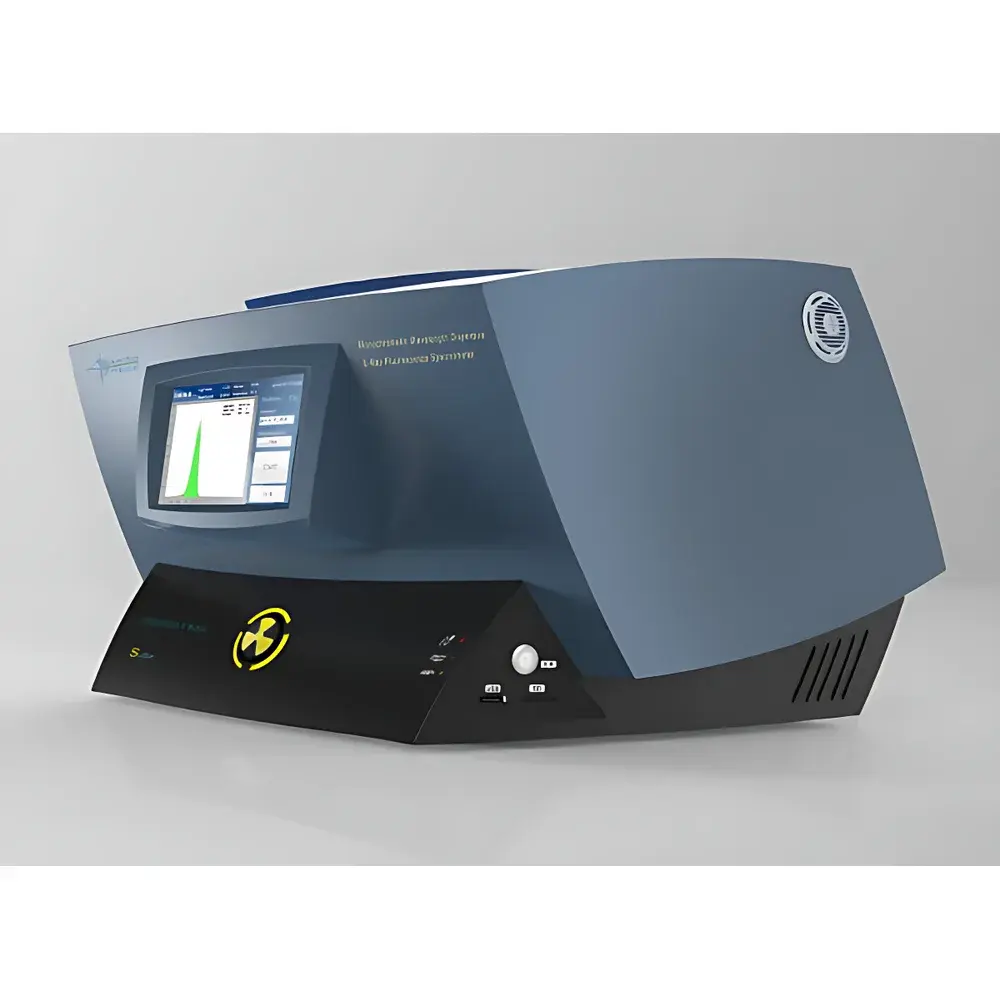
Anchor Wisdom DUBHE-1710 Single-Wavelength Dispersive X-Ray Fluorescence Spectrometer for Ultra-Low Chlorine Analysis
| Brand | Anchor Wisdom |
|---|---|
| Origin | Beijing, China |
| Model | DUBHE-1710 |
| Detection Limit (Cl) | 0.1 ppm |
| Measurement Range | 0.1 ppm – 5 wt% |
| Analysis Time | 60–300 s |
| Repeatability | ≤0.2 ppm (at 1 ppm Cl), ≤0.5 ppm (at 5 ppm Cl), ≤2.5 ppm (at 50 ppm Cl) |
| Sample Prep Time | <10 s |
| Operating Warm-up | ≤10 min |
| Cost per Sample | <USD 0.55 (excl. labor) |
Overview
The Anchor Wisdom DUBHE-1710 is a benchtop single-wavelength dispersive X-ray fluorescence (SWDXRF) spectrometer engineered specifically for ultra-trace chlorine quantification in hydrocarbon matrices. Unlike conventional energy-dispersive XRF (EDXRF) or wavelength-dispersive XRF (WDXRF) systems, the DUBHE-1710 employs a doubly curved crystal (DCC) optic to monochromatize the primary X-ray beam—selectively exciting only the Cl Kα line (2.62 keV) while suppressing background and spectral interferences from sulfur, silicon, calcium, and transition metals commonly present in crude oil, naphtha, gasoline, diesel, and process streams. This monochromatic excitation enables sub-part-per-trillion effective background suppression, delivering a practical limit of detection (LOD) of 0.1 ppm Cl in liquid samples with minimal matrix effects. The instrument operates on fixed-angle, fixed-optic geometry—eliminating mechanical goniometer movement—and is fundamentally designed for long-term stability in continuous refinery QC environments where drift, recalibration frequency, and operator dependency directly impact compliance reporting integrity.
Key Features
- Monochromatic Excitation Architecture: Dual-bent crystal optics deliver narrow-band excitation at Cl Kα, minimizing Bremsstrahlung background and enhancing signal-to-noise ratio by >10× compared to polychromatic EDXRF.
- XFS (X-Ray Fixed System) Patent Technology: Entire optical path—including X-ray tube, DCC monochromator, and SDD detector—is factory-aligned and rigidly mounted; no field realignment required over instrument lifetime.
- ESP (Easy Sample Preparation) Module: Integrated sample cup holder with pre-tensioned polymer film clamping mechanism ensures reproducible 25-mm diameter analysis windows without manual stretching or adhesive use.
- Zero-Consumable Operation: No carrier gases, no quartz combustion tubes, no electrolyte reagents, and no solvent dilution—reducing cost-of-ownership and eliminating failure modes associated with consumable degradation.
- Rapid Turnaround: Full measurement cycle—from sample loading to report generation—completed in ≤300 seconds; system ready for analysis within 10 minutes of power-on.
- Robust Hydrocarbon Compatibility: Optimized for undiluted liquid fuels and distillates; validated per ASTM D7042 and IP 566 for chlorine in middle distillates and reformulated gasoline.
Sample Compatibility & Compliance
The DUBHE-1710 accepts neat liquid samples (0.5–3 mL) in standard 32-mm polypropylene cups sealed with 6-µm Mylar or 8-µm Kapton films. It supports direct analysis of gasoline, diesel, kerosene, naphtha, hydrotreated feedstocks, and crude assay fractions without digestion, ashing, or derivatization. Method validation data comply with ISO/IEC 17025 requirements for method verification, including precision (within-lab RSD <2.1% at 1 ppm Cl), linearity (r² ≥0.9998 across 0.1–50 ppm), and recovery (98.4–101.7% spiked into ASTM D4057 reference materials). Instrument firmware includes audit trail logging per FDA 21 CFR Part 11 (electronic records and signatures), supporting GLP/GMP-regulated laboratories conducting catalyst poison monitoring per refinery internal specifications (e.g., ExxonMobil XOM-STD-2201, Shell DEP 34.19.00.31).
Software & Data Management
Control and analysis are executed via Anchor Wisdom’s QuantStudio XRF v3.2 software, running on embedded Windows IoT OS. The interface provides guided workflow navigation, real-time spectrum visualization, automated peak deconvolution using fundamental parameter (FP) algorithms with Cl-specific matrix correction, and batch report generation in PDF/CSV formats. All raw spectra, calibration logs, user actions, and instrument status parameters are timestamped and stored locally with optional encrypted export to network drives or LIMS via OPC UA or FTPS. Software supports multi-level user roles (Operator, Supervisor, Administrator), electronic signature capture for calibration verification, and automatic backup of critical configuration files to prevent unauthorized modification.
Applications
- Chlorine monitoring in FCC feedstocks and hydrotreater inlet streams to prevent Pt/Pd catalyst deactivation and stainless-steel corrosion.
- Final product release testing for gasoline (ASTM D7345), jet fuel (ASTM D1319), and marine diesel (ISO 8217 Annex D) to meet <1.0 ppm Cl specifications.
- Root-cause investigation of chloride-induced stress corrosion cracking (SCC) in overhead condensers and fractionation columns.
- QC support for alkylation unit feed pretreatment and caustic wash efficiency evaluation.
- Contract laboratory services for third-party verification of vendor-supplied naphthas and condensates per API RP 932-C guidelines.
FAQ
Does the DUBHE-1710 require daily recalibration?
No—calibration stability is verified weekly using a certified Cl reference standard; drift remains <0.03 ppm over 30 days under continuous operation.
Can it analyze solid catalysts or filter residues?
Not natively; the system is optimized for homogeneous liquids. Solid suspensions require centrifugation/filtration prior to analysis to avoid particle-size bias.
Is spectral interference from sulfur a concern in high-S crude assays?
No—the monochromatic excitation selectively targets Cl Kα and excludes S Kα (2.30 keV); spectral overlap is physically eliminated at the optical level.
What maintenance intervals are recommended?
Annual preventive maintenance (PM) includes X-ray tube output verification, detector resolution check, and optical alignment validation—no user-serviceable parts exist within the sealed X-ray chamber.
How does it compare to ASTM D5808 or D7260 microcoulometric methods?
It matches D5808 LOD performance (0.1 ppm) without combustion gas dependency, electrode replacement, or electrolyte management—reducing method uncertainty components related to conversion efficiency and titration endpoint detection.






