
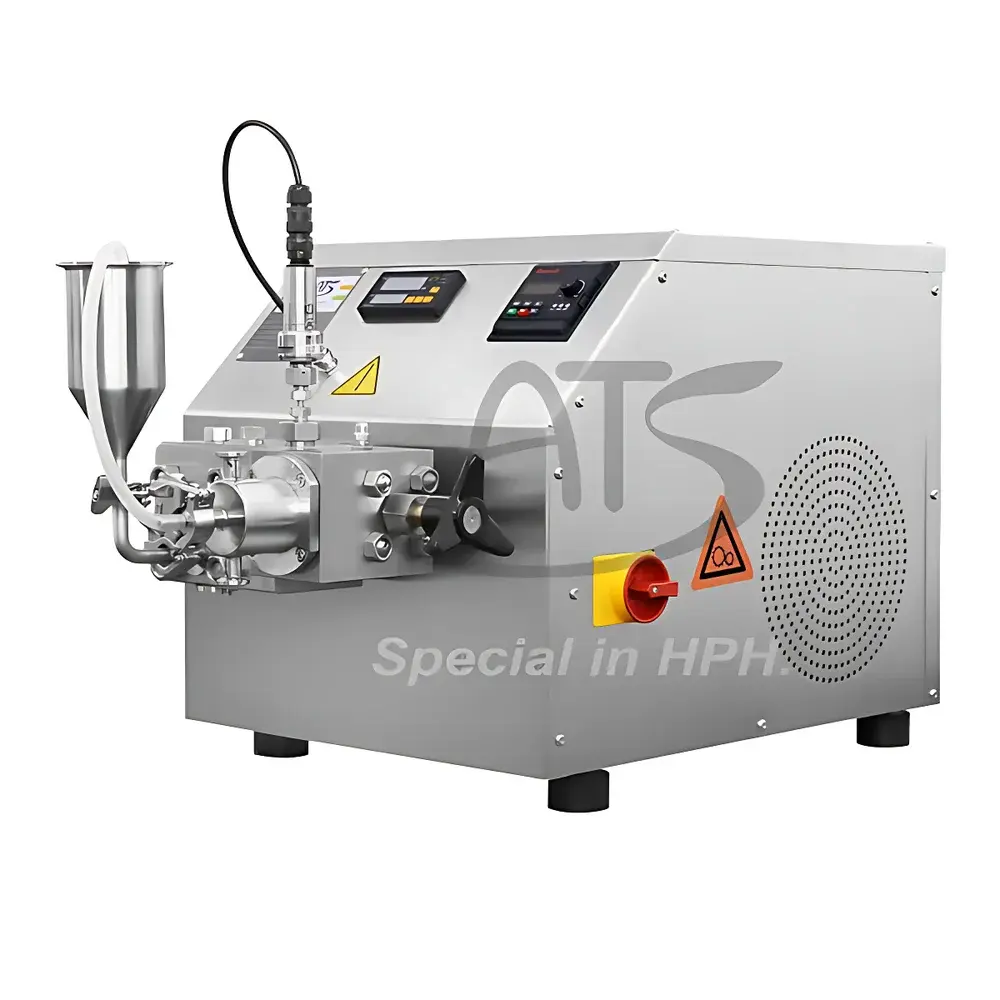
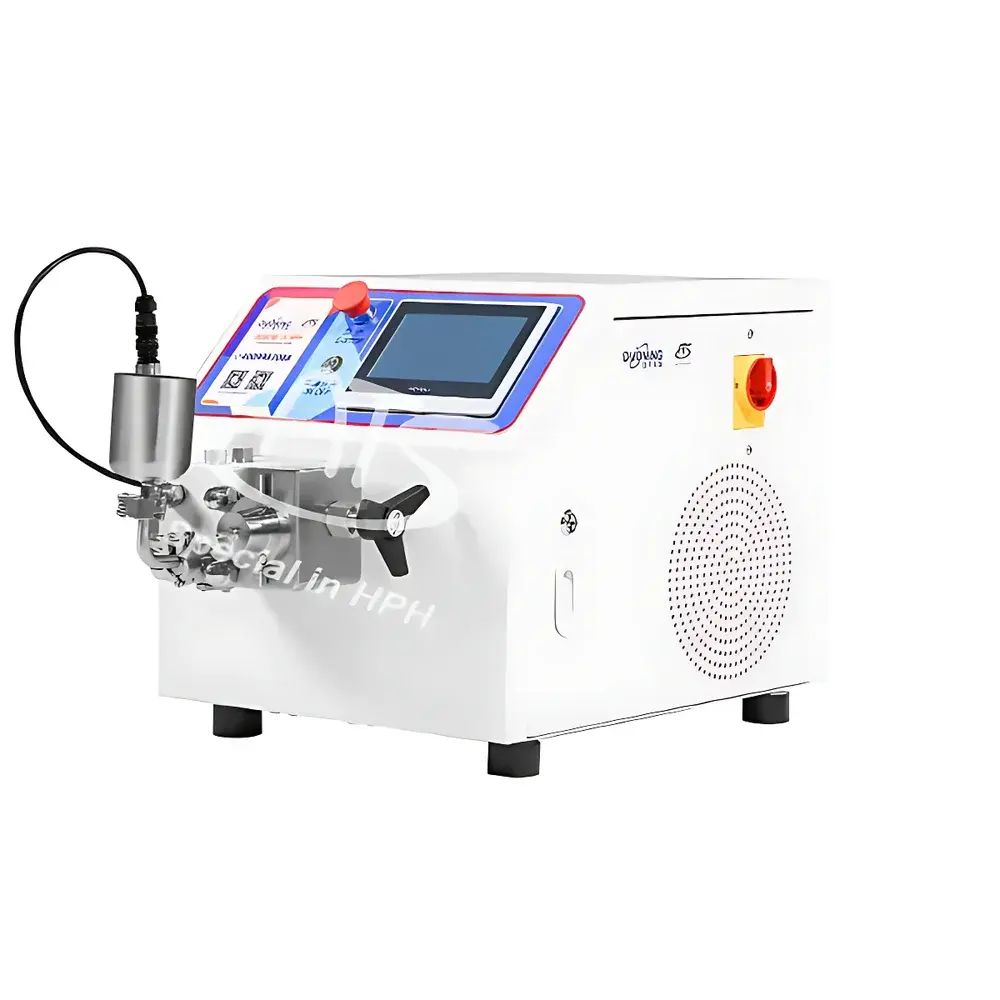
ATS AH-1500 High-Pressure Homogenizer
| Brand | ATS |
|---|---|
| Origin | Canada |
| Manufacturer Type | Original Equipment Manufacturer (OEM) |
| Product Category | Imported Instrument |
| Model | AH-1500 |
| Instrument Type | High-Pressure Cell Disruptor |
| Max Operating Pressure | 1500 bar (22,500 psi) |
| Optional Overpressure Capability | 1800 bar (27,000 psi) |
| Flow Rate | 15 L/h |
| Minimum Sample Volume | 25 mL |
| In-Line Cooling System | Integrated, maintains sample temperature < 20 °C |
| Contact Wetted Materials | ASTM A240 316L stainless steel |
| Motor Power | 2.2 kW, 380 V / 50 Hz |
| Weight | 110 kg |
| Compliance | CE-marked, GMP-compliant design |
| Particle Size Output | < 100 nm (after single-pass homogenization) |
| Disruption Efficiency | >95% for *E. coli*, >90% for yeast |
Overview
The ATS AH-1500 High-Pressure Homogenizer is an engineered solution for scalable, reproducible cell lysis and subcellular particle size reduction in life science and biopharmaceutical research and development. Based on the principle of high-pressure microfluidic homogenization, the system forces cell suspensions through a precisely engineered valve orifice under controlled pressure (up to 1500 bar, with optional 1800 bar capability), inducing rapid pressure drop, turbulent flow, and collision-based mechanical stress. This process generates three primary physical disruption mechanisms—cavitation, impact, and shear—resulting in uniform submicron particle distribution (<100 nm) and high-efficiency disruption (>95% for *Escherichia coli*, >90% for *Saccharomyces cerevisiae*). Designed for laboratory-to-pilot scale applications, the AH-1500 supports continuous processing at up to 15 L/h while maintaining strict thermal control—a critical requirement for preserving labile proteins, enzymes, plasmids, and viral vectors.
Key Features
- GMP-aligned mechanical architecture with full traceability of wetted components; all fluid-contact surfaces constructed from ASTM A240 316L stainless steel for corrosion resistance and cleanability.
- Integrated in-line cooling system actively extracts heat generated during homogenization, sustaining sample temperature below 20 °C without external chiller dependency—essential for thermosensitive biomolecules.
- Optimized valve geometry and hydraulic design enable consistent single-pass processing with no requirement for pre-degassing or manual priming; feed inlet valve allows direct sample introduction.
- Robust 2.2 kW drive motor delivers stable pressure output across full operational range (50–1500 bar), minimizing pressure fluctuation and ensuring batch-to-batch reproducibility.
- Modular thermal management: standard in-line cooler supplemented by optional external cooling coil for extended operation or ultra-sensitive applications (e.g., membrane protein extraction).
- CE-certified design compliant with IEC 61000-6-2 (EMC immunity) and IEC 61000-6-4 (EMC emission) standards; meets essential health and safety requirements per EU Machinery Directive 2006/42/EC.
Sample Compatibility & Compliance
The AH-1500 accommodates a broad spectrum of biological matrices—including bacterial cultures (*E. coli*, *Bacillus* spp.), yeasts (*S. cerevisiae*, *Pichia pastoris*), microalgae (*Chlorella*, *Nannochloropsis*), and mammalian cell lines—provided feed suspension solids content remains ≤15% w/v and maximum particle size is <100 µm. Its validated performance supports workflows aligned with ISO 22412 (particle size analysis by dynamic light scattering), USP <729> (subvisible particle testing), and ICH Q5A(R2) (viral clearance validation). The system’s construction and documentation framework support GLP/GMP audit readiness, including configurable electronic logbooks compatible with 21 CFR Part 11-compliant data integrity practices when integrated with validated third-party acquisition software.
Software & Data Management
While the AH-1500 operates via analog pressure regulation and manual parameter setting (pressure, flow rate, cycle count), its modular architecture permits integration with external programmable logic controllers (PLCs) or SCADA systems via 4–20 mA analog I/O and digital relay outputs. Pressure transducers and temperature sensors are factory-calibrated and traceable to NIST standards. For regulated environments, users may deploy validated third-party data acquisition platforms (e.g., LabVIEW-based systems with audit trail and electronic signature modules) to capture time-stamped pressure, temperature, and runtime data—enabling full compliance with FDA 21 CFR Part 11, Annex 11, and ALCOA+ principles.
Applications
- Downstream processing of recombinant proteins and inclusion bodies from *E. coli* fermentation broths.
- Preparation of whole-cell lysates for enzymatic activity assays, Western blotting, and mass spectrometry sample preparation.
- Production of nanoemulsions and liposomal formulations for vaccine adjuvant development (human and veterinary).
- Disruption of robust microbial cell walls prior to nucleic acid extraction in CRISPR/Cas9 vector production and synthetic biology workflows.
- Generation of sub-100 nm extracellular vesicles (EVs) and exosome fractions from mammalian cell culture supernatants.
- Process development and scalability studies bridging benchtop (AH-500) to pilot-scale (AH-1500) homogenization parameters.
FAQ
What is the maximum allowable feed viscosity for the AH-1500?
Viscosity should not exceed 100 mPa·s at 20 °C; higher viscosities require dilution or pre-filtration to prevent valve clogging and pressure instability.
Can the AH-1500 be used for sterile processing?
Yes—when coupled with steam-in-place (SIP)-compatible accessories and validated cleaning-in-place (CIP) protocols using 0.5 M NaOH or 30% ethanol, the system supports aseptic operation in classified environments.
Is calibration documentation provided with the instrument?
Each unit ships with a factory calibration certificate for pressure and temperature sensors, traceable to national metrology institutes; annual recalibration is recommended per ISO/IEC 17025 guidelines.
Does the system support multi-cycle homogenization?
Yes—manual cycling is enabled via pressure release and re-pressurization; automated cycling requires external PLC integration.
What maintenance intervals are recommended for the homogenizing valve assembly?
Valve wear inspection is advised every 200 operating hours or after processing 500 L of biomass; replacement frequency depends on feed composition and operating pressure.





