
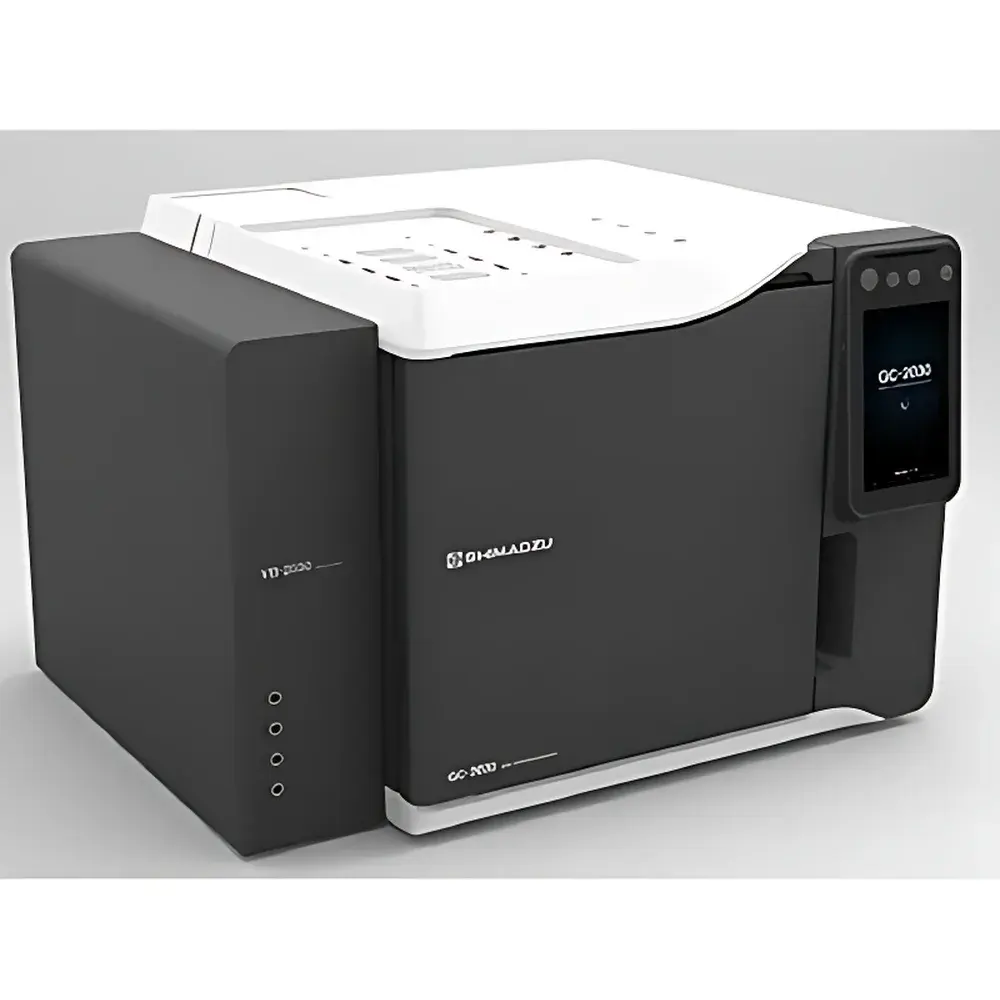
Shimadzu Trace Moisture Analyzer GC-BID System
| Brand | Shimadzu |
|---|---|
| Origin | Japan |
| Manufacturer Type | Original Equipment Manufacturer (OEM) |
| Import Status | Imported |
| Model Designation | ASTM-compliant GC-BID Configuration |
| Pricing | Available upon Request |
Overview
The Shimadzu Trace Moisture Analyzer GC-BID System is a dedicated gas chromatography–barrier discharge ionization detector (GC-BID) platform engineered for ultra-trace water quantification in challenging hydrocarbon matrices. Unlike conventional coulometric or volumetric Karl Fischer titration—methods limited by chemical interference, electrode passivation, and poor reproducibility below 10 ppm—the GC-BID system leverages physical separation coupled with universal, non-destructive plasma-based detection. Water is resolved from complex volatile organic backgrounds—including LPG, natural gas condensates, solvents, and refinery streams—using a specialized porous-layer open-tubular (PLOT) column (MilliporeSigma Watercol), followed by selective, high-sensitivity detection via Shimadzu’s proprietary dielectric barrier discharge (BID) detector. The BID operates under helium carrier gas, generating a stable, low-noise plasma that ionizes all electronegative species—including H2O—with near-identical response factors and negligible matrix-dependent quenching. This enables direct, calibration-based quantification without derivatization or sample pre-concentration.
Key Features
- Ultra-low detection capability: Method detection limit (MDL) of 0.22 ppm and quantitation limit (LOQ) of 0.66 ppm for water in liquefied petroleum gas (LPG), validated per ASTM D7443 and ISO 8573-8 protocols
- BID detector sensitivity >100× higher than thermal conductivity detection (TCD) for water, with linear dynamic range spanning 0.5–1000 ppm (v/v)
- MilliporeSigma Watercol PLOT column: Chemically inert, moisture-selective stationary phase enabling baseline resolution of H2O from C3/C4 hydrocarbons, mercaptans, sulfides, and other sulfur-containing interferents
- Robust architecture: Fully integrated Shimadzu GC-2030 platform with electronic pressure control (EPC), cryogenic oven cooling, and inert flow path components (siliconized stainless steel, fused silica liners)
- Compliance-ready operation: Supports audit trails, user access levels, and electronic signatures aligned with FDA 21 CFR Part 11 and GLP/GMP documentation requirements when paired with LabSolutions GC software
Sample Compatibility & Compliance
The system is validated for gaseous and highly volatile liquid samples where water content critically impacts process safety, catalyst lifetime, or product specification—particularly in petrochemical refining, LNG processing, polymer-grade monomer purification, and pharmaceutical solvent manufacturing. It accommodates direct injection of vapor-phase LPG, propane, butane, ethylene, propylene, and chlorinated solvents without derivatization or headspace equilibration. Analytical performance meets ASTM D7443 (“Standard Test Method for Determination of Water in Liquefied Petroleum Gases (LPG) and Other Light Hydrocarbons by Gas Chromatography”) and ISO 8573-8 (“Compressed air — Part 8: Test methods for oil vapour and organic solvent content”). All hardware and method parameters are traceable to NIST-certified moisture standards and certified reference materials (CRMs) from NPL or VSL.
Software & Data Management
Controlled exclusively via Shimadzu LabSolutions GC software (v5.9 or later), the system provides full method development, sequence management, peak integration with retention time locking, and automated calibration curve generation using internal standard or external standard modes. Data files (.gcw) include embedded metadata (instrument configuration, column lot number, detector settings, operator ID), supporting full data integrity per ALCOA+ principles. Audit trail functionality logs all method modifications, reprocessing events, and user logins with timestamps. Raw data and processed reports export in PDF/A-1b, CSV, and XML formats compatible with LIMS integration (e.g., Thermo Fisher SampleManager, LabVantage).
Applications
- Quantification of residual moisture in LPG and refinery off-gas streams to prevent hydrate formation and valve freezing
- Monitoring water breakthrough in molecular sieve dryers used in olefin production units
- Verification of drying efficiency in pharmaceutical-grade solvent recovery systems (e.g., acetone, THF, dichloromethane)
- Trace moisture analysis in semiconductor-grade carrier gases (N2, Ar, He) per SEMI F57 specifications
- Stability-indicating assay of hydrolytically labile APIs during accelerated stability studies
FAQ
Is this system compliant with ASTM D7443?
Yes—the GC-BID configuration, Watercol column, and validated method protocol fully satisfy all instrumental, calibration, and precision requirements specified in ASTM D7443-22.
Can the BID detector quantify water in the presence of hydrogen sulfide or mercaptans?
Yes. The Watercol column resolves H2O from sulfur compounds; the BID’s uniform ionization efficiency ensures no suppression or enhancement of the water signal, as confirmed by spike-recovery experiments across 0.5–50 ppm H2O in H2S-spiked LPG.
What is the typical analysis time per injection?
Total run time is 8.2 minutes, including column re-equilibration, with water eluting at 3.42 min under standard isothermal conditions (40 °C oven, 25 mL/min He flow).
Does the system require routine detector maintenance?
The BID features a sealed, maintenance-free plasma chamber with no consumable electrodes or filaments; only annual verification of helium purity and detector baseline stability is recommended.
Can existing Shimadzu GC systems be retrofitted with the BID detector?
Yes—BID detectors are compatible with GC-2010 Plus, GC-2030, and GC-2030 Nexis platforms via standard detector mounting interface and firmware update (LabSolutions v5.9+ required).
Related Products




