
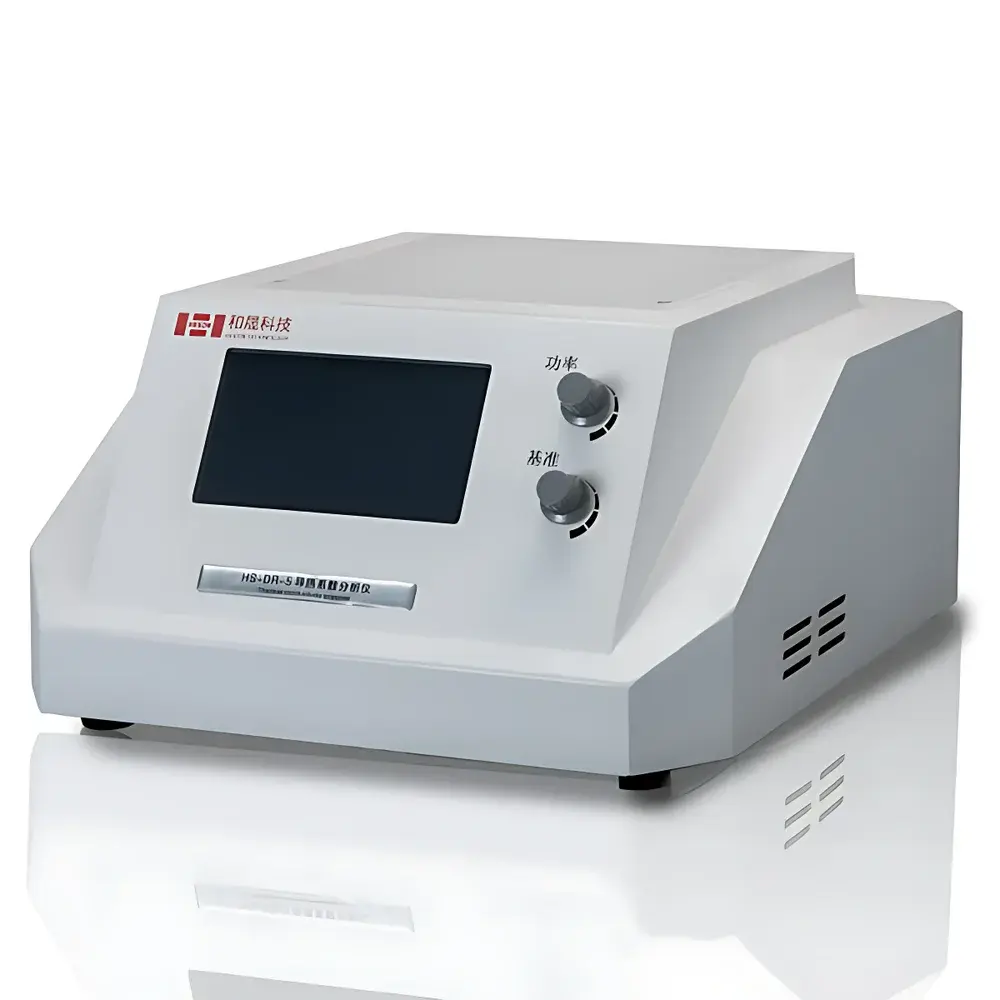
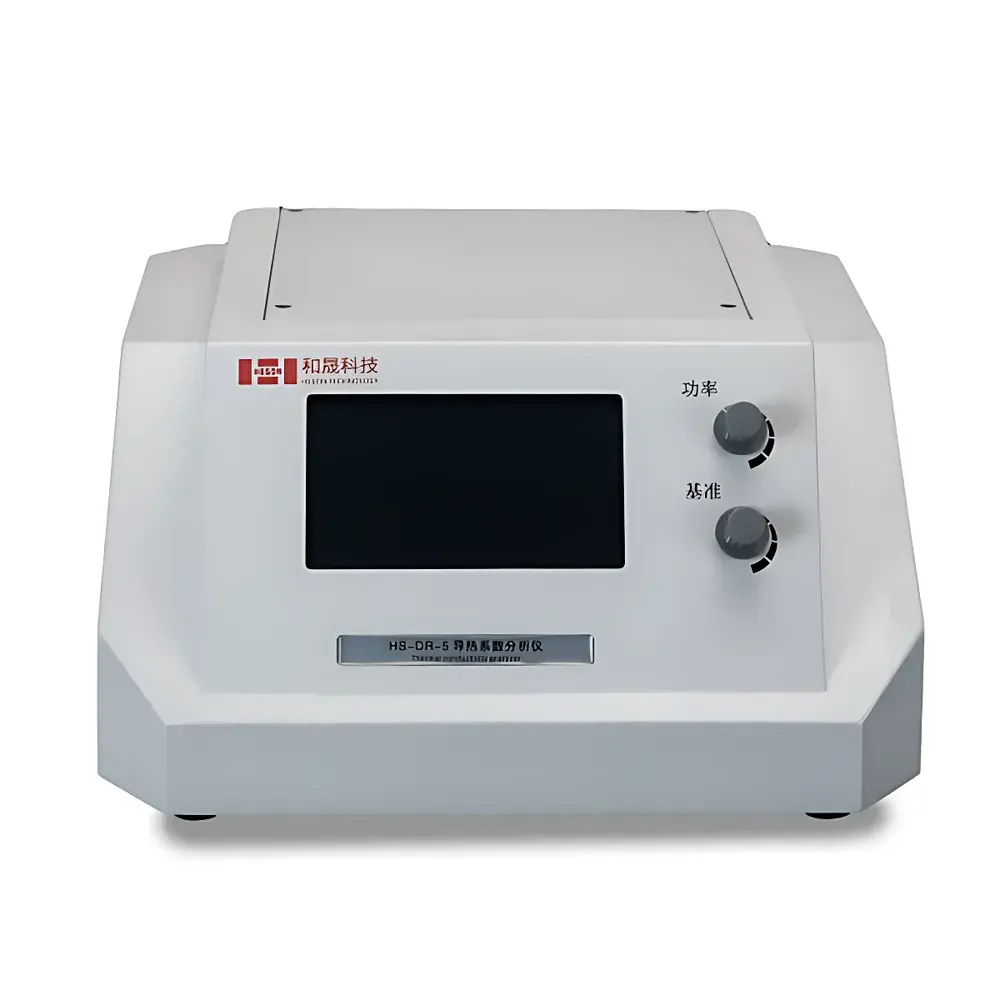
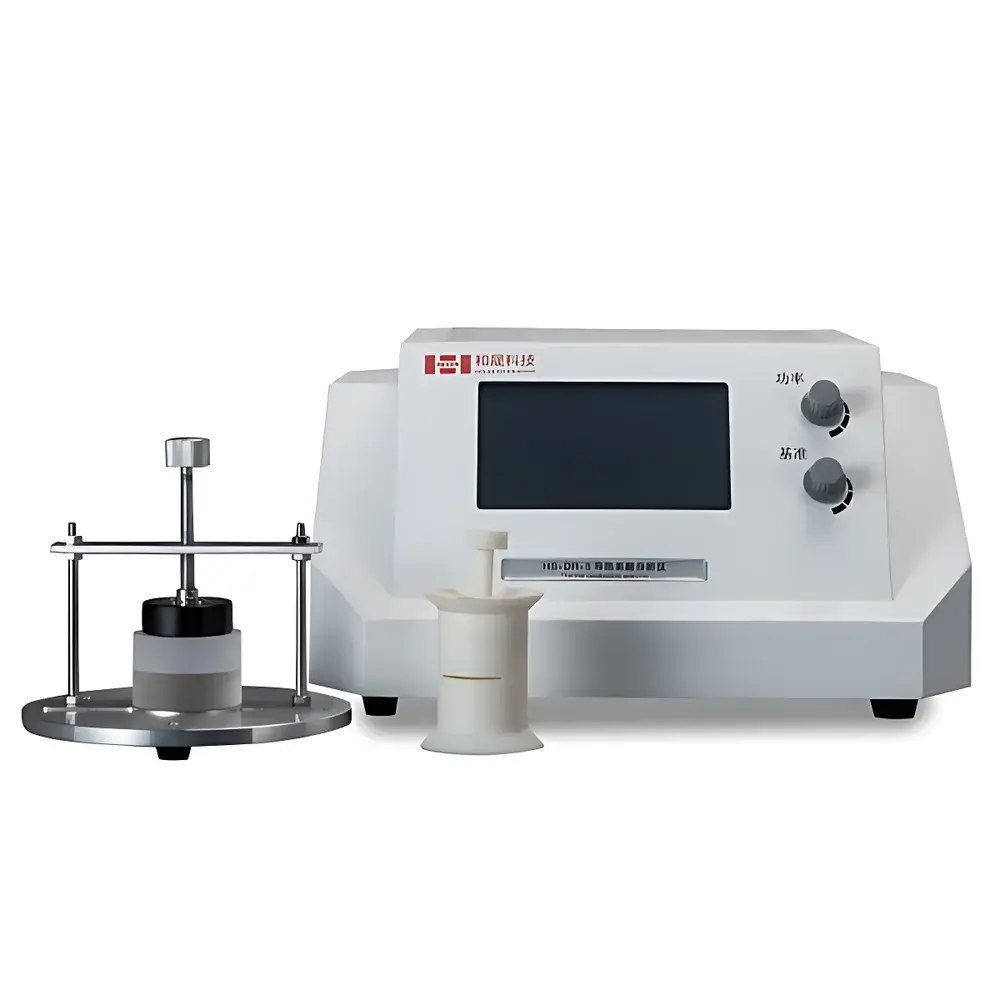
HESON HS-DR-5 Transient Plane Source (TPS) Thermal Conductivity Analyzer
| Brand | HESON |
|---|---|
| Origin | Shanghai, China |
| Manufacturer Type | Direct Manufacturer |
| Instrument Type | Transient Plane Source Method |
| Sample Capacity | Single sample per test |
| Test Environment | Ambient temperature (20–30 °C) |
| Dimensions (L×W×H) | 450 × 385 × 165 mm |
| Accuracy | ≤3% |
| Thermal Conductivity Range | 0.005–300 W/(m·K) |
| Repeatability | ≤3% |
| Probe Options | 7.5 mm and 15 mm diameter dual-spiral probes |
| Measurement Time | 5–160 s (user-configurable) |
| Max. Sample Temperature Rise | <15 °C |
| Power Supply | 220 V AC, <500 W |
| Compatible Sample Forms | Solid blocks, powders, pastes, gels, liquids, coatings, films, foams, and insulating materials |
Overview
The HESON HS-DR-5 is a precision-engineered Transient Plane Source (TPS) thermal conductivity analyzer designed for rapid, non-destructive, and contact-independent measurement of thermal transport properties in heterogeneous and anisotropic materials. Based on the fundamental solution to Fourier’s heat conduction equation for an instantaneous planar heat source embedded in an infinite homogeneous medium, the TPS method eliminates reliance on steady-state assumptions or interfacial contact calibration—critical limitations inherent in guarded-hot-plate or laser-flash techniques. The instrument employs a self-contained, dual-spiral alloy probe acting simultaneously as both resistive heater and resistance thermometer. Upon current application, the probe generates a controlled thermal impulse; its time-resolved resistance change—linearly correlated with local temperature rise—is recorded at microsecond resolution. Using closed-form analytical inversion of the transient temperature response, the system computes thermal conductivity directly without iterative curve-fitting or empirical correction factors. This first-principles approach ensures traceability to SI units and enables reliable characterization across an exceptionally broad dynamic range—from aerogels (0.005 W/(m·K)) to dense metals and graphite composites (up to 300 W/(m·K)).
Key Features
- True TPS methodology compliant with ISO 22007-2:2015 for thermal conductivity determination in solids and liquids.
- Dual-probe configuration (7.5 mm and 15 mm diameter) optimized for dimensional scaling: small probes enable high spatial resolution on thin or limited-volume samples; larger probes improve signal-to-noise ratio for low-conductivity insulators.
- Non-invasive, single-sided insertion—no sample cutting, polishing, or metallization required. Minimal surface flatness tolerance: sample dimensions ≥2× probe diameter in length/width; thickness ≥½ probe diameter.
- Measurement duration fully programmable from 5 s to 160 s, balancing speed and statistical confidence; typical acquisition completes within 30–90 s per sample.
- ARM-based real-time control architecture ensures deterministic timing, low-latency data capture, and immunity to host PC interruptions during critical transient acquisition.
- High-resolution analog front-end using imported 24-bit delta-sigma ADCs delivers <1 µΩ resistance resolution, enabling sub-1% thermal diffusivity uncertainty under controlled ambient conditions.
- Modular sample stage accommodates variable thicknesses (3.75–7.5 mm nominal) via adjustable clamping mechanism—no tooling or reconfiguration needed between tests.
- Integrated thermal shielding and ambient drift compensation algorithms mitigate convective and radiative artifacts during extended measurement sessions.
Sample Compatibility & Compliance
The HS-DR-5 supports direct characterization of diverse material classes without preconditioning: rigid and flexible solids (ceramics, polymers, composites), granular media (powders, sands, expanded perlite), dispersions (slurries, pastes, gels), bulk liquids, thin films (<100 µm), and porous insulation matrices (VIP cores, aerogels, mineral wool). Its TPS implementation satisfies ASTM D5470-22 Annex A3 for comparative thermal transmission testing and aligns with the metrological framework of ISO/IEC 17025 for accredited laboratories. While not inherently GLP-compliant, audit-ready operation is enabled through full digital chain-of-custody: timestamped raw voltage/resistance traces, user ID logging, probe calibration certificate linkage, and immutable metadata embedding in exported .tps files. Software-generated reports include uncertainty budgets per GUM (JCGM 100:2018) guidelines when reference standards are used.
Software & Data Management
The proprietary HESON TPS Analysis Suite (v4.2+) provides ISO/IEC 17025-aligned data handling. Key capabilities include: automatic probe-specific coefficient calibration using NIST-traceable reference materials (e.g., Pyroceram 9606, glycerol); simultaneous computation of thermal conductivity (λ), thermal diffusivity (α), and volumetric heat capacity (ρcp = λ/α); real-time goodness-of-fit assessment against theoretical TPS model residuals; multi-curve overlay with independent axis scaling and drag-to-pan navigation; customizable report templates supporting institutional letterhead, QA/QC stamps, and digital signature fields. Data export formats include XLSX (with formula-locked calculation cells), CSV (tab-delimited, UTF-8), PNG (publication-grade vector-equivalent raster), and native .tps (binary, versioned, checksum-verified). The software enforces FDA 21 CFR Part 11–compatible electronic signatures, audit trails with immutable timestamps, and role-based access control (administrator, operator, reviewer). Remote firmware and algorithm updates are delivered over TLS 1.3-secured channels with SHA-256 package verification.
Applications
The HS-DR-5 serves R&D and QC laboratories engaged in advanced thermal management material development. It is routinely deployed for: optimization of polymer nanocomposites (graphene-, CNT-, BN-filled epoxies); qualification of phase-change material (PCM) microcapsules and macro-encapsulated formulations; thermal interface material (TIM) screening for power electronics packaging; validation of aerospace-grade ablative and insulating foams; benchmarking of bio-based insulation (wood fiber, bamboo aerogel, tannin foams); and regulatory submission support for building envelope materials (EN ISO 10456, ASTM C518). Its ability to characterize hydrated gels, slurries, and reactive precursors—without drying or curing artifacts—makes it indispensable in battery electrolyte research, cementitious thermal modeling, and pharmaceutical excipient thermal profiling.
FAQ
What standards does the HS-DR-5 comply with?
It implements the TPS principle defined in ISO 22007-2:2015 and supports method validation per ASTM D5470-22 Annex A3. Calibration traceability is established to NIST SRMs via optional certified reference materials.
Can the instrument measure anisotropic materials?
Yes—by orienting the probe normal to the direction of interest and applying appropriate boundary condition corrections in post-processing. For strongly orthotropic systems (e.g., layered composites), orthogonal measurements are recommended.
Is vacuum or inert atmosphere operation supported?
No—the standard configuration operates at ambient pressure and temperature. Optional environmental chamber integration (−20 °C to +130 °C, N2-purged) is available as a factory-modified variant.
How is probe calibration performed?
Users perform two-point calibration using supplied reference materials (e.g., copper, Pyroceram, distilled water) at known temperatures. The software calculates probe-specific constants and stores them in encrypted device memory.
Does the system support automated batch testing?
Manual sample loading is required per test; however, the software supports script-driven sequence execution, auto-report generation, and folder-based result archiving for unattended multi-sample workflows.
Related Products



