
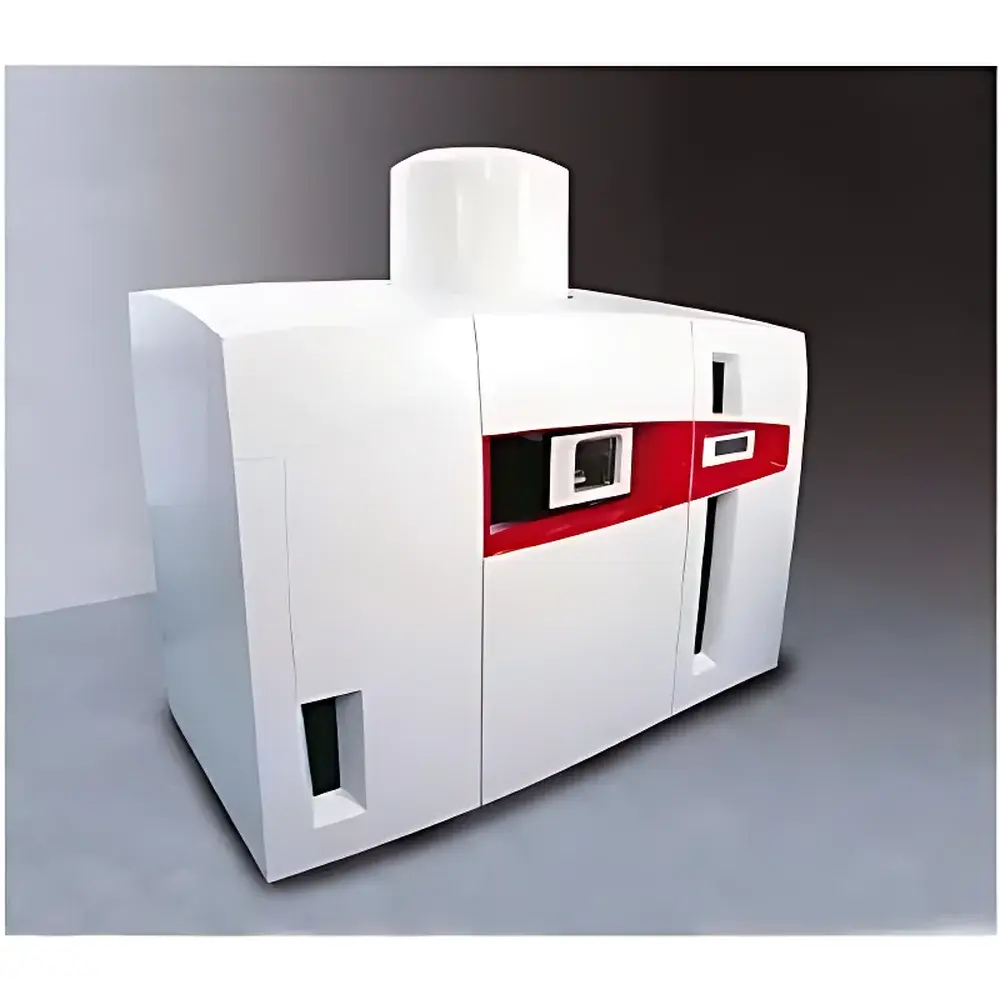
Shimadzu/Kratos AXIS Nova X-ray Photoelectron Spectrometer
| Brand | Shimadzu |
|---|---|
| Origin | United Kingdom |
| Manufacturer | Kratos Analytical (a Shimadzu company) |
| Type | AXIS Nova |
| Category | Import Instrument |
| Pricing | Upon Request |
Overview
The Shimadzu/Kratos AXIS Nova is a high-performance, imaging-capable X-ray Photoelectron Spectrometer (XPS) engineered for quantitative surface chemical analysis at sub-micron spatial resolution. Based on the core principles of photoemission physics—where monochromatic Al Kα or Mg Kα X-rays irradiate a sample surface to eject photoelectrons whose kinetic energy is measured by a hemispherical electron energy analyzer—the AXIS Nova delivers exceptional energy resolution, detection sensitivity, and spatial mapping fidelity. Developed by Kratos Analytical in Manchester, UK—a pioneer in commercial XPS instrumentation since the 1970s—and now fully integrated into Shimadzu Corporation’s global analytical platform, the AXIS Nova represents over two decades of iterative advancement in lens design, charge neutralization, and detector architecture. Its operational foundation rests on three interdependent innovations: a high-brightness micro-focused X-ray source, an immersion magnetic lens system that maximizes collection solid angle and transmission efficiency, and a 165 mm mean-radius double-focusing hemispherical analyzer optimized for <0.45 eV full-width-at-half-maximum (FWHM) energy resolution at pass energy 10 eV.
Key Features
- Immersion magnetic lens optics: Enhances photoelectron collection efficiency by >3× compared to conventional electrostatic lenses, enabling high signal-to-noise ratio spectra even from low-cross-section elements or ultra-thin films.
- Second-generation Delay-Line Detector (DLD): A position-sensitive, two-dimensional array detector located at the focal plane of the hemispherical analyzer; acquires full-spectrum data (binding energy vs. intensity) in ≤5 seconds with simultaneous spatial encoding—enabling rapid survey scans and high-throughput depth profiling.
- Co-axial low-energy electron flood gun: Integrated within the electrostatic transfer lens, delivering precise, tunable charge compensation for insulating samples—including rough, porous, or particulate surfaces such as fractured cross-sections, catalyst powders, and polymer blends—without inducing surface damage or spectral distortion.
- Spherical mirror energy analyzer: Positioned concentrically with the main hemispherical analyzer, this auxiliary optic enables parallel acquisition of photoelectron images with ≤5 µm spatial resolution, supporting chemical-state-specific elemental mapping (e.g., distinguishing Si⁰, SiO₂, and SiC domains).
- Automated 4-inch sample stage: Motorized XYZ translation with ±0.1 µm repeatability, integrated optical microscope (10×–100× zoom) in load-lock chamber for pre-analysis site selection, and programmable multi-point analysis routines compliant with ASTM E1521 and ISO 18118 surface analysis standards.
Sample Compatibility & Compliance
The AXIS Nova accommodates a broad range of solid-state specimens—including conductive metals, semiconductors, ceramics, polymers, thin-film stacks, and heterogeneous composites—without requiring conductive coating. Its dual-mode charge neutralization (low-energy electrons + optional Ar⁺ ion beam for sputter cleaning) ensures stable, reproducible spectra from challenging insulators such as glass, oxides, and biological coatings. The system meets ISO/IEC 17025 requirements for calibration traceability and supports GLP/GMP-compliant operation through audit-trail-enabled software logging (21 CFR Part 11 ready). All vacuum subsystems conform to UHV specifications (<5 × 10⁻¹⁰ mbar base pressure), ensuring minimal hydrocarbon contamination during extended acquisition sessions.
Software & Data Management
Controlled via Kratos’ Vision software suite, the AXIS Nova provides intuitive workflow-driven acquisition, real-time spectral visualization, and automated peak fitting using CasaXPS-compatible algorithms. Data export formats include VAMAS, CDF, and ASCII-compatible .txt for third-party quantification (e.g., QUASES, Scofield sensitivity factors). The software enforces user-access hierarchies, electronic signature capture, and immutable metadata tagging—including instrument configuration, calibration history, and environmental parameters—to satisfy regulatory documentation requirements in pharmaceutical, aerospace, and semiconductor QA/QC environments.
Applications
- Surface oxidation state identification in battery cathode materials (e.g., Ni²⁺/Ni³⁺/Ni⁴⁺ ratios in NMC layered oxides)
- Interface chemistry characterization of ALD-grown dielectric stacks on Si wafers
- Corrosion product speciation on stainless steel weld zones
- Functional group distribution mapping across printed organic electronics substrates
- Depth-resolved contamination analysis of medical device polymer surfaces post-sterilization
FAQ
What vacuum level does the AXIS Nova maintain during analysis?
The system operates under ultra-high vacuum conditions, achieving a base pressure of ≤5 × 10⁻¹⁰ mbar in the analysis chamber using a combination of turbomolecular pumping and non-evaporable getter (NEG) technology.
Can the AXIS Nova perform angle-resolved XPS (AR-XPS)?
Yes—the motorized sample stage supports precise tilt control from –90° to +90°, enabling AR-XPS for non-destructive depth profiling of surface layers down to ~2 nm.
Is the delay-line detector compatible with synchrotron radiation sources?
While optimized for laboratory-based monochromated X-ray sources, the DLD architecture supports external photon source synchronization via TTL trigger input for hybrid synchrotron-lab experiments.
How is energy calibration performed and verified?
Calibration uses Au 4f₇/₂ (84.0 eV), Cu 2p₃/₂ (932.7 eV), and Ag 3d₅/₂ (368.3 eV) reference standards; automated daily verification routines are configurable within Vision software.
Does the system support automated batch analysis of multiple samples?
Yes—through Vision’s scriptable macro engine and integrated barcode reader option, users can define unattended multi-sample workflows with auto-focus, region-of-interest targeting, and report generation.




