
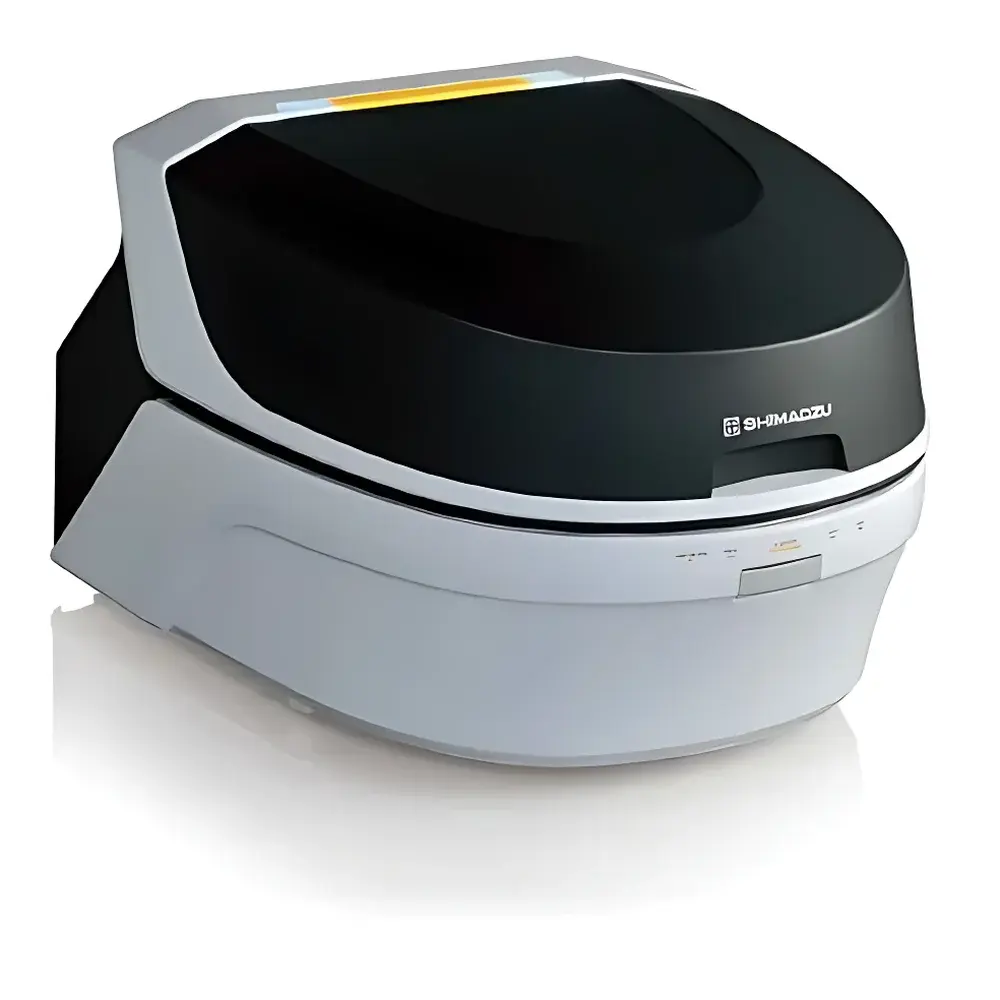
Shimadzu EDX-8100 Energy Dispersive X-Ray Fluorescence Spectrometer
| Brand | Shimadzu |
|---|---|
| Origin | Japan |
| Manufacturer Type | Original Equipment Manufacturer (OEM) |
| Import Status | Imported |
| Model | EDX-8100 |
| Configuration | Benchtop & Floor-Standing Options |
| Application Scope | General-Purpose Elemental Analysis |
| Elemental Range | C (Z=6) to U (Z=92) |
| Quantification Range | 1 ppm – 99.99 wt% |
| Energy Resolution | <140 eV at Mn Kα |
| Repeatability | <0.1% RSD (Relative Standard Deviation) |
Overview
The Shimadzu EDX-8100 is a high-performance, benchtop- and floor-standing energy dispersive X-ray fluorescence (ED-XRF) spectrometer engineered for precision elemental analysis across research laboratories, quality control facilities, and regulatory-compliant manufacturing environments. Utilizing fundamental physical principles—primary X-ray excitation followed by detection of characteristic fluorescent X-rays emitted from sample atoms—the EDX-8100 delivers quantitative and semi-quantitative compositional data without destructive sample preparation. Its core architecture integrates a high-power X-ray tube, a silicon drift detector (SDD) with Peltier-based electronic cooling (eliminating the need for liquid nitrogen), and a fully motorized optical path enabling automated selection of collimators and primary beam filters. Designed for operational flexibility and analytical robustness, the system supports both air, vacuum, and helium-purged measurement atmospheres—critical for analyzing light elements (C–F) in volatile, hygroscopic, or porous matrices.
Key Features
- Light-element capability: Full spectral coverage from carbon (Z=6) to uranium (Z=92), enabled by helium gas purge or vacuum operation—essential for accurate quantification of low-Z elements in polymers, lubricants, soils, and battery materials.
- High-resolution detection: Silicon drift detector (SDD) with energy resolution <140 eV at Mn Kα (5.9 keV), ensuring clear peak separation for overlapping transitions (e.g., S Kα/Pb Mα, Cl Kα/Ca Kβ) and improved detection limits.
- Automated beam conditioning: Motorized turret supporting six primary beam filters (including OPEN) and four interchangeable collimators (1, 3, 5, and 10 mm Φ), yielding 24 unique excitation/detection configurations—optimized for micro-area analysis, bulk homogeneity assessment, or trace contamination screening.
- Thermal stability & reproducibility: Peltier-cooled SDD maintains consistent detector gain and noise characteristics over extended acquisition periods; repeatability <0.1% RSD for major element intensities under controlled conditions.
- Dual software platform: PCEDX-Navi for rapid pass/fail screening and routine QA/QC; PCEDX-Pro for advanced method development, matrix correction (fundamental parameters/F.P.), and compliance-ready reporting.
Sample Compatibility & Compliance
The EDX-8100 accommodates diverse physical forms—including liquids, wet solids, fine powders (sub-micron), and gas-filled porous media—via selectable atmospheric control. Helium purging enables reliable analysis of samples incompatible with vacuum (e.g., aqueous solutions, gels, or foams), while vacuum mode enhances sensitivity for ultra-trace light elements. The instrument meets essential international standards for analytical instrumentation: ISO 21043 (XRF general requirements), ASTM E1621 (standard test method for elemental analysis by ED-XRF), and supports audit trails and user access controls required under GLP and GMP frameworks. Data integrity features—including electronic signatures, version-controlled method files, and time-stamped raw spectra—are compatible with FDA 21 CFR Part 11 readiness when deployed with validated IT infrastructure.
Software & Data Management
PCEDX-Pro provides full spectral processing, peak deconvolution, background subtraction, and F.P.-based quantification with optional matrix-matched standard calibration. All 24 collimator/filter combinations are pre-registered in the method editor and automatically applied during sequence runs. Raw spectral data (.eds, .spe) and processed reports (.pdf, .xlsx) are stored with embedded metadata (operator ID, timestamp, instrument parameters, atmospheric condition). Batch analysis workflows support multi-sample queues with auto-reload positioning. Export modules enable seamless integration with LIMS platforms via ASTM E1382-compliant data exchange protocols. Audit logs record all parameter changes, calibration events, and report generations—facilitating internal review and external regulatory inspection.
Applications
- Routine alloy grade identification and positive material identification (PMI) in metal fabrication and aerospace supply chains.
- RoHS/ELV/WEEE compliance screening for regulated elements (Pb, Cd, Hg, Cr⁶⁺, Br) in electronics, plastics, and coatings.
- Geological surveying and mining QA: rapid determination of major oxides (SiO₂, Al₂O₃, Fe₂O₃) and trace metals (Ni, Co, V) in ores and sediments.
- Battery cathode/anode material characterization: LiCoO₂, NMC, LFP stoichiometry verification and transition metal impurity profiling.
- Forensic and failure analysis: micro-contamination mapping on semiconductor wafers, solder joint intermetallics, or corrosion products on failed components.
FAQ
Does the EDX-8100 require liquid nitrogen cooling?
No. It employs a thermoelectrically cooled silicon drift detector (SDD), eliminating cryogenic handling, dewar maintenance, and associated operational downtime.
Can it quantify carbon in polymer films?
Yes—when operated under helium purge or vacuum, the system achieves reliable C Kα detection and quantification down to ~100 ppm, subject to film thickness and substrate interference.
Is FP-based quantification validated for all 24 collimator/filter combinations?
Yes. Each configuration is independently characterized during factory calibration; PCEDX-Pro applies appropriate sensitivity coefficients and absorption corrections per combination.
What vacuum level is achievable, and how long does evacuation take?
The integrated scroll pump achieves ≤10 Pa within 90 seconds for standard 10 mm Φ sample chambers; optional turbo-molecular pumping reduces residual pressure to <1×10⁻² Pa for enhanced light-element performance.
How is method transfer supported between instruments?
PCEDX-Pro exports complete method packages—including spectral libraries, calibration curves, filter/collimator settings, and F.P. parameters—as encrypted .pem files, enabling consistent deployment across multi-site EDX-8100 installations.
Related Products




