
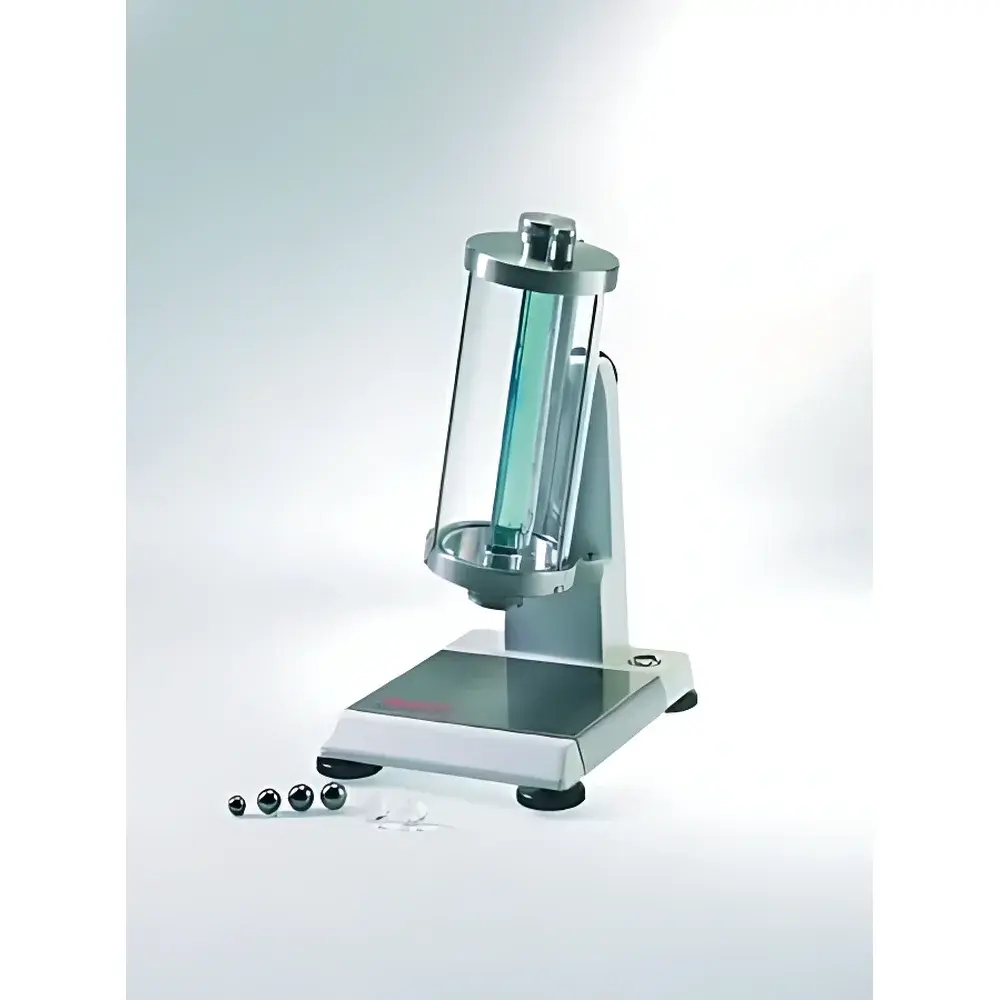
Thermo Fisher HAAKE Falling Ball Viscometer
| Brand | Thermo Fisher |
|---|---|
| Origin | Germany |
| Manufacturer | Thermo Fisher Scientific |
| Model | HAAKE Falling Ball |
| Instrument Type | Falling Ball Viscometer |
| Viscosity Range | 0.5 – 100,000 mPa·s |
| Temperature Range | −1 °C to +26 °C |
| Repeatability | < 0.5 % |
| Reproducibility | < 1 % |
| Measurement Tube Material | Borosilicate Glass (Tubes 1, 2, G) |
| Ball Materials | Nickel–Iron Alloy (Balls 3, 4, 5, 6) |
| Compliance | DIN 53015, ISO 120587 |
| Optional Accessories | Digital Stopwatch, Ball G (for gas viscosity), PT100 Temperature Sensor for HAAKE D50 Circulator |
Overview
The Thermo Fisher HAAKE Falling Ball Viscometer is a precision gravity-driven viscometer engineered for the accurate determination of dynamic viscosity in transparent Newtonian liquids and gases. Based on the classical falling (or rolling) ball principle, it operates under controlled thermal conditions within a precisely inclined borosilicate glass capillary tube. As a sphere descends—under gravitational force—through the test fluid over a defined distance, the transit time is measured. Viscosity is then calculated using the Stokes–Hagenbach equation, which relates terminal velocity, sphere density and diameter, fluid density, gravitational acceleration, and tube inclination angle. This method delivers high reproducibility and traceable results without requiring complex calibration fluids or shear-rate-dependent assumptions. Designed and manufactured in Germany, the instrument meets stringent metrological requirements outlined in DIN 53015 and ISO 120587, qualifying it as a reference-grade device suitable for regulatory-compliant laboratories, certified reference material (CRM) verification, and primary viscosity standardization.
Key Features
- Gravity-based measurement principle ensures intrinsic independence from mechanical drive systems, eliminating motor-induced vibration or torque artifacts
- Modular ball-and-tube configuration with six calibrated nickel–iron alloy spheres (Balls 3–6) and three borosilicate glass tubes (Tubes 1, 2, G) enabling broad dynamic range coverage (0.5–100,000 mPa·s)
- Integrated tilt-angle adjustment mechanism maintains consistent, repeatable tube inclination—critical for Stokes-law validity and inter-laboratory comparability
- Compatible with external temperature-controlled circulators (e.g., HAAKE D50) via PT100 sensor interface, supporting stable operation from −1 °C to +26 °C with ±0.02 °C thermal uniformity
- No moving parts in the measurement zone—minimizing wear, contamination risk, and maintenance overhead
- Direct mPa·s output aligned with SI-derived units; no conversion factors required for reporting in ISO/IEC 17025-accredited environments
Sample Compatibility & Compliance
The HAAKE Falling Ball Viscometer is validated for use with optically clear, particle-free Newtonian fluids—including organic solvents, polymer solutions, glycerol, sucrose syrups, mineral oils, and low-density gases (with Ball G). Non-Newtonian or opaque samples are excluded due to reliance on visual transit-time detection and laminar flow assumptions. The system complies fully with DIN 53015 (Viscosity Determination by Falling Ball Method) and ISO 120587 (Laboratory Glassware — Capillary Viscometers — Specifications and Test Methods), making it admissible in GLP, GMP, and pharmacopoeial workflows (e.g., USP for viscosity of ophthalmic solutions). All components are CE-marked and manufactured under ISO 9001-certified processes at Thermo Fisher’s German facility.
Software & Data Management
While the core instrument operates manually using a digital stopwatch, full traceability is supported through optional integration with Thermo Fisher’s HAAKE RheoWin software suite (via third-party timing modules). When paired with automated optical detection upgrades or synchronized PT100 logging, raw transit times, temperature logs, and calculated viscosities can be exported in CSV or ASTM E1382-compliant formats. Audit trails, user authentication, and electronic signatures align with FDA 21 CFR Part 11 requirements when deployed in regulated QC/QA settings. Calibration certificates include uncertainty budgets per EURAMET cg-12 guidelines.
Applications
- Quality control of solvent batches in fine chemical synthesis
- Viscosity verification of pharmaceutical excipients (e.g., propylene glycol, glycerin) per EP/USP monographs
- Stability assessment of edible oil oxidation products during accelerated shelf-life testing
- Reference measurements for calibrating rotational viscometers and capillary viscometers
- Gas-phase viscosity studies in inert atmospheres (using Ball G and vacuum-compatible fixtures)
- Academic rheology labs conducting fundamental validation of Newtonian behavior prior to advanced shear-rate sweeps
FAQ
Is the HAAKE Falling Ball Viscometer suitable for non-Newtonian fluids?
No. It is strictly limited to Newtonian, optically transparent media where laminar, steady-state flow around the sphere is assured.
What temperature stability is required for ±0.5% viscosity accuracy?
A circulator maintaining ±0.05 °C stability across the measurement zone is recommended; the built-in PT100 interface enables real-time thermal correction in post-processing.
Can this instrument be used for ISO/IEC 17025 accreditation?
Yes—provided documented calibration of timing devices, traceable temperature sensors, and validated tube/ball geometry are maintained per ILAC-G24 requirements.
How often must the glass tubes and balls be recalibrated?
Annually or after mechanical impact; dimensional verification of tube bore and ball sphericity (per ISO 3290) is advised before critical reference measurements.
Does Thermo Fisher provide NIST-traceable calibration services?
Yes—factory calibration includes certificate of conformance with uncertainties referenced to NIST SRM 2490c (viscosity standards) and NIST SP 250-95 (temperature standards).



