
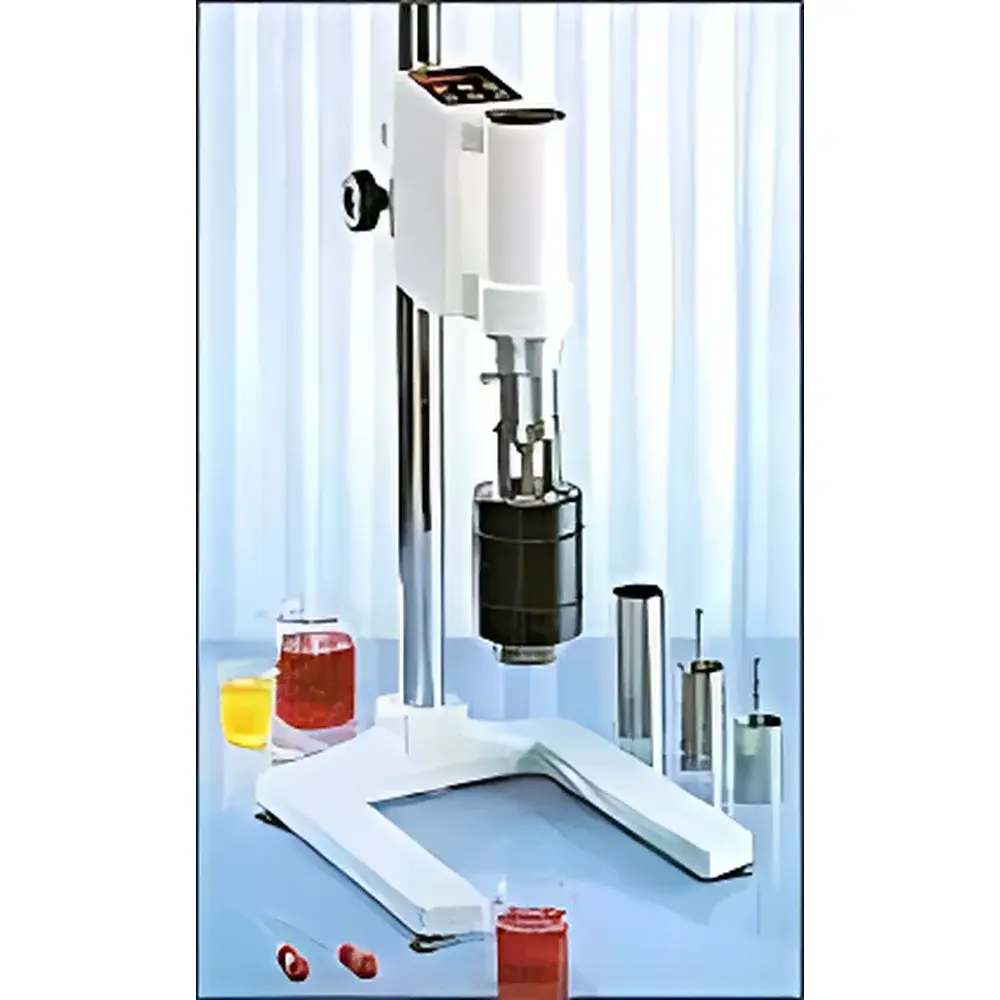
HAAKE VT550 Advanced Rotational Viscometer
| Brand | HAAKE |
|---|---|
| Origin | Germany |
| Instrument Type | Rotational Viscometer |
| Model | VT550 |
| Measurement Principle | Searle (rotating spindle) geometry |
| Viscosity Range | 2–10⁷ mPa·s |
| Speed Range | 0.5–800 rpm |
| Torque Range | 0.1–50 mN·m (up to 400 rpm) |
| Temperature Range | −40 °C to +350 °C (with external temperature control unit) |
| Compliance Standards | ISO 2555, ISO 3219, DIN 53018, DIN 53019 |
| Operating Modes | Controlled Rate (CR), Controlled Deformation (CD) |
| Predefined Protocols | 10 factory-programmed routines |
| Display | Integrated LCD with digital readout |
| Output | Real-time digital display and optional thermal printout |
Overview
The HAAKE VT550 is a high-precision rotational viscometer engineered for absolute viscosity measurement across an exceptionally broad dynamic range—from low-viscosity liquids such as solvents and mineral oils to highly structured semi-solids including polymer melts, pharmaceutical gels, and ceramic suspensions. Based on the Searle principle, the instrument operates by rotating a spindle (rotor) at a defined angular velocity within the sample while measuring the torque required to maintain that speed. This torque, combined with known geometric constants of the spindle and the imposed shear rate, enables direct calculation of shear stress and shear rate—yielding absolute viscosity (η = τ/γ̇) in SI units (mPa·s). Unlike relative or empirical instruments, the VT550 delivers traceable, standards-compliant rheological data suitable for regulatory submissions, quality control documentation, and comparative material characterization.
Key Features
- Two operational modes: Controlled Rate (CR) for standard viscosity profiling and Controlled Deformation (CD) for yield stress determination and non-Newtonian flow behavior analysis
- Wide speed range (0.5–800 rpm) with high-resolution motor control enabling precise shear rate sweeps from 0.01 s⁻¹ to >1,000 s⁻¹ (dependent on spindle geometry)
- High-sensitivity torque transducer with dual-range capability: ±0.1–50 mN·m (≤400 rpm) and ±0.1–20 mN·m (≤800 rpm), ensuring optimal resolution across viscosity orders of magnitude
- Modular spindle architecture supporting all internationally standardized geometries—including coaxial cylinder (ISO 3219/DIN 53018), cone-and-plate (DIN 53019), parallel plate, immersion sensors (ISO 3219/DIN 53019), and relative sensors (ISO 2555)
- Integrated 10-routine firmware library covering routine QC tests (e.g., time-scan, ramp, step-shear), eliminating manual protocol setup and reducing operator error
- LCD interface with real-time numeric display of viscosity, shear stress, shear rate, torque, and temperature—no external PC required for basic operation
Sample Compatibility & Compliance
The VT550 accommodates heterogeneous, particulate-laden, and thermally sensitive samples through its flexible spindle selection. Immersion-type spindles enable testing of high-fill composites and coarse suspensions; cone-and-plate configurations provide uniform shear fields ideal for low-volume, shear-thinning formulations such as topical creams and inkjet inks. All measurements adhere to internationally recognized standards: ISO 2555 (relative viscosity of polymer solutions), ISO 3219 (rotational methods for viscoelastic fluids), DIN 53018 (coaxial cylinder), and DIN 53019 (cone-and-plate and parallel-plate geometries). The system supports GLP/GMP-aligned workflows via optional audit-trail-enabled software and complies with FDA 21 CFR Part 11 requirements when integrated with validated data acquisition platforms.
Software & Data Management
While standalone operation is fully functional via the front-panel interface, the VT550 is compatible with Thermo Scientific™ RheoWin™ software (v4.x or later) for advanced data capture, curve fitting, and report generation. RheoWin supports automated sequence execution, multi-step protocols (e.g., oscillatory pre-shear followed by steady-shear ramp), and export to CSV, PDF, and XML formats. Raw torque/time and viscosity/shear rate datasets are timestamped and include metadata (spindle ID, temperature, ambient pressure if logged), facilitating traceability in regulated environments. Exported files retain full calibration coefficients, enabling third-party validation and inter-laboratory comparison without proprietary format dependency.
Applications
- Food Science: Yield stress quantification of chocolate masses, flow profiling of starch-thickened sauces, stability assessment of emulsified beverages, and gelation kinetics of pectin-based desserts
- Pharmaceuticals & Cosmetics: Viscosity mapping of O/W and W/O emulsions,屈服应力 (yield point) determination for topical ointments and toothpaste extrudability, and shear-thinning behavior of surfactant-based shampoos and liquid soaps
- Paints & Coatings: Application viscosity of waterborne latex paints, sag resistance evaluation of architectural coatings, and thixotropic recovery testing of rheology-modified systems
- Chemical & Polymer Industry: Solution viscosity of PVC plastisols, molecular weight estimation via intrinsic viscosity (via ISO 2555), and processing window definition for thermoplastic melts using temperature-ramped shear sweeps
FAQ
What spindle geometries are supported by the VT550?
The VT550 accepts all major standardized spindles: coaxial cylinders (ISO 3219/DIN 53018), cone-and-plate (DIN 53019), parallel plates, immersion sensors (ISO 3219/DIN 53019), and relative sensors (ISO 2555). Custom spindles may be calibrated upon request.
Can the VT550 measure yield stress?
Yes—using Controlled Deformation (CD) mode, the instrument applies incremental torque until sample flow initiates, allowing precise yield stress determination per ASTM D4440 or ISO 3219 Annex B.
Is temperature control integrated?
No—the VT550 itself does not include a built-in Peltier or bath system; however, it interfaces seamlessly with external circulators (e.g., Haake Phoenix, Julabo F25) for temperature-controlled measurements from −40 °C to +350 °C.
Does the instrument comply with FDA 21 CFR Part 11?
Standalone operation does not meet Part 11 requirements; however, when paired with validated RheoWin software and appropriate IT infrastructure (electronic signatures, audit trails, secure user roles), full compliance is achievable.
How is calibration verified?
Calibration is performed using NIST-traceable silicone oil standards across three viscosity points (low, medium, high). Certificate of Calibration includes uncertainty budget per ISO/IEC 17025 and is supplied with each instrument shipment.



