
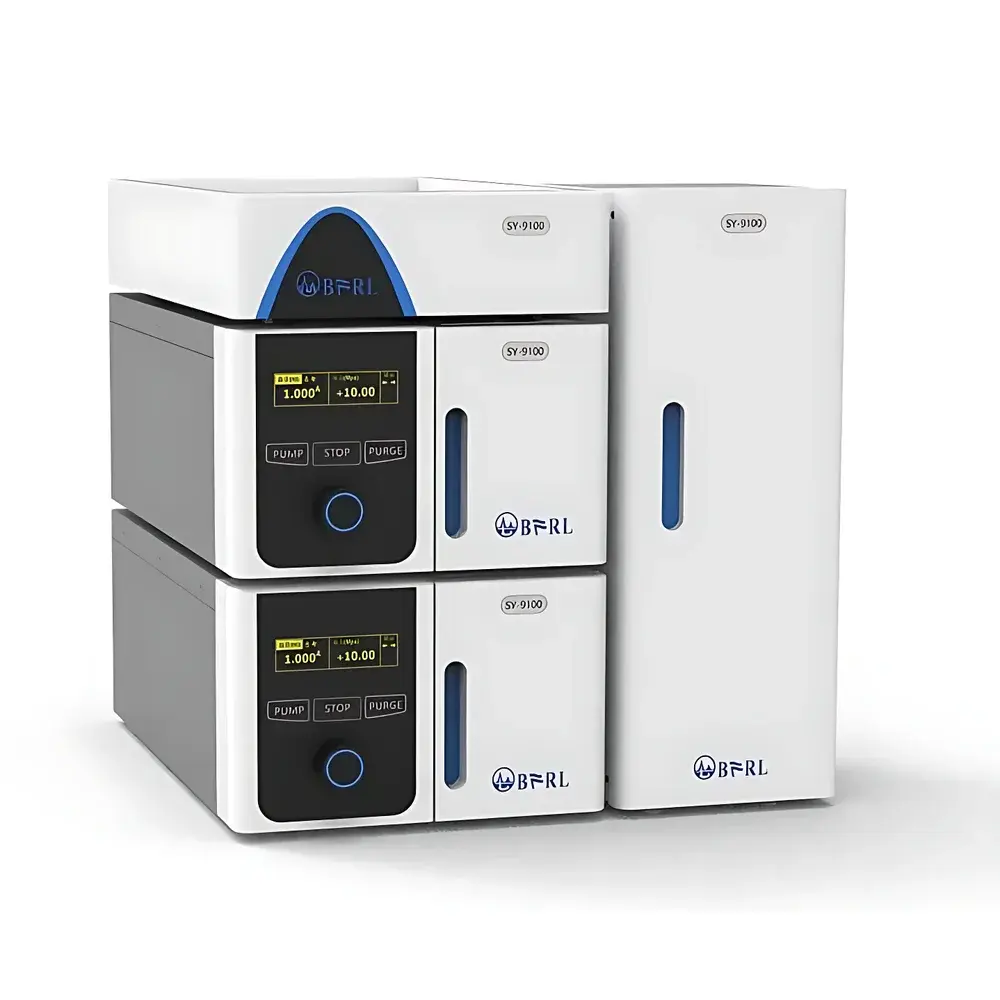
Beifen Ruili SY-9100 High-Performance Liquid Chromatograph
| Brand | Beifen Ruili |
|---|---|
| Origin | Beijing, China |
| Manufacturer Type | Authorized Distributor |
| Regional Classification | Domestic (PRC) |
| Model | SY-9100 |
| Price Range | USD 14,000–28,000 |
| Instrument Type | Conventional HPLC System |
| Application Scope | General-purpose analytical use |
| Flow Rate Range | 0.001–9.999 mL/min (0.001 mL/min increment) |
| Maximum Operating Pressure | 42 MPa |
| Flow Precision | <0.1% RSD |
| Sample Tray Capacity | 96 positions (1.5 mL vials) |
| Injection Volume Range | 1–100 µL |
| Column Oven Temperature Range | Ambient +5 °C to 100 °C |
| UV-Vis Wavelength Range | 190–800 nm |
| Data Acquisition Frequency | 50 Hz |
Overview
The Beifen Ruili SY-9100 is a fully integrated, conventional high-performance liquid chromatograph engineered for precision, robustness, and long-term operational stability in routine laboratory environments. Based on classical reversed-phase and normal-phase separation principles, the system employs high-pressure gradient elution with dual-pump solvent delivery, enabling reliable retention time reproducibility and peak resolution across diverse analyte classes. Its architecture conforms to standard HPLC design conventions—including low-dead-volume fluidic pathways, thermally stabilized column compartment, and dual-wavelength UV-Vis detection—making it suitable for method development, quality control release testing, and academic research workflows where regulatory traceability and instrument reliability are foundational requirements.
Key Features
- Modular solvent manager supporting up to four independent mobile phase reservoirs—enabling flexible gradient programming beyond binary configurations without hardware modification.
- High-pressure quaternary pump with real-time electronic pulse damping, minimizing pulsation-induced baseline noise and improving retention time reproducibility (<0.1% RSD over 24 h).
- Dual-channel UV-Vis detector operating simultaneously at two user-selectable wavelengths (190–800 nm), facilitating co-elution analysis, ratio monitoring, or orthogonal detection strategies within a single run.
- Column oven with PID-controlled heating and forced-air circulation, maintaining temperature stability within ±0.3 °C across the full 5–100 °C range—critical for method transfer and retention time consistency.
- Autosampler with 96-position 1.5 mL vial capacity, precise syringe-driven injection mechanism (1–100 µL range, 0.1 µL resolution), and needle wash station to prevent cross-contamination.
- Integrated PC-based chromatography data system (CDS) offering full bidirectional control of all modules, method storage, sequence management, peak integration, calibration curve generation, and audit-trail-enabled reporting.
Sample Compatibility & Compliance
The SY-9100 accommodates standard 3.9–4.6 mm ID analytical columns (up to 250 mm length) and is compatible with common reversed-phase (C18, C8), HILIC, ion-exchange, and size-exclusion stationary phases. It supports aqueous/organic mobile phases including water, methanol, acetonitrile, phosphate buffers, and trifluoroacetic acid modifiers. The system meets essential mechanical and electrical safety standards per GB/T 18268 (equivalent to IEC 61326-1) and complies with general laboratory instrumentation requirements under ISO/IEC 17025:2017 for test and calibration laboratories. While not pre-certified for 21 CFR Part 11, its software architecture supports configurable user access levels, electronic signatures, and activity logging—facilitating internal validation for GLP/GMP-aligned environments.
Software & Data Management
The embedded chromatography workstation provides intuitive method editor, real-time chromatogram display, automated peak detection and integration (with customizable baseline algorithms), and quantitative report generation (area%, height%, external/internal standard). Raw data files are stored in vendor-neutral .CDF format (compatible with third-party processing tools). Audit trail functionality records all user actions—including method changes, sequence edits, integration parameter adjustments, and result approvals—with timestamps and operator IDs. Export options include PDF, CSV, and XML formats for LIMS integration. Software updates are delivered via secure HTTPS channel with version-controlled release notes.
Applications
The SY-9100 is routinely deployed in pharmaceutical QC labs for assay, related substances, and dissolution testing per USP and EP 2.2.46; in environmental laboratories for pesticide residue analysis (EPA Method 8081B/8321B); in food safety testing for mycotoxins and preservatives (AOAC Official Methods); and in university research for natural product isolation, polymer characterization, and metabolite profiling. Its broad wavelength coverage and thermal stability also support method development for stability-indicating assays and forced degradation studies.
FAQ
Is the SY-9100 compliant with FDA 21 CFR Part 11?
The system supports essential Part 11 elements—including role-based access control, electronic signatures, and audit trails—but requires site-specific validation documentation and procedural controls to achieve full compliance.
Can the autosampler accommodate 2 mL vials or microtiter plates?
The standard configuration supports only 1.5 mL screw-thread vials in a 96-well footprint; 2 mL vial trays and 96-well plate adapters are available as optional accessories.
What is the minimum dwell volume of the gradient system?
The integrated solvent manager has a total system dwell volume of approximately 750 µL, optimized for method transfer from other mid-range HPLC platforms.
Does the UV detector support variable bandwidth or spectral scanning?
No—the detector operates in fixed-bandwidth (±2 nm) absorbance mode at two simultaneous wavelengths; it does not provide full-spectrum acquisition or photodiode array capability.
Is remote monitoring or cloud-based data backup supported?
Local network connectivity (Ethernet) enables remote desktop access and shared folder-based data archiving; native cloud synchronization is not implemented but can be configured via institutional IT infrastructure.
Related Products





