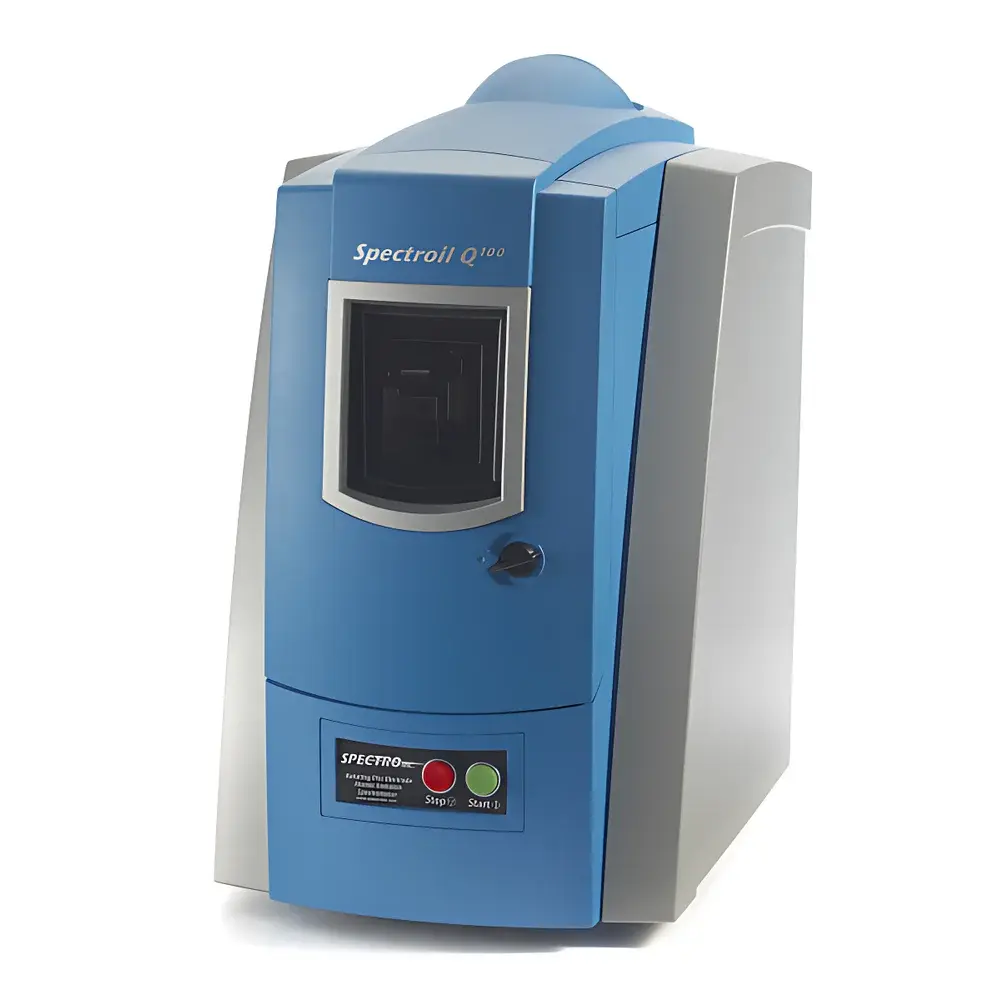
Spectro Scientific N99903 RDE Spectrometer for Coolant Elemental Analysis
| Brand | Spectro Scientific |
|---|---|
| Origin | USA |
| Model | N99903 |
| Application | Elemental analysis of engine coolants (antifreeze), lubricating oils, fuel oils, and greases |
| Measurement principle | Rotating Disc Electrode (RDE) atomic emission spectroscopy |
| Analysis time | ≤30 seconds per sample |
| Sample preparation | None required |
| Consumables | No carrier gas required |
| Element count | Up to 13 elements simultaneously quantifiable in coolant matrices |
| Compliance | Designed for ASTM D6595-compliant operation |
| Instrument class | Benchtop laboratory spectrometer |
| Regulatory context | Supports GLP/GMP data integrity requirements via audit-trail-capable software |
Overview
The Spectro Scientific N99903 is a dedicated rotating disc electrode (RDE) atomic emission spectrometer engineered for rapid, quantitative elemental analysis of engine coolants—commonly referred to as antifreeze/coolant fluids. Unlike generic ICP or XRF systems, the N99903 implements a proprietary RDE excitation source optimized for low-viscosity, aqueous-glycol-based coolant matrices. It operates on the fundamental principle of arc discharge between a rotating graphite electrode (loaded with a microliter-volume coolant droplet) and a counter-electrode, generating plasma that emits element-specific wavelengths. These emissions are resolved by a fixed-grating polychromator and detected via photomultiplier tubes calibrated for 13 critical wear, contaminant, and additive elements—including sodium (Na), potassium (K), boron (B), calcium (Ca), magnesium (Mg), silicon (Si), iron (Fe), copper (Cu), aluminum (Al), lead (Pb), zinc (Zn), tin (Sn), and phosphorus (P). With no requirement for digestion, dilution, or solvent extraction, the N99903 delivers results in under 30 seconds while maintaining analytical reproducibility (RSD < 5% at typical coolant concentration levels) across routine laboratory workflows.
Key Features
- Single-platform capability for multi-fluid analysis: validated protocols for ethylene glycol– and propylene glycol–based coolants, as well as lubricating oils, diesel fuel, and grease extracts.
- RDE optical architecture eliminates dependency on argon or nitrogen purge gases—reducing operational cost and infrastructure complexity.
- Zero-solvent methodology: avoids use of chlorinated or aromatic hydrocarbons, aligning with EPA Method 6010D and ISO 8573-1 air purity guidelines for lab environments.
- Pre-loaded, coolant-specific calibration curves traceable to NIST SRM 2720a (Coolant Standard) and internal reference materials certified per ISO/IEC 17025.
- Benchtop footprint (45 × 52 × 38 cm) with integrated touchscreen interface and Ethernet connectivity for LIMS integration.
- Self-diagnostic optics module with real-time lamp intensity monitoring and automatic wavelength verification.
Sample Compatibility & Compliance
The N99903 accepts undiluted, homogenized coolant samples (minimum volume: 150 µL) directly from field-collected bottles or OEM-supplied test kits. It accommodates both conventional silicate-based and extended-life organic acid technology (OAT) formulations without matrix interference. Analytical performance meets ASTM D6595 “Standard Test Method for Determination of Wear Metals and Contaminants in Used Lubricating Oils and Coolants by Rotating Disc Electrode Atomic Emission Spectrometry.” Data output complies with FDA 21 CFR Part 11 requirements when paired with Spectro’s SpectroSoft v5.2—supporting electronic signatures, role-based access control, and immutable audit trails. Instrument qualification documentation (IQ/OQ/PQ) templates are provided for GxP-regulated facilities.
Software & Data Management
SpectroSoft v5.2 provides full instrument control, method management, and report generation. Its coolant-specific module includes automated trend tracking against OEM-recommended limits (e.g., Caterpillar SOS, Cummins QuickServe, Volvo VDS-4), customizable alert thresholds, and deviation flagging per SAE J1834 guidelines. All raw spectral data, calibration logs, and user actions are stored in encrypted SQLite databases with SHA-256 hashing. Export formats include CSV, PDF, and XML (ASTM E1382-compliant), enabling seamless ingestion into enterprise asset management (EAM) or predictive maintenance platforms.
Applications
- Early detection of cylinder liner cavitation (via elevated Fe, Cu, Al)
- Identification of heat exchanger corrosion (Si, Ca, Mg anomalies)
- Monitoring of inhibitor depletion (B, P, Zn trends over service interval)
- Contamination screening (Na, K ingress indicating hard-water top-off or seawater leakage)
- Cross-fluid contamination assessment (e.g., glycol in lube oil sump via B or Na spikes)
- Validation of coolant batch consistency during manufacturing QA/QC
FAQ
Does the N99903 require daily recalibration?
No—calibration stability is verified weekly using a certified coolant reference standard; drift correction is applied automatically during each analysis sequence.
Can it analyze concentrated coolant concentrates (neat glycol)?
Yes, but only after dilution to typical service concentration (30–60% glycol in water); undiluted concentrates exceed optimal plasma excitation conditions and require method adaptation.
Is method transfer possible from legacy Spectro instruments?
Yes—calibration files and spectral libraries from Spectro OilView and Spectro LubeScan systems are natively importable into SpectroSoft v5.2.
What maintenance intervals apply to the RDE electrode assembly?
Graphite electrodes are consumables rated for ≥1,000 analyses; automatic wear compensation is applied during peak integration.
How does the system handle samples with suspended solids or rust particles?
Samples must be centrifuged or filtered (0.45 µm) prior to analysis; particulate matter can cause arc instability and signal suppression.