
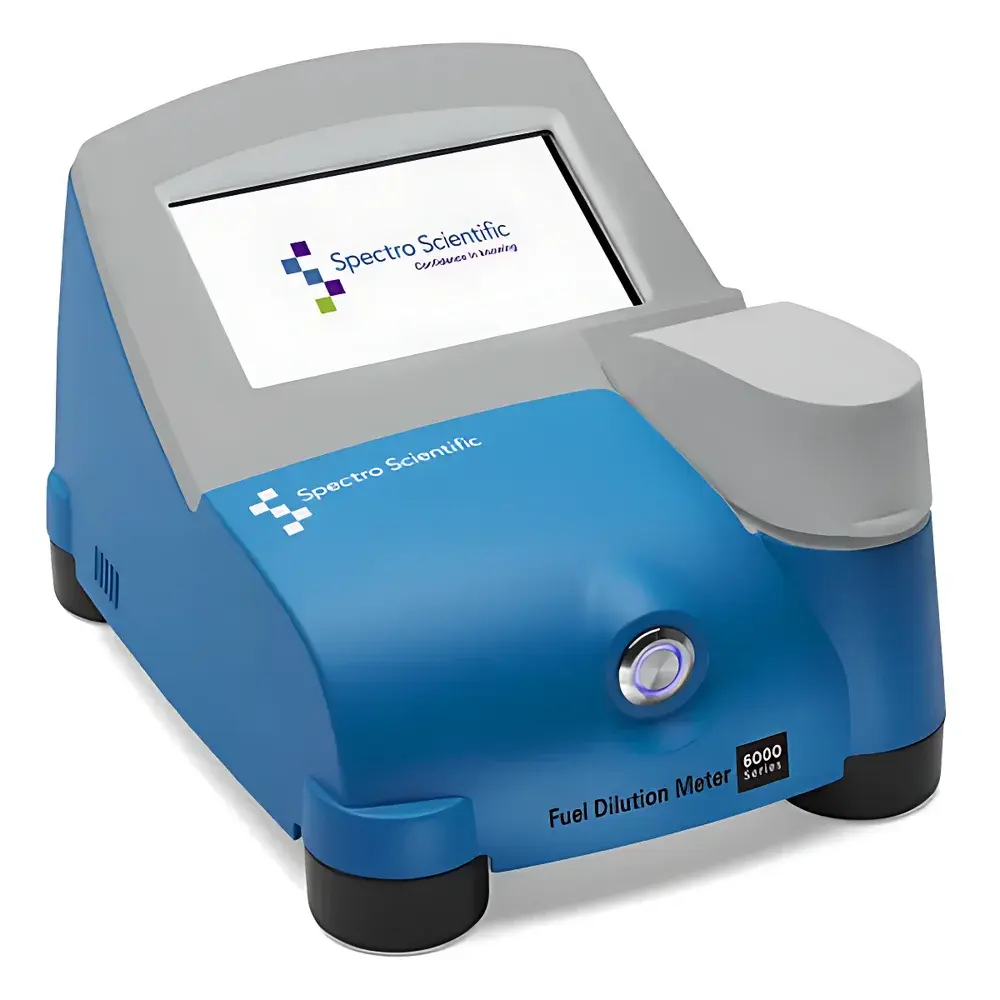
Spectro Scientific FDM 6000 Fuel Dilution Meter
| Brand | Spectro Scientific |
|---|---|
| Origin | USA |
| Model | FDM 6000 |
| Type | Portable Instrument |
| Detection Principle | Surface Acoustic Wave (SAW) Sensor Technology |
| Measurement Range | 0.2–15% fuel dilution (v/v) |
| Repeatability | ≤5% RSD |
| Analysis Time | ≤120 seconds per sample |
| Sample Volume | <1 mL |
| Power Source | Rechargeable lithium-ion battery |
| Data Storage | Up to 3 calibration curves |
| Display | Color touchscreen interface |
| Compliance | Designed for ASTM D7943-22 and ISO 4406-aligned maintenance practices |
| Software Guidance | Multilingual audio-assisted operation (including English voice prompts) |
Overview
The Spectro Scientific FDM 6000 Fuel Dilution Meter is a field-deployable, surface acoustic wave (SAW)-based analytical instrument engineered for rapid, quantitative determination of fuel contamination in in-service engine oils. Unlike indirect methods such as gas chromatography or Fourier-transform infrared (FTIR) spectroscopy—which require solvent extraction, lengthy sample preparation, and laboratory infrastructure—the FDM 6000 employs a direct headspace vapor-phase detection principle. It measures volatile hydrocarbon signatures from the ullage space above an undiluted oil sample, enabling real-time assessment of diesel or gasoline dilution without chemical reagents or consumables. Developed in collaboration with the U.S. Navy, the instrument addresses critical operational reliability concerns in marine propulsion systems, heavy-duty transport fleets, and stationary power generation assets where uncontrolled fuel dilution accelerates wear, reduces viscosity, compromises oxidation stability, and increases risk of catastrophic lubricant failure.
Key Features
- SAW sensor architecture optimized for hydrocarbon vapor selectivity—minimizing cross-sensitivity to water, glycol, or oxidation byproducts
- “Sawtooth” sensor design enhancing signal-to-noise ratio and achieving ≤5% relative standard deviation (RSD) across repeated measurements
- Extended linear dynamic range: 0.2% to 15% v/v fuel dilution, covering both incipient contamination and severe degradation scenarios
- Compact form factor (24 × 15 × 8 cm) and integrated rechargeable lithium-ion battery supporting ≥100 analyses per charge
- Intuitive color touchscreen interface with context-sensitive prompts and configurable language options—including English audio-guided workflow navigation
- Onboard calibration management: stores up to three user-defined or factory-certified calibration curves, each traceable to NIST-traceable reference oils
- No solvent, no consumables, no waste disposal—fully compliant with OSHA and EPA field-use guidelines for hazardous material handling
Sample Compatibility & Compliance
The FDM 6000 is validated for use with mineral-based, synthetic, and semi-synthetic engine oils meeting API CK-4, FA-4, CJ-4, and ACEA E9/E7 specifications. It accommodates samples collected via standard vacuum sampling pumps or dip-tube protocols, requiring only 0.8–1.0 mL of unfiltered, unheated oil placed directly into a 20-mL glass vial. The system conforms to ASTM D7943-22 (“Standard Practice for Determining Fuel Dilution in In-Service Diesel Engine Lubricants Using Surface Acoustic Wave Sensors”) and supports alignment with ISO 4406:2017 particle contamination reporting frameworks when integrated into predictive maintenance programs. While not a GLP-certified instrument per se, its audit-ready calibration logs, timestamped result export (CSV), and firmware version tracking meet baseline requirements for ISO/IEC 17025-accredited laboratories conducting condition-based oil analysis.
Software & Data Management
Data acquisition and reporting are managed through embedded firmware (v3.2+), which records measurement time, ambient temperature, sensor response amplitude, and calculated dilution percentage with automatic rounding to 0.1%. Results export via USB-C to CSV files compatible with Spectro’s FluidScan® LubeSuite™ database or third-party CMMS platforms (e.g., IBM Maximo, SAP PM). Firmware updates are delivered via secure HTTPS endpoint; all calibration history—including date, operator ID, reference oil lot number, and pass/fail verification status—is retained for ≥5 years. Optional Bluetooth module enables wireless synchronization with mobile tablets running Spectro’s FieldLink™ companion app for geotagged sampling and fleet-level trend visualization.
Applications
- Routine monitoring of diesel-powered locomotives, marine auxiliary engines, and mining haul trucks during scheduled maintenance windows
- Troubleshooting abnormal oil consumption or low-viscosity readings identified during routine elemental spectroscopy (ICP-OES)
- Verification of fuel injector integrity following overhaul or replacement in compression-ignition systems
- Supporting MIL-STD-3007B and NAVSEA S9086-UB-PRO-010 compliance for naval vessel propulsion oil health surveillance
- Integration into OEM service bulletins requiring on-site fuel dilution verification prior to warranty claim adjudication
- Field validation of crankcase ventilation system performance in natural gas-fueled reciprocating engines
FAQ
What types of fuel can the FDM 6000 detect?
It quantifies diesel fuel, gasoline, and jet fuel (JP-5, JP-8) dilution in engine oils, based on shared hydrocarbon volatility profiles detectable by SAW sensing.
Does the instrument require daily calibration?
No—calibration is performed at installation and after firmware updates; verification checks using reference standards are recommended every 30 days or 50 tests, whichever occurs first.
Can results be exported to enterprise asset management systems?
Yes—CSV exports include ISO 8601 timestamps, sample IDs, and metadata fields compatible with common CMMS and ERP data ingestion protocols.
Is the FDM 6000 suitable for use in explosive atmospheres?
It is not ATEX or IECEx certified; operation is restricted to non-hazardous locations per NFPA 70E and OSHA 1910.120 guidelines.
How does the FDM 6000 compare to FTIR-based fuel dilution analysis?
While FTIR offers broader contaminant screening capability, the FDM 6000 delivers superior precision for fuel-specific quantification in field environments, with faster turnaround, lower operational cost, and no dependency on optical alignment or spectral library maintenance.






