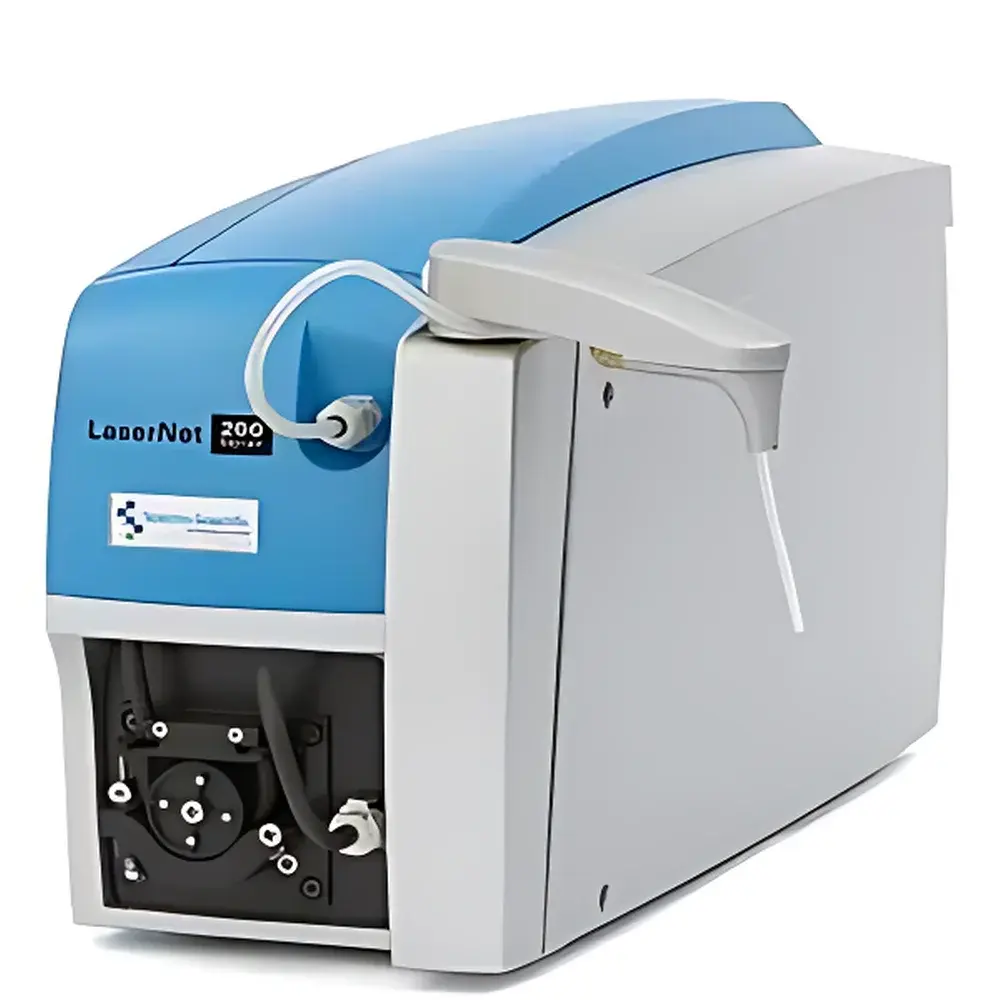
Spectro Scientific LaserNet 200 Series Multi-Function Ferrographic Analyzer
| Brand | Spectro Scientific |
|---|---|
| Origin | USA |
| Model | LaserNet 200 Series |
| Particle Sizing Range | 4–100 µm |
| Max. Particle Concentration | 10,000,000 particles/mL (<2% error) |
| Viscosity Compatibility | ISO VG 15–320 (no dilution required) |
| Ferrous Particle Detection Time | 20 s |
| Standards Compliance | ASTM D7596, ASTM D6786, ASTM D8120, ISO 4406, NAS 1638, SAE AS4059, NAVAIR 01-1A-17, GOST, HAL |
Overview
The Spectro Scientific LaserNet 200 Series Multi-Function Ferrographic Analyzer is an automated direct-imaging particle analysis system engineered for precision lubricant condition monitoring in predictive maintenance programs. Unlike traditional optical particle counters or offline ferrography, the LaserNet 200 employs high-resolution laser microscopy combined with real-time image acquisition and AI-assisted morphological classification to deliver simultaneous quantitative and qualitative assessment of wear debris and contamination in used oils. Its core measurement principle relies on digital imaging of individual particles suspended in a thin oil film under controlled flow, enabling deterministic sizing (4–100 µm), shape analysis, and material-based categorization without reliance on light extinction or scattering assumptions. Designed specifically for reliability engineers and tribology specialists in power generation, marine propulsion, aerospace, and heavy industrial OEMs, the system supports both routine fleet-level oil health screening and root-cause failure analysis—providing actionable data within minutes of sample loading.
Key Features
- Automated particle counting, sizing distribution, and cleanliness code assignment per ISO 4406, NAS 1638, SAE AS4059, NAVAIR 01-1A-17, GOST, and HAL standards
- Direct imaging-based ferrous particle detection and quantification per ASTM D8120, reporting large ferrous particle concentration (PPM), percent large ferrous particles (PLFP), and Ferrous Wear Severity Index (FWSI)
- Real-time discrimination between water droplets, air bubbles, and solid particles using refractive index and edge morphology analysis—eliminating false counts common in turbid or soot-laden oils
- Intelligent automatic classification of wear particles ≥20 µm into seven morphologically distinct categories: cutting wear, sliding wear, fatigue wear, non-metallic debris (e.g., silica, fiber), water droplets, air bubbles, and fibers
- Laser auto-gain control enabling reliable imaging of heavily sooted oils with soot content >1% w/w, without pre-treatment or dilution
- Viscosity range coverage from ISO VG 15 to ISO VG 320 hydraulic and turbine oils—no solvent dilution required
- High dynamic range particle capacity up to 107 particles/mL with <2% counting error at saturation limit
- Optional Automated Sample Processor (ASP) for unattended batch analysis of up to 40 samples with barcode tracking and integrated QC flagging
Sample Compatibility & Compliance
The LaserNet 200 Series is validated for use with mineral-based, synthetic, and semi-synthetic lubricants—including turbine oils, hydraulic fluids, engine oils, gear oils, and distillate fuels. It meets the technical requirements of ASTM D7596 (“Standard Test Method for Automatic Particle Counting and Particle Shape Classification Using Direct Imaging”) and supports full regulatory traceability for GLP and GMP environments. Data integrity features include audit-trail logging per FDA 21 CFR Part 11 requirements, user-access controls, electronic signature support, and immutable result archiving. All reported cleanliness codes, FWSI values, and particle category distributions are fully traceable to raw image metadata and calibrated pixel-to-micron mapping protocols.
Software & Data Management
Powered by Spectro’s proprietary NetView™ software, the LaserNet 200 provides intuitive workflow navigation, customizable reporting templates, and embedded statistical process control (SPC) tools. Trend analysis modules enable longitudinal tracking of particle population shifts across fleets or individual assets—supporting early detection of abnormal wear onset, filter breakthrough events, or ingress contamination. Export formats include CSV, PDF, XML, and LIMS-compatible ASTM E1384-compliant structured data. Integrated database architecture allows role-based access to historical datasets, comparative benchmarking against OEM-specific alarm thresholds, and automated alerting via email or enterprise notification systems.
Applications
- Rotating equipment health monitoring (turbines, compressors, pumps, gearboxes)
- Condition-based maintenance decision support for critical infrastructure assets
- Root-cause analysis of catastrophic failures through wear mode correlation
- Filter performance validation and service interval optimization
- Oil reclamation and recycling qualification testing
- Supplier quality assurance for new lubricants and components
- Field-deployable diagnostics for offshore platforms and remote installations
FAQ
Does the LaserNet 200 require oil dilution prior to analysis?
No—its optical design and laser gain compensation allow direct analysis of undiluted oils across ISO VG 15–320 viscosity grades.
Can it distinguish rust particles from machining debris?
Yes—morphological classification algorithms differentiate crystalline iron oxide (rust) from ductile ferrous shear debris based on edge sharpness, aspect ratio, and surface texture features.
Is calibration traceable to NIST standards?
Yes—particle sizing calibration is performed using NIST-traceable polystyrene latex (PSL) microspheres and verified annually per ISO/IEC 17025-accredited procedures.
What is the minimum sample volume required?
Only 3–5 mL of used oil is needed for a complete analysis cycle including particle count, ferrous quantification, and wear classification.
How does it handle highly opaque or carbon-rich oils?
The system’s adaptive laser illumination and dynamic contrast enhancement ensure consistent image fidelity even in oils with >1% soot content, eliminating manual exposure adjustments.