
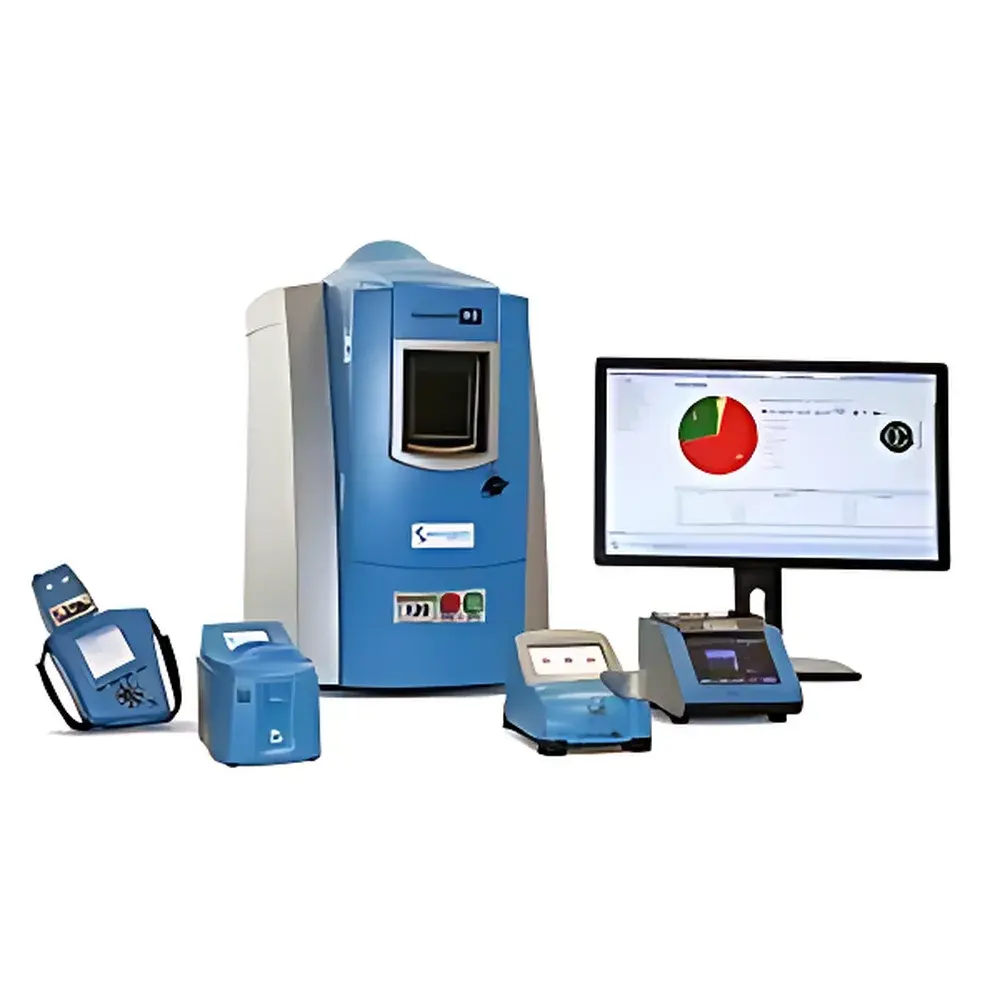
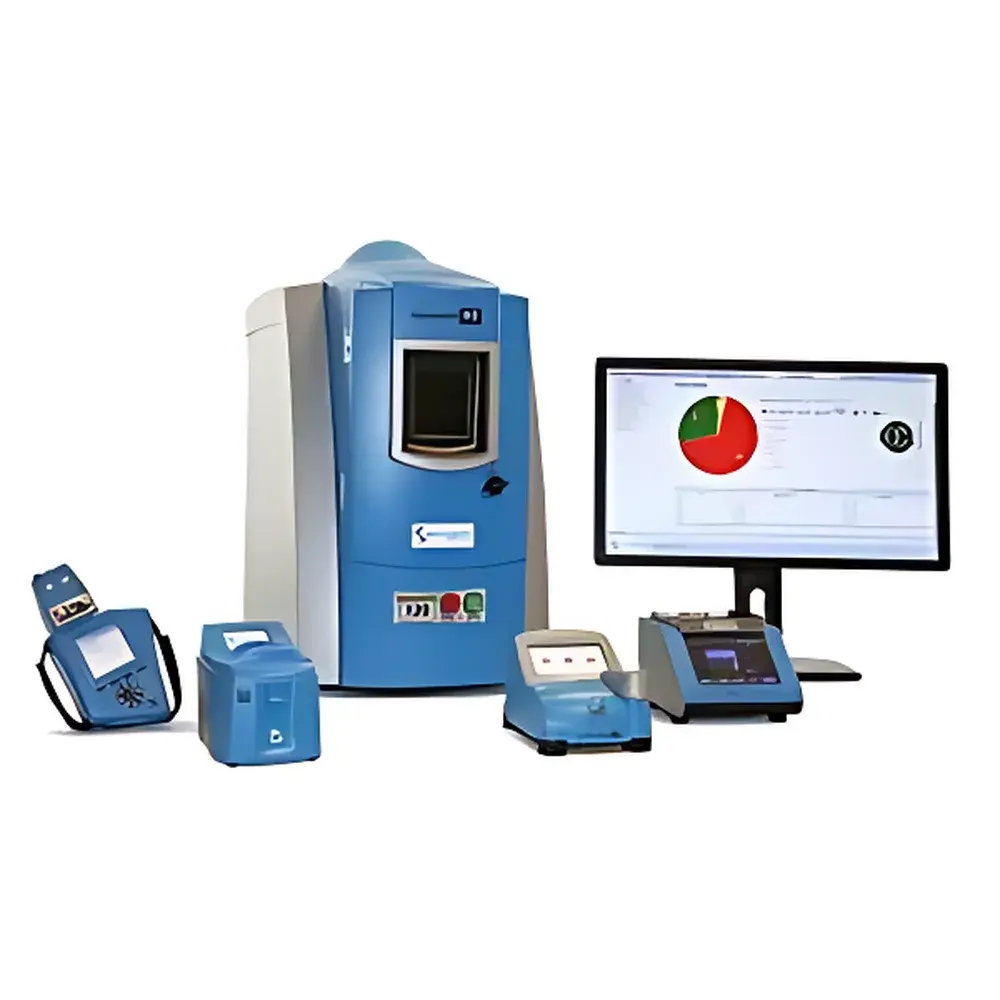
MiniLab EL – Spectro Scientific Portable Engine Oil Analysis System
| Brand | Spectro Scientific |
|---|---|
| Origin | USA |
| Model | MiniLab EL |
| Application | Elemental Analysis of Lubricating Oils |
| Instrument Type | Benchtop/Field-Deployable Laboratory Analyzer |
| Compliance | Designed for ASTM D6595, ASTM D5185, ISO 8217, SAE J183, MIL-STD-3007 |
Overview
The MiniLab EL is a field-deployable, benchtop-grade elemental oil analysis system engineered by Spectro Scientific (USA) for real-time condition monitoring of lubricating oils in high-performance internal combustion and gas turbine engines. It employs rotary anode X-ray fluorescence (XRF) spectroscopy—a non-destructive, matrix-independent technique—to quantify wear metals (e.g., Fe, Cu, Al, Cr, Pb), contaminants (Si, Na, B), and additive elements (Ca, Zn, P, Mg) at parts-per-trillion (ppt) to parts-per-million (ppm) detection levels. Unlike laboratory-based ICP-OES or ICP-MS, the MiniLab EL delivers lab-equivalent precision without sample digestion or acid preparation, enabling on-site analysis during engine development, dynamometer testing, or in-service fleet maintenance. Its architecture supports traceability, repeatability, and regulatory alignment—making it suitable for engineering validation, predictive maintenance programs, and OEM service bulletins requiring documented oil health metrics.
Key Features
- Rotary anode XRF excitation source with dual-target configuration (Rh/Mo) for optimized sensitivity across light and heavy elements
- Integrated sample handling: automated 12-position carousel accommodating standard 25-mm or 32-mm oil cups; optional magnetic stirrer for homogeneous suspension of particulates
- Self-calibrating optical path with real-time drift correction using internal reference standards
- Ruggedized chassis rated IP54 for operation in hangar, test cell, or mobile maintenance units
- Embedded thermal management system ensuring stable detector response across ambient temperatures from 10 °C to 40 °C
- Pre-loaded spectral libraries compliant with ASTM D6595 (XRF analysis of used lubricants) and ASTM D5185 (multi-element determination in new and used oils)
Sample Compatibility & Compliance
The MiniLab EL accepts neat engine oils (mineral, synthetic, bio-based), hydraulic fluids, gear oils, and turbine oils—including those formulated with high-zinc anti-wear additives or ashless dispersants. It accommodates viscosity ranges from ISO VG 22 to VG 680 and water content up to 1.5% v/v without interference. All analytical protocols adhere to ISO/IEC 17025–accredited methodologies when operated under controlled environmental conditions. The system supports GLP-compliant audit trails, including user authentication logs, instrument calibration history, and raw spectrum archiving. Data outputs are structured to meet FAA Advisory Circular AC 120-17B (engine oil monitoring for turbine aircraft) and SAE AIR4176 (oil analysis for reciprocating engine fleets).
Software & Data Management
The MiniLab software suite comprises two interoperable modules: MiniLab Device Console (MDC) and MiniLab LIMS. MDC runs locally on Windows OS and provides instrument control, spectral acquisition, peak deconvolution, and QC flagging (e.g., inter-element interference, low count statistics). It assigns unique identifiers to samples and assets, timestamps all measurements, and exports XML-formatted data packets to the LIMS layer. MiniLab LIMS is a browser-based platform deployable on-premise or via AWS-hosted infrastructure. It enables centralized management of multi-site analyzers, configurable alarm thresholds per asset class, automated trend reporting (e.g., Fe/Cu ratio over time), PDF/CSV report generation with embedded spectral overlays, and SMTP-triggered notifications upon threshold breach. All data transactions comply with FDA 21 CFR Part 11 requirements when configured with electronic signatures and role-based access controls.
Applications
- Aerospace: Monitoring turbine bearing wear in commercial jet engines (CFM56, LEAP, PW1000G families); detecting fuel dilution and glycol contamination in auxiliary power units
- Heavy-duty transportation: Tracking piston ring wear in Class 8 diesel engines; validating extended drain intervals for natural gas–fueled transit buses
- Marine propulsion: Assessing crankcase oil degradation in medium-speed four-stroke diesel generators operating on residual fuel blends
- R&D laboratories: Accelerating lubricant formulation screening by correlating additive depletion rates with oxidative stability metrics
- Military ground vehicles: Enabling forward-deployed diagnostics for Abrams M1A2 and Bradley A4 platforms under field conditions
FAQ
Does the MiniLab EL require daily recalibration?
No—its self-referencing XRF optics and built-in reference foils enable stable performance for up to 72 hours between verification checks. Daily verification with a certified control oil is recommended but not mandatory per ASTM D6595.
Can it analyze greases or solid debris?
Not directly. The MiniLab EL is optimized for liquid-phase analysis. Grease samples must be solvent-extracted into base oil prior to measurement; ferrographic filters require separate imaging analysis.
Is remote firmware update supported?
Yes—MiniLab LIMS includes secure OTA (over-the-air) update capability with SHA-256 signature verification and rollback protection.
What is the typical turnaround time per sample?
From cup loading to final report generation: ≤90 seconds for full 22-element quantification, including background subtraction and matrix correction.
How does it handle high-sulfur fuels or biodiesel blends?
The Rh/Mo dual-target excitation and multivariate calibration models explicitly account for sulfur Kα interference and oxygen absorption effects, maintaining accuracy across ULSD, B20, and FAME-contaminated samples.






