
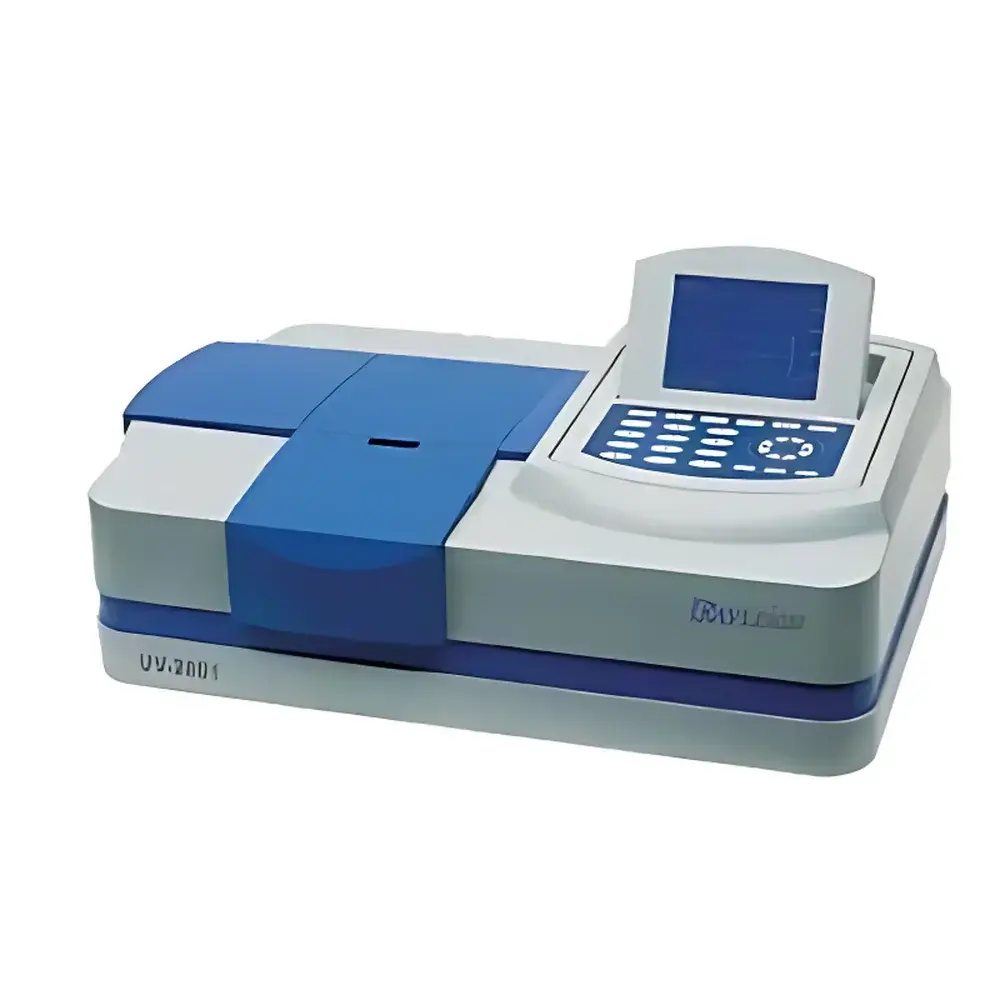
Beifen Ruili UV-2601 Dual-Beam Ultraviolet-Visible Spectrophotometer
| Brand | Beifen Ruili |
|---|---|
| Origin | Beijing, China |
| Model | UV-2601 |
| Optical Design | Dual-beam |
| Detector | Photodiode Array |
| Wavelength Range | 190–1100 nm |
| Wavelength Accuracy | ±0.3 nm |
| Spectral Bandwidth | 0.5–5.0 nm (5 selectable steps) |
| Stray Light | ≤0.1% T (at 220 nm using NaI |
| Display | 6-inch high-brightness blue LCD |
| Light Sources | Socket-type deuterium lamp and tungsten-halogen lamp |
| Power Supply | AC 220 V/50 Hz or 110 V/60 Hz |
| Power Consumption | 200 W |
| Dimensions (W×D×H) | 630 × 470 × 210 mm |
| Net Weight | 26 kg |
Overview
The Beifen Ruili UV-2601 Dual-Beam Ultraviolet-Visible Spectrophotometer is engineered for precision absorbance, transmittance, and concentration measurements across the full UV-Vis spectrum (190–1100 nm). Based on dual-beam optical architecture, it continuously compares sample and reference beam intensities in real time—minimizing drift caused by source instability or environmental fluctuations. This design ensures high photometric stability and measurement reproducibility, critical for quantitative analysis in regulated environments. The instrument employs a Czerny-Turner monochromator with optimized grating and mirror coatings, coupled with imported socket-type deuterium and tungsten-halogen lamps to deliver consistent spectral output over extended operational lifetimes. Its modular detector system uses a linear photodiode array for rapid data acquisition without mechanical scanning, enabling efficient wavelength scanning and kinetic monitoring.
Key Features
- Dual-beam optical path with real-time background correction for enhanced baseline stability and long-term photometric repeatability.
- Five-step adjustable spectral bandwidth (0.5, 1.0, 2.0, 4.0, and 5.0 nm), compliant with pharmacopeial requirements including USP and EP 2.2.25 for resolution-critical assays.
- High-accuracy wavelength calibration traceable to NIST-standard holmium oxide and didymium filters; wavelength accuracy maintained at ±0.3 nm across the entire range.
- Low stray light performance (≤0.1% T at 220 nm with NaI and 360 nm with NaNO₂), essential for high-dynamic-range measurements in nucleic acid and protein quantification.
- Integrated 6-inch blue-backlit LCD interface with intuitive menu navigation—enabling standalone operation without external PC dependency.
- Automated 8-position 10-mm cuvette holder with optional wide-format 4-cell accessory accommodating cuvettes from 5 mm to 50 mm pathlengths; dual-hinged lid design improves ergonomics and optical sealing.
- Robust power management supporting both 110 V/60 Hz and 220 V/50 Hz inputs; internal non-volatile memory retains method parameters and measurement history after power loss.
Sample Compatibility & Compliance
The UV-2601 supports standard quartz, glass, and plastic cuvettes (10 mm nominal pathlength), as well as custom cells up to 50 mm. It is routinely deployed in laboratories adhering to GLP and GMP frameworks, where documented instrument qualification (IQ/OQ/PQ) is required. While not pre-certified for FDA 21 CFR Part 11, its RS232 serial interface (with optional RS485 and USB variants) enables integration into validated LIMS or ELN systems supporting electronic signature and audit trail functionality. The instrument meets IEC 61010-1 safety standards and complies with electromagnetic compatibility (EMC) requirements per EN 61326-1. Its optical performance aligns with ISO 9001 quality assurance protocols and ASTM E275 for spectrophotometer characterization.
Software & Data Management
PC-based control software (optional) provides expanded functionality including advanced spectral processing (first-, second-, and third-order derivative analysis), time-scan kinetics modeling, multi-wavelength ratio calculations, and DNA/protein A260/A280 ratio reporting. All acquired spectra and quantitative results are exportable in CSV and ASCII formats for downstream statistical analysis in tools such as OriginLab or GraphPad Prism. Internal memory stores up to 500 spectra and 1,000 quantitative records. Data integrity is preserved through timestamped entries and user-defined method naming. Optional password-protected access levels support role-based operation in shared-lab environments.
Applications
- Pharmaceutical QC: Active pharmaceutical ingredient (API) assay, dissolution testing, and excipient purity verification per USP and ChP monographs.
- Biochemical analysis: Quantification of dsDNA, ssDNA, RNA, and proteins using extinction coefficients and standard curves.
- Environmental monitoring: Nitrate, phosphate, and heavy metal ion detection via colorimetric reagent-based methods (e.g., APHA Standard Methods).
- Food and beverage testing: Measurement of antioxidants (e.g., polyphenols), colorants (e.g., anthocyanins), and contaminants (e.g., melamine).
- Educational use: Teaching core spectroscopic principles—including Beer-Lambert law validation, spectral deconvolution, and filter characterization—in undergraduate and graduate chemistry labs.
- Clinical research: Hemoglobin derivative analysis, enzyme kinetics (e.g., LDH, ALP), and immunoassay development support.
FAQ
Is the UV-2601 compliant with pharmacopeial wavelength accuracy requirements?
Yes—the ±0.3 nm wavelength accuracy satisfies USP , EP 2.2.25, and JP 17 specifications for UV-Vis instrumentation used in pharmaceutical testing.
Can the instrument perform kinetic measurements over extended time periods?
Yes—time-scan mode supports acquisition intervals from 0.1 s to 600 s per point, with up to 10,000 data points per run, suitable for enzyme reaction monitoring and stability studies.
What cuvette materials are supported for UV-range measurements?
Quartz cuvettes are required for measurements below 350 nm; fused silica or high-transmission synthetic quartz is recommended for optimal UV throughput and durability.
Does the system support automated data export to laboratory information management systems (LIMS)?
Via RS232 (standard) or optional USB/RS485 interfaces, raw and processed data can be transmitted to LIMS platforms configured for ASCII-based ingestion and metadata tagging.
Is firmware upgrade capability available?
Yes—firmware updates are delivered via USB flash drive and applied through the onboard menu system, preserving all user methods and calibration settings during installation.






