
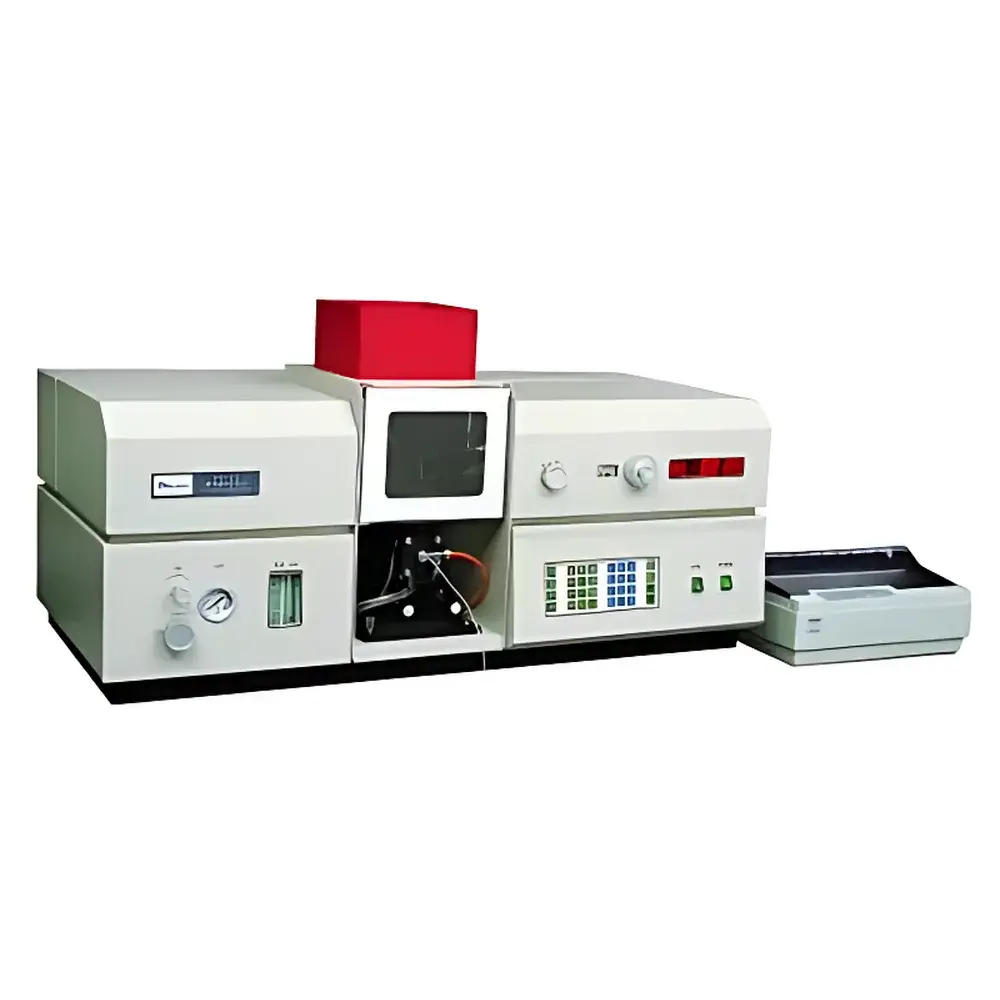
WFX-320 Flame Atomic Absorption Spectrophotometer
| Brand | Beifen Ruili |
|---|---|
| Origin | Beijing, China |
| Model | WFX-320 |
| Instrument Type | Flame AAS |
| Monochromator | Plane Grating |
| Optical System | Single-beam |
| Detector | Photomultiplier Tube (PMT) |
| Resolution | Resolves Mn 279.5 nm and 279.8 nm doublet with valley energy <36% |
| Sensitivity | Cu 0.04 µg/mL per 1% absorption |
| Repeatability (RSD) | ≤0.9% (flame mode) |
| Detection Limit | Cu 0.007 µg/mL (flame mode) |
| Optional Accessory | Hydride Generation System |
Overview
The WFX-320 Flame Atomic Absorption Spectrophotometer is a rigorously engineered benchtop analytical instrument designed for routine quantitative elemental analysis of aqueous and acid-digested samples in environmental, geological, food safety, and industrial quality control laboratories. It operates on the fundamental principle of atomic absorption spectroscopy: ground-state free atoms in a flame atomizer absorb characteristic radiation from a hollow cathode lamp at element-specific wavelengths; the degree of absorption is quantitatively related to analyte concentration via the Beer–Lambert law. Optimized for flame-based atomization only, the WFX-320 delivers robust performance for high-throughput determination of over 60 metallic elements—including Na, K, Ca, Mg, Fe, Cu, Zn, Mn, Pb, Cd, and Cr—without graphite furnace complexity or cost overhead.
Key Features
- Single-beam optical architecture with plane grating monochromator ensures stable spectral dispersion and precise wavelength selection across 190–900 nm range.
- High-sensitivity photomultiplier tube detector provides low-noise signal acquisition and supports detection limits down to 0.007 µg/mL for copper under standardized flame conditions.
- Integrated host microcomputer enables full instrument control—including lamp current regulation, wavelength scanning, slit width selection, and background correction—without external PC dependency.
- Optimized flame atomization system with air-acetylene combustion delivers reproducible atomization efficiency, achieving RSD ≤0.9% for repeated measurements under identical operating parameters.
- Resolution verified against the Mn 279.5/279.8 nm doublet, confirming spectral separation capability compliant with ISO 11042-1 and ASTM E1993 requirements for line-pair resolution in flame AAS instrumentation.
- Modular design allows seamless integration of an optional hydride generation accessory for trace-level determination of As, Se, Sb, Bi, Te, Sn, Pb, and Ge—extending method flexibility while maintaining core flame platform integrity.
Sample Compatibility & Compliance
The WFX-320 accommodates standard 10–50 mL liquid samples in polypropylene or borosilicate glass vials. It is compatible with common sample preparation protocols including open-vessel acid digestion (HNO₃/HCl/HF), microwave-assisted digestion, and dilution series for calibration. Instrument operation adheres to key regulatory frameworks: measurement traceability aligns with ISO/IEC 17025:2017 laboratory competence requirements; spectral validation procedures follow ISO 11042-1 for resolution verification; and flame AAS methodology conforms to EPA Method 7000B, ISO 11885, and ASTM D1688 for metal analysis in water and wastewater. While not inherently 21 CFR Part 11-compliant due to its embedded microcomputer architecture, audit-ready data export (CSV, TXT) supports GLP/GMP-aligned record retention when paired with validated laboratory information management systems (LIMS).
Software & Data Management
The built-in microcomputer runs proprietary firmware supporting real-time absorbance monitoring, multi-point calibration curve generation (linear, quadratic, or forced-zero), and automatic concentration calculation with internal standard correction. Data are stored internally and exportable via USB interface to external storage devices in ASCII-compatible formats. No proprietary software installation is required for basic operation; however, optional Windows-based data management software (sold separately) enables advanced reporting, statistical analysis (e.g., confidence intervals, ANOVA), and electronic signature support for regulated environments. All calibration and measurement records include timestamp, operator ID, lamp type, wavelength, slit width, and flame gas flow settings—ensuring full method traceability.
Applications
- Environmental monitoring: quantification of heavy metals (Pb, Cd, Cu, Zn) in surface water, groundwater, and wastewater per national discharge standards.
- Food and agricultural testing: determination of essential (Fe, Zn, Cu) and toxic (As, Pb, Cd) elements in cereals, dairy products, and soil extracts.
- Pharmaceutical excipient screening: verification of elemental impurities (ICH Q3D Class 1 & 2 elements) in raw materials and intermediates.
- Industrial process control: rapid analysis of catalyst residues, plating bath composition, and alloy dissolution samples in metallurgical QA/QC labs.
- Educational use: ideal platform for undergraduate and graduate teaching of atomic spectroscopy fundamentals, calibration theory, and instrumental error analysis.
FAQ
Is the WFX-320 suitable for graphite furnace analysis?
No—the WFX-320 is a dedicated flame atomic absorption spectrophotometer and does not support electrothermal atomization. For sub-ppt detection capabilities, users should consider complementary GF-AAS platforms.
Can the instrument be connected to a LIMS or enterprise network?
Direct network connectivity is not supported; however, exported data files are interoperable with most LIMS platforms via automated file ingestion workflows.
What maintenance is required for long-term stability?
Routine maintenance includes daily burner head cleaning, monthly alignment verification using Cu hollow cathode lamp, and annual PM involving optical path inspection and gas flow calibration.
Does the system support background correction?
Yes—deuterium arc background correction is implemented as a hardware-integrated function to compensate for non-specific absorption and scattering effects in complex matrices.
Is hydride generation included by default?
No—hydride generation is an optional accessory requiring separate purchase and mechanical/electrical integration with the flame atomizer base unit.
Related Products





