
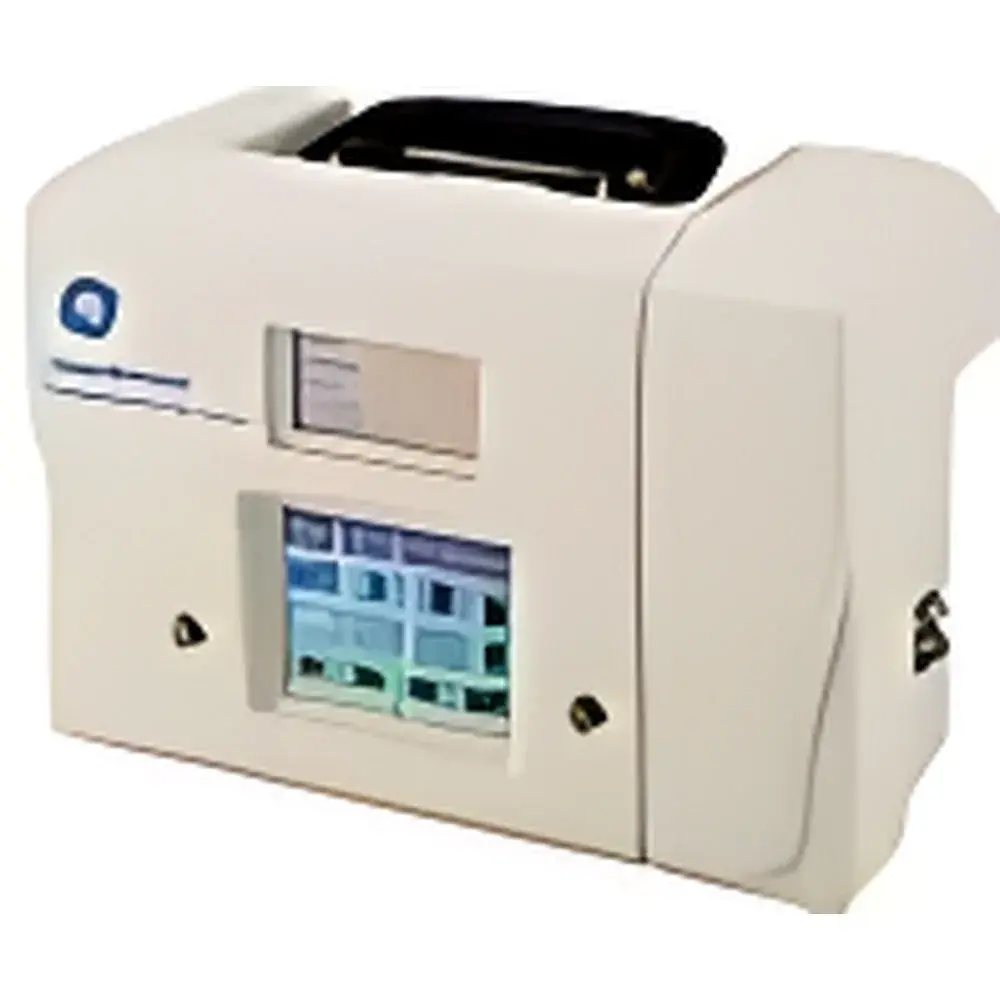
Sievers CheckPoint Portable/Online Total Organic Carbon Analyzer
| Brand | Sievers/Veolia |
|---|---|
| Origin | USA |
| Manufacturer Type | Authorized Distributor |
| Product Category | Imported Instrument |
| Model | CheckPoint |
| Pricing | Available Upon Request |
| Detection Range | 0.05–1,000 ppb C |
| Precision | Greater of <1% RSD or 0.05 ppb (online, 20–40 °C) |
| Analysis Modes | Online continuous averaging, online timed sampling, offline grab sampling |
| Analysis Time | 15 s (online), 10 min (grab) |
| TOC Calibration Interval | 6 months |
| Conductivity Tolerance | Up to 1.4 µS/cm (0.7 MΩ·cm) CO₂-compensated conductivity |
| Conductivity Precision | ±0.5% RSD (20–40 °C) |
| Conductivity Accuracy | ±2.0% |
| Conductivity Calibration Interval | 6 months |
| Operating Pressure (Online) | 15–100 psi |
| Low-Pressure Sampling | Max. 0.70 m head above analyzer |
| Minimum Online Flow Rate | >60 mL/min |
| Power Supply | 100–240 V ±10%, 60 W, 50/60 Hz |
| Sample Temperature Range | 10–90 °C |
| Ambient Operating Temperature | 10–40 °C |
| Enclosure Rating | Indoor use only |
| I/O Options | Ethernet, 2 analog outputs, 2 alarm outputs, parallel inputs |
| Installation Category | Overvoltage Category II |
| Dimensions (H×W×D) | 25.4 × 30.48 × 15.24 cm (standard) |
| Weight | 2.9 kg (no battery), 3.58 kg (with battery), +0.6 kg (vial sampler) |
| Safety Certifications | CE, ETL Listed |
Overview
The Sievers CheckPoint Portable/Online Total Organic Carbon Analyzer is a compact, dual-mode analytical instrument engineered for high-reliability TOC quantification in regulated water systems—particularly purified water (PW) and water for injection (WFI) used in pharmaceutical, biotechnology, and medical device manufacturing. It employs patented UV-persulfate oxidation coupled with highly sensitive, non-dispersive infrared (NDIR) detection to convert organic carbon compounds into CO₂, which is then measured with trace-level accuracy. Unlike traditional benchtop TOC analyzers, the CheckPoint is purpose-built for both permanent online installation and rapid field deployment, enabling real-time process monitoring and compliance verification without sacrificing laboratory-grade data integrity. Its design adheres to core regulatory expectations outlined in USP , EP 2.2.44, JP 2.59, and ASTM D5905, supporting routine validation, trend analysis, and deviation investigation under GMP environments.
Key Features
- True Dual-Mode Operation: Seamlessly transitions between online continuous monitoring (15-second cycle time) and offline grab sampling—eliminating the need for separate instruments or method transfers.
- Battery-Powered Portability: Integrated rechargeable battery supports up to 5 hours of uninterrupted operation, enabling walk-around PW/WFI system audits, point-of-use verification, and emergency response without AC dependency.
- Regulatory-Ready Architecture: Built-in audit trail, user-accessible calibration logs, and configurable event timestamps meet foundational requirements for FDA 21 CFR Part 11 compliance when paired with validated software workflows.
- Low-Maintenance Oxidation System: Solid-state UV lamp (185/254 nm) and chemically stable persulfate reagent ensure consistent oxidation efficiency across the full 0.05–1,000 ppb C range—with no acid or catalyst replacement required during normal operation.
- Robust Fluidic Design: Pressure-tolerant flow path (15–100 psi) and low-head sampling capability (<0.70 m) accommodate diverse piping configurations—from high-pressure distribution loops to gravity-fed storage tanks.
- Modular I/O Expansion: Optional I/O interface board provides Ethernet connectivity for SCADA integration, two 4–20 mA analog outputs for PLC interfacing, two programmable alarm relays, and parallel digital inputs for external trigger synchronization.
Sample Compatibility & Compliance
The CheckPoint is validated for use with ultrapure water matrices meeting pharmacopeial specifications (USP, EP, JP). Its CO₂-compensated conductivity measurement (range: 0–1.4 µS/cm) enables accurate TOC calculation even in low-conductivity streams where dissolved inorganic carbon (DIC) interference is significant. The instrument’s 6-month calibration stability for both TOC and conductivity modules reduces operational overhead while maintaining data continuity required for annual system qualification. All electrical and mechanical components conform to IEC 61010-1 safety standards, with CE marking and ETL listing confirming compliance with North American and European regulatory frameworks. For GxP applications, documented IQ/OQ protocols are available through authorized Veolia service partners.
Software & Data Management
Data acquisition and configuration are managed via the embedded web interface accessible over local Ethernet—requiring no proprietary software installation. Real-time concentration values, system status flags, and diagnostic codes are viewable in-browser with exportable CSV logs. When integrated into enterprise LIMS or MES platforms, the CheckPoint supports standardized communication protocols (Modbus TCP, HTTP RESTful API) for automated data ingestion. Audit trail records—including operator ID, parameter changes, calibration events, and alarm activations—are stored internally with tamper-resistant timestamps and retainable for ≥30 days. Optional firmware upgrades maintain alignment with evolving regulatory guidance on electronic record retention per ALCOA+ principles.
Applications
- Real-time monitoring of PW and WFI distribution loops in pharmaceutical cleanrooms
- Point-of-use verification prior to sterile filtration or filling operations
- Routine system suitability testing during periodic water system validation
- Root cause analysis of TOC excursions using synchronized grab sampling
- Commissioning support for new water generation and storage facilities
- Environmental monitoring of low-TOC rinse waters in semiconductor tool cleaning processes
FAQ
What is the minimum detectable TOC level, and how is it verified?
The instrument specifies a lower limit of quantitation (LLOQ) of 0.05 ppb C, confirmed per USP protocol using potassium hydrogen phthalate (KHP) standard solutions and system suitability criteria.
Can the CheckPoint be used in hazardous locations?
No—it is rated for indoor, non-classified environments only (IEC 60079 not applicable). Installation requires ambient temperature control (10–40 °C) and protection from condensation and particulate ingress.
Is method equivalence established between online and grab sampling modes?
Yes. Cross-validation studies per ASTM D5905 demonstrate ≤±5% relative difference between online continuous and offline grab results across the 50–500 ppb range when using identical sample handling procedures.
How often must the UV lamp and pump tubing be replaced?
The UV lamp has a rated lifetime of 12 months under typical usage; pump tubing is recommended for replacement every 6 months or after 500 cycles—whichever occurs first—to ensure volumetric accuracy and prevent carryover.
Does the analyzer support automatic zero/scale verification?
It performs daily self-diagnostic checks but does not include automated zero gas or span standard delivery; manual verification using certified TOC standards remains the recommended practice for regulatory audits.







