
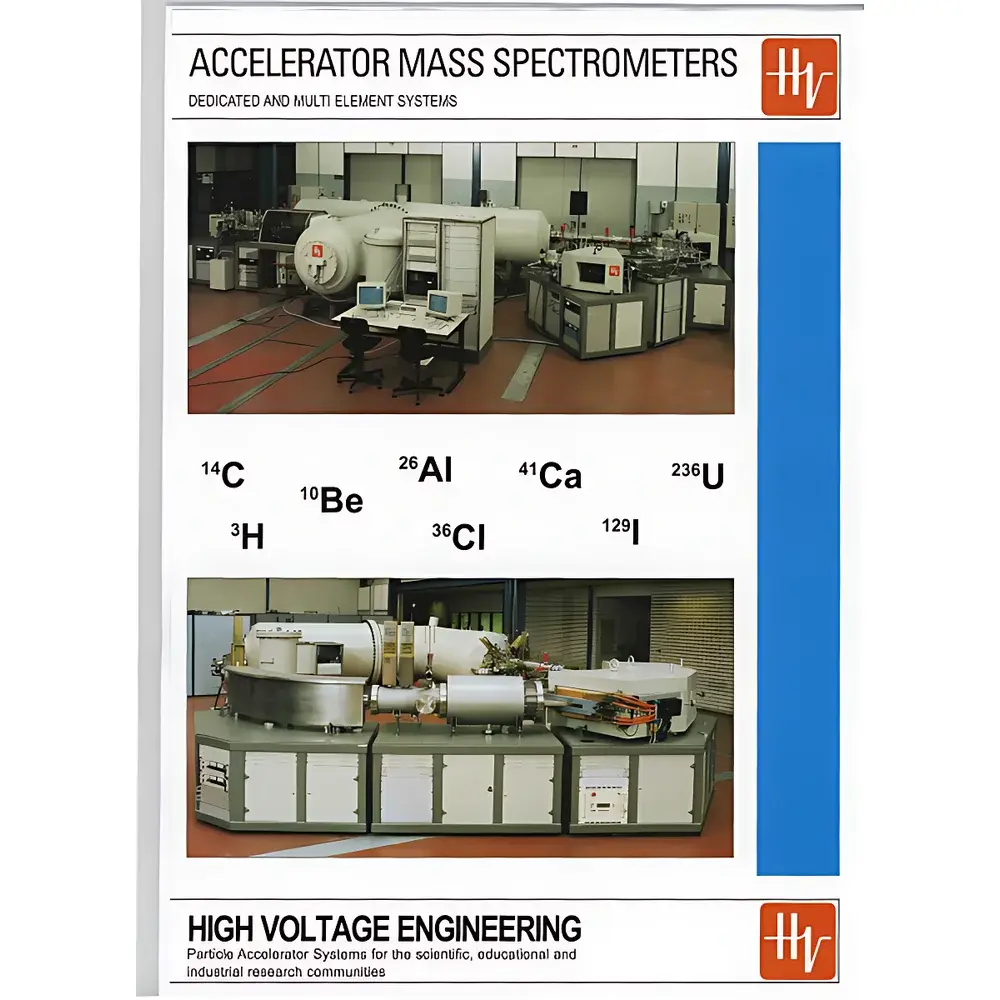
HVE Accelerator Mass Spectrometer
| Origin | Netherlands |
|---|---|
| Manufacturer Type | Distributor |
| Origin Category | Imported |
| Model | HVE |
| Price | Upon Request |
Overview
The HVE Accelerator Mass Spectrometer (AMS) is a high-precision nuclear instrumentation system engineered for ultra-trace isotopic ratio measurements at sub-attomole sensitivity levels. Unlike conventional decay-counting techniques—such as liquid scintillation counting—which rely on statistical detection of radioactive decay events over extended periods, AMS directly quantifies rare isotopes by accelerating ionized atoms to MeV energies, enabling mass separation and individual ion counting with near-unit detection efficiency. This principle eliminates reliance on half-life limitations and dramatically reduces required sample mass—from gram-scale down to sub-milligram quantities—while achieving isotopic abundance sensitivities as low as 10−15 (e.g., 14C/12C). The core architecture centers on HVE’s proprietary tandem electrostatic accelerator array, designed specifically for AMS applications where terminal voltage stability, low electronic noise, and long-term operational reproducibility are non-negotiable.
Key Features
- Electrostatic tandem accelerator with solid-state high-voltage power supply—no moving parts, zero mechanical vibration, and terminal voltage ripple < ±10 ppm over 24 h
- Grounded ion source design eliminates need for radiation-shielded HV enclosures, enabling safe operation in standard laboratory environments
- Modular sample introduction: supports both solid targets (via 50-position or optional 200-position sputter source) and gaseous CO2 (direct low-voltage inlet compatible with EA or GC interfaces)
- Dual injection modes: simultaneous multi-isotope injection (patented quadrupole-based beam recombination) and sequential injection (nanosecond-gated beam blanking for full periodic table coverage)
- Integrated vacuum architecture: cryo-pumped ion source chamber with localized pumping ensures minimal memory effects—critical for high-precision 14C, 26Al, 36Cl, 41Ca, and 236U analysis
- Beam transport optimization via time-of-flight stabilization, decoupling measurement accuracy from slow drifts in bias voltages
Sample Compatibility & Compliance
HVE AMS systems accommodate diverse sample matrices—including graphite, metal oxides, carbonate powders, and pressurized CO2—with automated sample carousel handling and pneumatic valve isolation to prevent cross-contamination during source exchange. All configurations comply with ISO/IEC 17025 requirements for testing laboratories and support GLP/GMP-aligned data integrity protocols. The system’s traceability framework aligns with ASTM D6866 (radiocarbon dating), ISO 14855 (biodegradability testing), and IAEA guidelines for environmental isotope hydrology. For regulated environments, optional audit-trail logging and user-access controls conform to FDA 21 CFR Part 11 requirements.
Software & Data Management
Control and acquisition are managed through HVE’s AMS Control Suite—a deterministic real-time operating environment supporting synchronized detector gating, beam current normalization, and dead-time correction algorithms. Raw ion counts, energy spectra, and time-resolved transmission metrics are stored in vendor-neutral HDF5 format with embedded metadata (sample ID, source position, HV setpoint, vacuum status). Batch processing pipelines integrate with third-party tools (Python-based SciPy stack, MATLAB) for isotopic ratio calibration using certified reference materials (e.g., Oxalic Acid II, ANU Sucrose, ICN 14C standards). Full export compatibility with LIMS platforms ensures seamless integration into centralized QA/QC workflows.
Applications
- Archaeology & Geochronology: High-precision 14C dating of micro-samples (e.g., single seeds, textile fibers, bone collagen)
- Environmental Tracing: 10Be and 26Al cosmogenic nuclide dating in quartz; 36Cl groundwater residence time modeling
- Nuclear Safeguards: Detection of anthropogenic 236U and 240Pu isotopes in environmental swipe samples
- Biochemical Kinetics: Quantification of 41Ca-labeled calcium metabolism in human clinical trials
- Materials Science: Depth profiling of dopant isotopes (e.g., 15N, 18O) using coupled RBS-C/PIXE/ERD modules
- Astrophysics: Measurement of extinct radionuclides (60Fe, 244Pu) in presolar grains
FAQ
What distinguishes AMS from conventional magnetic sector or TOF mass spectrometry?
AMS uniquely combines MeV-energy acceleration with molecular dissociation in the stripper canal, eliminating isobaric interferences (e.g., 14N vs. 14C) that limit conventional MS. This enables unambiguous detection of rare isotopes at natural abundance levels below 10−12.
Can the HVE AMS analyze both solid and gaseous samples without hardware modification?
Yes—the ion source is configurable for either Cs+-sputtered solids or low-energy CO2 gas introduction, with vacuum-integrated switching valves ensuring rapid transition between modalities.
Is remote operation supported for long-duration runs?
The system includes Ethernet-based supervisory control with SNMP monitoring, email alerts for vacuum faults or beam loss, and secure SSH access for script-driven batch acquisition.
How is calibration traceability maintained across instrument lifetime?
Each run incorporates interleaved standard reference materials; long-term stability is verified quarterly using NIST-traceable 14C and 26Al secondary standards, with drift compensation applied in post-processing.
Does HVE provide application-specific method development support?
Yes—dedicated AMS application scientists collaborate on method validation, including matrix-matched standard preparation, background subtraction protocols, and uncertainty budgeting per GUM (JCGM 100:2008).




