
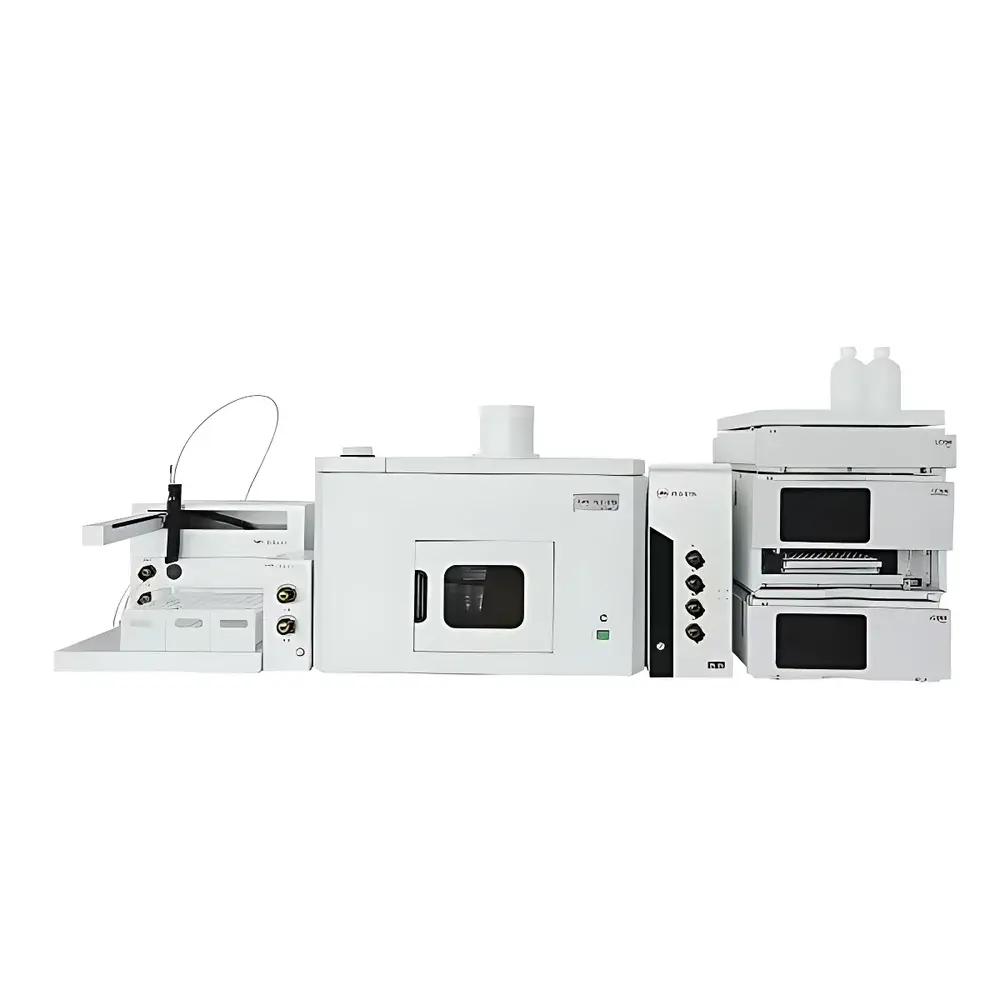
LWLI D-Series Liquid Chromatography-Atomic Fluorescence Spectrometer (LC-AFS)
| Brand | LWLI |
|---|---|
| Origin | Fujian, China |
| Model | D-Series |
| Instrument Type | LC-AFS Hyphenated System |
| Sample Introduction | Peristaltic Pump |
| Waste Disposal | Peristaltic Pump Extraction |
| Hydride/Vapor Generation Mode | On-line UV Digestion + Chemical Reduction |
| Target Elements (Total) | Hg, As, Se, Sb, Bi, Pb, Cd, Ge, Sn, Te, Zn, Au |
| Target Species (Speciation) | As(III), As(V), MMA, DMA, monomethylmercury (MMHg), ethylmercury (EtHg), Se(IV), Se(VI), selenomethionine, antimony species, etc. (≥12 species) |
| RSD | <0.6% |
| Linear Dynamic Range | >3 orders of magnitude |
| Detection Limits (ng/L) | Hg ≤ 0.001 |
| PMT Wavelength Range | 160–320 nm |
Overview
The LWLI D-Series Liquid Chromatography-Atomic Fluorescence Spectrometer (LC-AFS) is a fully integrated hyphenated analytical platform engineered for trace-level elemental speciation and total element quantification in environmental, food, clinical, and regulatory laboratories. It couples high-resolution liquid chromatography (LC) with atomic fluorescence spectroscopy (AFS) based on hydride generation (HG) or cold vapor (CV) principles—enabling selective, ultra-sensitive detection of volatile metalloids and metals following post-column chemical derivatization. The system operates on the fundamental principle of atomization in a quartz cell via hydrogen/argon flame or quartz furnace, followed by excitation using element-specific hollow cathode lamps (HCLs) and fluorescence emission detection at characteristic wavelengths (160–320 nm). Its fourth-generation AFS architecture incorporates real-time background correction, microsecond-scale pulsed excitation, and optimized gas-phase atomization kinetics—delivering robust performance for compliance-driven applications such as EPA Method 1638 revision, ISO/TS 19620:2018, HJ 1268–2022, and GB 5009.11–2024.
Key Features
- Modular, field-upgradable architecture supporting independent configuration of LC modules, UV digestion units, HG/CV interfaces, and dual-channel AFS detectors.
- On-line UV photolysis coupled with post-column sodium borohydride reduction for complete oxidation-state conversion and quantitative hydride generation across diverse arsenic, mercury, selenium, and antimony species.
- Integrated solid-state hydrogen generator eliminating external gas cylinders—reducing operational hazards and improving long-term flow stability.
- Micro-precision peristaltic pumping system with chemically resistant tubing and pressure-compensated flow control, ensuring <±0.5% volumetric accuracy over extended run times.
- High-duty-cycle pulsed HCL driver (microsecond pulse width, >50% duty cycle) delivering 3× higher peak irradiance versus conventional DC operation—extending lamp lifetime to >5,000 hours and minimizing thermal drift.
- FPGA-based signal acquisition engine with time-division multiplexing (TDM), enabling 50 MHz real-time sampling and dynamic baseline subtraction for both channels simultaneously.
- Proprietary two-stage gas–liquid separator with laminar-flow geometry and low-surface-energy coating—reducing memory effects by >90% compared to conventional membrane separators.
- Optimized quartz-trap atomizer with sub-100 ms residence time and active cooling, ensuring rapid signal response and minimal carryover (<0.05%) even at sub-ppt concentrations.
- Intelligent ignition system employing repetitive high-voltage spark discharge (>10⁶ cycles rated) with continuous flame status monitoring and auto-reignition within 200 ms of extinction.
- EFC-controlled Ar/H₂ mixing with ±0.5 mL/min precision across 20–200 mL/min range—maintaining stoichiometric combustion conditions essential for reproducible atomization efficiency.
Sample Compatibility & Compliance
The D-Series LC-AFS supports aqueous matrices including drinking water, wastewater, soil leachates, biological fluids (urine, serum), food extracts (rice, fish, dairy), and cosmetic formulations. It is validated for use in accordance with multiple national and international standards: HJ 1268–2022 (methylmercury/ethylmercury in water), ISO/TS 19620:2018 (arsenic speciation), DB22/T 2464–2016 and DB22/T 2205–2014 (alkylmercury in water/wastewater), SN/T 3034–2011 (mercury species in aquatic products), GB 5009.11–2024 and GB 5009.17–2021 (total and inorganic arsenic/mercury in food), DB37/T 4090–2020 and DB37/T 4089–2020 (inorganic and organomercury in cosmetics), and WS/T 635–2018 (arsenic species in urine). All system firmware and data handling routines are designed to support audit-ready GLP/GMP workflows, including electronic signatures, full audit trails, and 21 CFR Part 11–compliant user access controls.
Software & Data Management
The instrument is operated via LWLI ChromoAFS v4.2 software—a Windows-based platform compliant with ICH M10 and FDA data integrity guidelines. It provides synchronized LC gradient control, real-time AFS signal acquisition, species identification via retention time matching and spectral deconvolution, and automated calibration curve generation using internal standard normalization. Raw data files (.cdf) are stored with embedded metadata (operator ID, method version, instrument log, environmental conditions) and support direct export to LIMS via ASTM E1384-compliant XML schema. The software includes built-in validation tools for linearity assessment (r² ≥ 0.9995), carryover verification, and system suitability testing per USP /.
Applications
The D-Series LC-AFS delivers validated performance in regulated speciation analysis including: quantification of inorganic vs. methylated arsenic in rice and groundwater; differentiation of neurotoxic methylmercury from less toxic inorganic mercury in seafood and human biomonitoring samples; monitoring of selenomethionine bioavailability in dietary supplements; speciation of antimony in PET packaging leachates; and detection of thiomersal (ethylmercury thiosalicylate) in vaccine formulations. Its sub-ppt detection capability and <0.6% RSD make it suitable for reference laboratory participation in interlaboratory comparison studies (e.g., FAPAS®, IRMM proficiency schemes).
FAQ
What sample types are compatible with the D-Series LC-AFS?
Aqueous extracts from environmental, food, clinical, and pharmaceutical matrices—including filtered water, acid-digested soils, enzymatically hydrolyzed tissues, and centrifuged biological fluids.
Does the system support dual-species simultaneous detection?
Yes—the dual-channel AFS detector enables concurrent measurement of two elements (e.g., As and Hg) or two oxidation states (e.g., As(III) and As(V)) without hardware reconfiguration.
Is UV digestion mandatory for all speciation analyses?
UV digestion is required for organometallic species (e.g., methylmercury, selenomethionine) but optional for inorganic ions (e.g., As(III), As(V)), depending on the selected separation chemistry.
How is data integrity ensured during long unattended runs?
All acquisitions include timestamped checksums, operator authentication logs, and automatic backup to redundant NAS storage—fully traceable under 21 CFR Part 11 Annex 11 requirements.
Can the system be integrated into existing LIMS environments?
Yes—via ODBC/JDBC drivers and ASTM E1384-compliant XML export, supporting seamless bidirectional communication with major LIMS platforms including LabWare, Thermo Fisher SampleManager, and Agilent OpenLab.




